Golden Man of Kazakhstan: History & Where to See
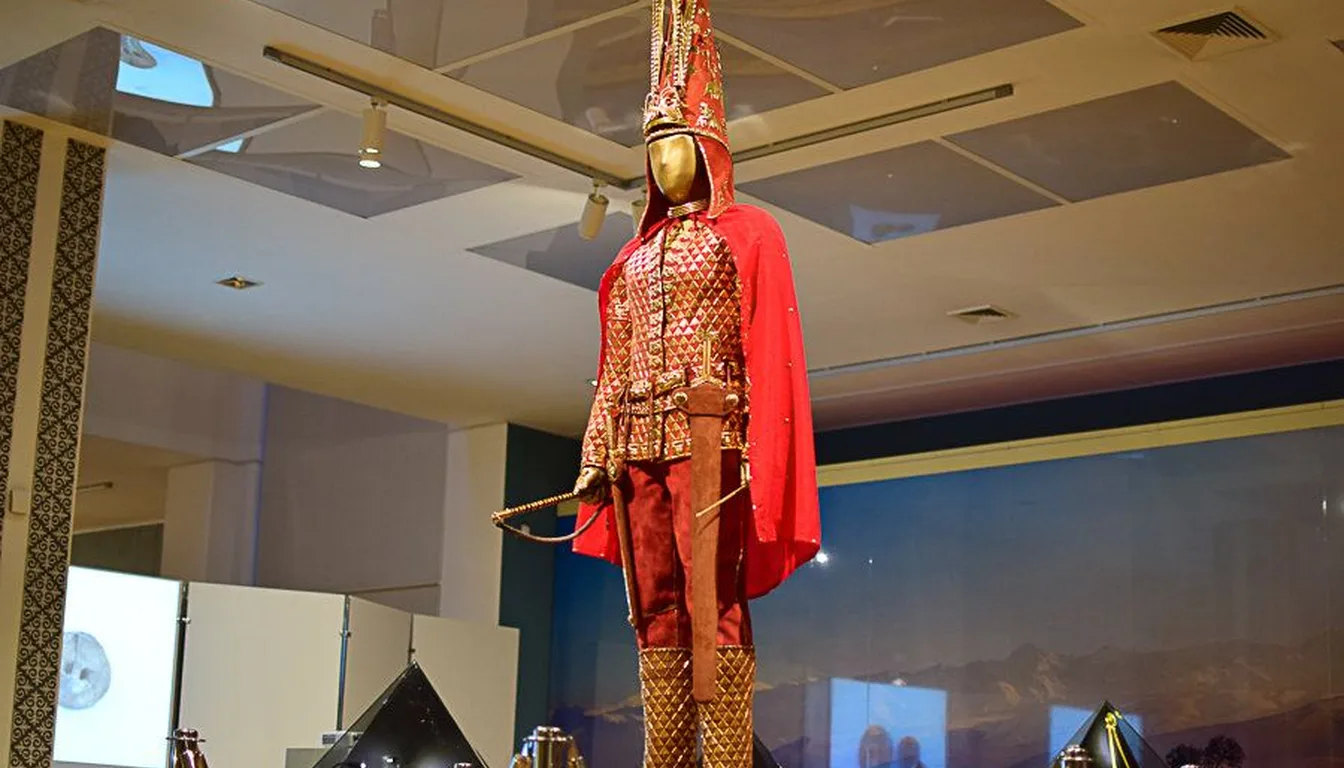
The Golden Man of Kazakhstan (Altyn Adam) is a 2,500-year-old Saka warrior discovered in 1969 at the Issyk kurgan, 50 km east of Almaty, wearing a suit of over 4,000 gold artifacts including a 63 cm conical headdress decorated with snow leopards, winged horses, and the tree of life. This iconic figure appears on Kazakhstan’s national emblem, presidential standard, and currency, making it the single most important archaeological discovery in Central Asian history and the defining symbol of Kazakh national identity.
The discovery of the Golden Man transformed understanding of the ancient Saka civilization and gave newly independent Kazakhstan a powerful pre-Soviet, pre-Russian symbol to anchor its national identity. Today you can see Golden Man artifacts and reconstructions at museums in Astana and Almaty, and visit the actual excavation site as a day trip from Almaty.
The Discovery at Issyk Kurgan
According to records from the A. Kh. Margulan Institute of Archaeology (Kazakhstan Academy of Sciences), in 1969 Kazakh archaeologist Kemal Akishev led an excavation of the Issyk burial mound complex, a group of more than 45 kurgans (burial mounds) scattered across a plateau near the town of Issyk in the foothills of the Trans-Ili Alatau mountains, approximately 50 km east of Almaty.
Most of the kurgans had been looted in antiquity. Grave robbers had tunneled into the main chambers centuries ago, removing whatever valuables they found. But one particular kurgan, standing about 6 meters high and 60 meters in diameter, contained a surprise: a sealed secondary burial chamber that the ancient looters had missed entirely.
Inside this untouched chamber, Akishev found the remains of a young person, estimated to be 17-18 years old at death, lying in a wooden sarcophagus. What made the discovery extraordinary was not the skeleton itself but what covered it.
What Was Found in the Tomb
The burial contained an astonishing inventory of artifacts:
| Category | Items | Description |
|---|---|---|
| Gold plaques | 4,000+ pieces | Sewn onto clothing, covering the entire body |
| Headdress | 1 conical hat, 63 cm tall | Decorated with gold animal figures |
| Weapons | Sword, dagger, arrow quiver | Iron with gold overlay and gold handles |
| Jewelry | Torque, earrings, rings, beads | Gold, turquoise, carnelian |
| Silver cup | 1 piece | Carries a 26-character inscription |
| Ceramic vessels | Multiple | For food and drink offerings |
| Bronze mirror | 1 piece | Chinese origin, evidence of trade |
| Wooden vessels | Several | Lacquered, some with gold fittings |
The gold artifacts were so densely packed that the original garments beneath were barely visible. Every surface of the warrior’s body, from boots to headdress tip, had been covered with precisely crafted gold plaques, pendants, and ornaments.
Who Were the Saka People
The Golden Man belonged to the Saka, a confederation of nomadic and semi-nomadic peoples who dominated the Central Asian steppe from approximately 800 to 200 BCE. The Greeks called them Scythians. The Persians distinguished between several Saka groups, including the Saka Tigraxauda (“Saka of the pointed hats”), who appear in carvings at the Achaemenid palace of Persepolis wearing tall conical headgear identical to the Golden Man’s headdress.
Saka Civilization at a Glance
| Aspect | Details |
|---|---|
| Period | 800-200 BCE |
| Territory | From the Black Sea to the Altai Mountains |
| Lifestyle | Nomadic pastoralists, horse warriors |
| Economy | Herding, raiding, trade, gold mining |
| Art | ”Animal Style” metalwork |
| Religion | Sky worship, animal totems, ancestor veneration |
| Legacy | Cultural ancestors of Turkic and Kazakh peoples |
The Saka were not primitive nomads. They controlled vast gold deposits in the Altai and Tian Shan mountains, traded with the Persian Empire, Greek colonies, and early Chinese states, and developed a sophisticated artistic tradition known as the “Animal Style” that influenced decorative art across Eurasia.
The Animal Style
The Animal Style is the defining artistic tradition of the Eurasian steppe peoples. It features dynamic depictions of animals, often in combat or twisted poses, rendered in gold, bronze, and bone. Common motifs include:
- Snow leopards attacking deer or mountain goats
- Winged horses or griffins (hybrid creatures)
- Eagles with outstretched wings
- Ibex (mountain goats) in running poses
- The tree of life connecting earth to sky
The Golden Man’s artifacts are among the finest surviving examples of Saka Animal Style. The headdress alone contains dozens of individual animal figures arranged in a cosmological order representing the Saka understanding of the universe.
The Golden Armor in Detail
The Headdress (Bashlik)
The most spectacular artifact. Standing 63 cm tall, this conical hat was covered with gold plaques depicting:
- Base level: Mountain goats (ibex) and snow leopards representing the earthly realm
- Middle level: Winged horses and birds in flight representing the celestial realm
- Top level: A golden bird at the apex, likely symbolizing divine power or the sun
- Arrow-shaped projections radiating from the sides, possibly representing sun rays
The headdress corresponds exactly to depictions of Saka Tigraxauda warriors in Persian reliefs at Persepolis and Behistun. This is one of the few archaeological finds that directly matches a known historical description.
The Clothing and Plaques
The warrior’s entire outfit (jacket, trousers, and boots) was covered with small gold plaques sewn into the fabric. The plaques show:
- Triangular and rhomboid shapes in repeating patterns
- Animal figures (mostly felines and ungulates) in running poses
- Geometric borders framing the garment edges
Based on Institute of Archaeology analysis, the estimated total gold weight is approximately 3-4 kg across all 4,000+ pieces. The gold is high-purity (estimated 90%+), consistent with Saka goldworking traditions.
The Weapons
A gold-handled iron sword (akinakes) lay at the warrior’s left side. A gold-decorated dagger was at the right. Both show Saka Animal Style decoration on the hilts and scabbards. An arrow quiver with gold fittings suggests the warrior was equipped for both close combat and mounted archery.
The Silver Cup Inscription
Perhaps the most scientifically significant find: a silver cup bearing a 26-character inscription in an unknown script. This is one of the longest pre-Turkic inscriptions ever found in Central Asia.
Multiple attempts at decipherment have been made:
- Some scholars read it as an early Turkic language
- Others propose it is an Iranian (Saka) language
- A third group suggests it may be a separate, now-lost language
Full decipherment would provide direct insight into the Saka language. As of 2026, no consensus translation exists, though the inscription is widely believed to describe the contents of the cup or a ritual offering.
The Gender Controversy
The original 1969 report by Akishev identified the remains as a young male warrior. The designation “Golden Man” (Altyn Adam) entered popular usage immediately and has been the standard term for over five decades.
However, subsequent analyses have raised questions:
- Bone analysis published by researchers at the Kazakhstan Academy of Sciences suggested features consistent with a young female
- The burial goods include items (mirrors, jewelry) found in both male and female Saka burials
- Skeletal preservation was incomplete, making definitive biological sex determination difficult
- Height (estimated 165 cm) is consistent with both male and female Saka individuals
The debate remains unresolved in academic literature. Some scholars prefer the gender-neutral terms “Golden Warrior” or “Golden Youth.” The Kazakh government continues to use “Golden Man” in official contexts.
What is certain: the individual was of extremely high status, either royalty or a ritual leader, based on the quantity and quality of burial goods.
National Symbol of Kazakhstan
After independence in 1991, Kazakhstan adopted the Golden Man as a cornerstone of national identity. The choice was deliberate and politically significant, selecting a pre-Islamic, pre-Russian, pre-Mongol Kazakh ancestor to represent the deep roots of statehood on this territory.
Where the Golden Man Appears
| Symbol | How It Appears |
|---|---|
| National emblem | The mythical winged horse (tulpar) on the emblem derives from the Golden Man’s headdress imagery |
| Presidential standard | Features Golden Man-inspired motifs |
| Currency | Depicted on commemorative coins and banknotes |
| Independence monument | The Golden Man statue tops the Independence Monument (Altyn Adam) on Republic Square in Almaty |
| Stamps and medals | Regular appearances on official state publications |
| Tourism branding | Used in Kazakhstan’s international tourism campaigns |
The Golden Man represents Kazakhstan’s core nation-building narrative: that Kazakh statehood has roots going back thousands of years, long predating the Russian Empire and Soviet Union. For more on Kazakhstan’s complex history timeline, see our dedicated guide.
Where to See the Golden Man
National Museum of the Republic of Kazakhstan, Astana
The primary destination for Golden Man exhibits. The National Museum (opened 2014) houses:
- Full-scale reconstruction of the Golden Man in golden armor
- Replica burial chamber recreating the Issyk kurgan excavation
- Original Saka artifacts from various excavations across Kazakhstan
- Interactive displays explaining the archaeological context
The museum’s Hall of Ancient and Medieval History is one of Central Asia’s finest archaeological exhibitions. Allow 2-3 hours for a thorough visit.
Address: 54 Tauelsizdik Avenue, Astana Hours: Tuesday-Sunday, 10:00-18:00 (closed Monday) Admission: 500 KZT (~$1) for adults
Central State Museum of Kazakhstan, Almaty
Located in the heart of Almaty, this museum houses some original artifacts from the Issyk excavation alongside high-quality replicas. The archaeological section covers Kazakhstan’s history from the Paleolithic through the medieval period, providing excellent context for understanding Saka culture.
Address: 44 Samal-1 microdistrict, Almaty Hours: Wednesday-Monday, 10:00-18:00 (closed Tuesday) Admission: 500 KZT (~$1)
A. Kh. Margulan Institute of Archaeology, Almaty
The actual original gold artifacts from the 1969 excavation are held here for research and conservation. Public access is limited and typically requires prior arrangement. Serious researchers can contact the institute for viewing appointments.
Issyk Archaeological Museum and Kurgan Site
The most atmospheric option. Located at the actual excavation site, 50 km east of Almaty near the town of Issyk:
- Open-air kurgan complex. See the burial mounds in their landscape setting.
- Small on-site museum. Replicas, photos, and archaeological context.
- The Issyk kurgan itself. Marked and fenced, you can walk around the mound where the Golden Man was found.
Getting there: Take the A351 highway east from Almaty (about 1 hour by car). Shared taxis to Issyk depart from Almaty’s Sayakhat bus station. Combine with a trip to the nearby Issyk Lake for a full day excursion.
Independence Monument, Almaty
Republic Square in central Almaty features the Independence Monument (1996), topped by a golden figure of the Golden Man standing on a winged snow leopard. This is the most photographed depiction of the Golden Man and an easy stop during any Almaty city walk.
Archaeological Context — Other Saka Discoveries
The Golden Man is the most famous Saka find, but it is not the only one. Kazakhstan has yielded numerous important Saka sites:
| Site | Location | Key Finds |
|---|---|---|
| Berel | East Kazakhstan | Frozen Saka burials with preserved horses and textiles |
| Shilikty | East Kazakhstan | Gold artifacts, “Second Golden Man” discovery (2003) |
| Talgar | Almaty Region | Saka settlement and burial grounds |
| Besshatyr | Almaty Region | Royal kurgan complex, largest in Semirechye |
| Arzhan | Tuva (related culture) | Rich Scythian royal burial |
According to National Museum of Kazakhstan records, the 2003 discovery at Shilikty by archaeologist Abdesh Toleubaev uncovered another gold-clad burial, sometimes called the “Second Golden Man” or “Golden Man of Shilikty,” dating to the 8th-7th century BCE, even older than the Issyk find.
The Saka Legacy in Kazakh Culture
The connection between ancient Saka and modern Kazakhs is a matter of both scholarly debate and national pride. While the Kazakh people as a distinct ethnic group formed in the 15th century with the Kazakh Khanate, the Saka represent one of many layers of Central Asian steppe heritage that contributed to Kazakh identity.
Saka influences visible in Kazakh culture and traditions include:
- Horse-centered lifestyle. Saka were horse warriors; Kazakhs were horse nomads.
- Animal motifs. Saka Animal Style echoes in Kazakh decorative arts and textiles.
- Burial traditions. Reverence for ancestors and elaborate funerary customs.
- Warrior culture. The batyr (hero-warrior) tradition in Kazakh epics parallels Saka warrior burials.
- Goldworking. Kazakhstan’s jewelry traditions trace back to Saka metalworking.
Visiting Tips
- Combine museums. See the National Museum in Astana and the Central State Museum in Almaty for different perspectives.
- Day trip to Issyk. Easily done from Almaty, combine with Issyk Lake.
- Guided tours. English-speaking guides at both major museums can explain the significance in depth.
- Photography. Allowed in most museum halls (no flash). The Independence Monument in Almaty is best photographed in morning light.
- Best time. Museums are less crowded on weekday mornings. The outdoor Issyk site is best visited April-October.
Frequently Asked Questions
- What is the Golden Man of Kazakhstan?
- The Golden Man (Altyn Adam) is a Saka warrior discovered in 1969 at the Issyk kurgan, 50 km east of Almaty. The individual, aged 17-18 at death, was buried approximately 2,500 years ago (4th-5th century BCE) wearing over 4,000 gold artifacts including a 63 cm conical headdress, gold-plated armor, weapons, and jewelry. It is Kazakhstan's most important archaeological find and appears on the national emblem.
- Where can I see the Golden Man in Kazakhstan?
- The best places are the National Museum of Kazakhstan in Astana (full reconstruction and replica burial chamber) and the Central State Museum in Almaty (original artifacts and replicas). You can also visit the actual Issyk kurgan excavation site 50 km east of Almaty, and see the Golden Man statue on the Independence Monument in Almaty's Republic Square.
- Is the Golden Man male or female?
- The gender is academically contested. The 1969 excavation report identified the remains as male, but later bone analysis suggested possible female characteristics. Skeletal preservation was incomplete, making definitive determination difficult. The term "Golden Man" became standard through early reporting. Some scholars now prefer "Golden Warrior" or "Golden Youth." The debate remains unresolved as of 2026.
- Who were the Saka people?
- The Saka were nomadic horse-warrior peoples who dominated the Central Asian steppe from approximately 800-200 BCE. Known as Scythians by the Greeks, they created the Animal Style metalwork tradition, controlled vast gold deposits, and traded with the Persian Empire, Greek colonies, and China. The Saka are among the cultural ancestors of the Kazakh people and are referenced in Persian Achaemenid inscriptions and reliefs at Persepolis.
- Why is the Golden Man important to Kazakhstan?
- The Golden Man serves as Kazakhstan's primary national symbol, representing the deep roots of statehood on Kazakh territory predating both the Russian Empire and Soviet Union. After independence in 1991, the imagery was adopted for the national emblem, presidential standard, currency, and the Independence Monument in Almaty. It anchors Kazakhstan's nation-building narrative in ancient steppe civilization rather than Soviet heritage.
- How do I get to the Issyk kurgan site from Almaty?
- The Issyk kurgan complex is 50 km east of Almaty via the A351 highway, approximately 1 hour by car. Shared taxis and marshrutkas (minibuses) to Issyk depart from Almaty's Sayakhat bus station. You can also hire a taxi for the round trip (approximately 5,000-8,000 KZT / $10-16). The site can be combined with a visit to nearby Issyk Lake for a full day trip.
More Stories

facts
Is Kazakhstan in Europe or Asia? The Definitive Answer
Is Kazakhstan in Europe? No — it's in Central Asia. A tiny western sliver crosses into Europe geographically, but 95%+ of the country is in Asia.
facts
Interesting Facts About Kazakhstan: 25+ Surprising Truths
Interesting facts about Kazakhstan — the largest landlocked nation, Baikonur space launches, origin of the apple, and 25+ surprising truths.
travel
12 Best Day Trips from Almaty: Complete Guide 2026
Best Almaty day trips — Charyn Canyon, Big Almaty Lake, Kolsai Lakes, Tamgaly petroglyphs, Altyn-Emel. Distances, costs, and how to get there.