Kazakh Steppe: World's Largest Grassland — Complete Guide
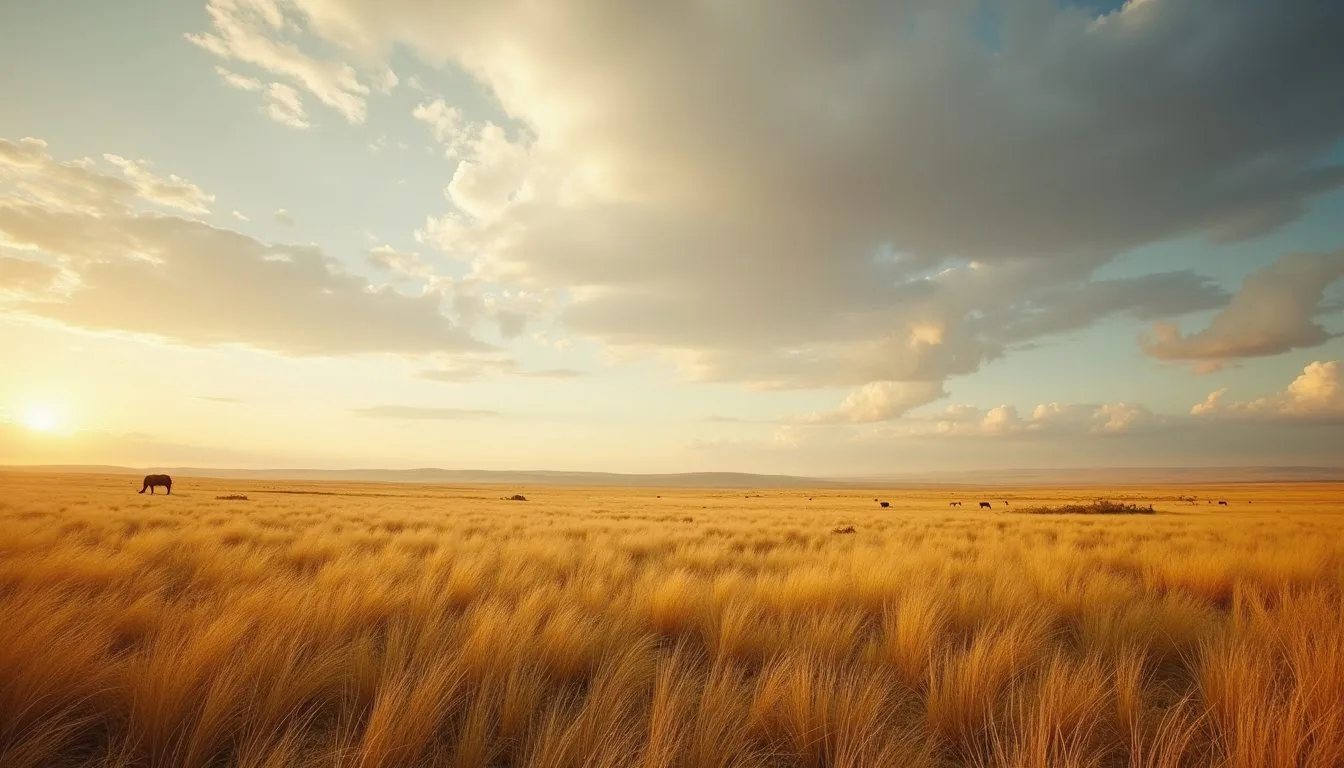
The Kazakh steppe (also called the Great Steppe or the Eurasian steppe in its broadest context) is one of Earth’s defining landscapes. Stretching over 800,000 km² within Kazakhstan alone (with extensions into Russia and Mongolia), it is the largest grassland ecosystem on Earth: larger than France and Germany combined, and historically one of the most consequential landscapes in human history. This is the place where the horse was first domesticated, where Genghis Khan assembled his empire, and where the Kazakh people developed one of the world’s most sophisticated nomadic cultures over three millennia.
What Is the Steppe?
The steppe (степь, step’) is a biome characterized by:
- Flat or gently rolling terrain, largely treeless except along watercourses
- Grassland vegetation: feather grass, fescue, wormwood, wildflowers
- Continental climate: Hot, dry summers (35–40°C); brutally cold winters (-30°C to -40°C)
- Low, irregular rainfall: 250–400 mm/year, too little for forest but enough for grass
- Fertile black soil (chernozem) in the north; drier, lighter soils in the south and east
The Kazakh steppe is not a single uniform landscape; it transitions across different zones:
| Direction from center | Transition |
|---|---|
| North | Russian steppe → Siberian forest-steppe |
| South | Semi-desert (Betpak-Dala) → Central Asian desert |
| East | Rising into the Altai mountains |
| Southeast | Abrupt rise of the Tian Shan range |
| West | Caspian Sea coast and lowlands |
Scale: How Large Is the Kazakh Steppe?
Within Kazakhstan: The steppe zone covers approximately 800,000–850,000 km², larger than France (551,000 km²) and Germany (357,000 km²) combined.
The broader Eurasian steppe (the connected belt of grassland running from Hungary through Russia, Kazakhstan, and into Mongolia) covers approximately 8 million km², making it the largest land biome on Earth by some measures.
To understand where Kazakhstan is located and why the steppe dominates its landscape, a map helps enormously. This scale is almost impossible to internalize until you are standing in it. Drive south from Astana or east from Aktobe and the steppe simply continues for hours, to the horizon and beyond, with no change in the fundamental character of the landscape.
Flora: What Grows on the Steppe?
The steppe’s vegetation shifts with latitude, elevation, and moisture, creating distinct zones:
Feather Grass (Kovyl)
The iconic steppe grass with long, silky, silver-white plumes that ripple in the wind like waves on an ocean. Several species of feather grass (Stipa spp.) cover vast areas of northern Kazakhstan. In late spring and early summer, vast fields of kovyl in the wind are one of the most visually stunning natural spectacles in Central Asia.
Fescue and Wheatgrass
Dominant in the drier central and southern steppe, these shorter, tougher grasses are adapted to less moisture. The landscape here is flatter and drier than the kovyl zones.
Wormwood (Zhussan)
The sharp, intensely aromatic shrub (Artemisia spp.) that dominates the semi-arid transition zones between steppe and desert. Its scent (clean, medicinal, slightly bitter) is perhaps the most evocative smell on the Kazakh steppe. Kazakhs call it zhussan and consider its smell the literal “smell of home.”
Spring Wildflowers
For 3–4 extraordinary weeks in April–May, portions of the steppe erupt in wildflowers: the wild Schrenk’s tulip (Tulipa schrenkii, one of the ancestors of cultivated tulips), purple irises, anemones, and dozens of other species. These blooms are fleeting, visible for weeks, then gone as the summer heat arrives. Few outsiders witness them; they are one of the great seasonal spectacles of Central Asia.
Fauna: What Lives on the Steppe?
The steppe ecosystem supports distinctive and ecologically significant wildlife:
Saiga Antelope (Saiga tatarica)
The most iconic steppe mammal and one of the world’s most ancient surviving large mammals, with a lineage dating to the Pleistocene, when it ranged alongside woolly mammoths. The saiga has a distinctive enlarged, bulbous nose that warms and humidifies cold air before it reaches the lungs, an adaptation to steppe winters.
According to WWF’s Central Asia programme, saiga populations suffered catastrophic decline after Soviet collapse due to poaching (the horns are valued in traditional Chinese medicine) and disease. A mass die-off in May 2015 killed approximately 200,000 saiga in just two weeks (60% of the entire world population at the time) from a bacterial infection triggered by abnormal heat and humidity. Populations have partially recovered since: as of 2025–2026, Kazakhstan’s saiga population is estimated at approximately 1.3–1.5 million, according to the Kazakhstan Ministry of Ecology and Natural Resources aerial census data.
Golden Eagle (Berkut)
The apex aerial predator of the steppe and the central figure of Kazakh cultural identity. The golden eagle is used in the 4,000-year-old tradition of berkutchi (eagle hunting), where Kazakh hunters train golden eagles to hunt foxes, hares, and even wolves. This tradition was inscribed on UNESCO’s list of Intangible Cultural Heritage of Humanity in 2010.
Great Bustard (Otis tarda)
One of the world’s heaviest flying birds, with males reaching 16kg. Kazakhstan has one of the last globally significant great bustard populations; the species is now classified as Vulnerable globally due to habitat loss.
Demoiselle Crane (Anthropoides virgo)
The most numerous crane species in the world, and the Kazakh steppe is on one of the world’s most important crane migration routes. Vast flocks migrate through in spring (April–May) and autumn (August–October). At key staging areas, thousands of demoiselle cranes congregate before continuing their migrations.
Other Steppe Wildlife
- Corsac fox (Vulpes corsac): Ranges throughout the grasslands; more social than the red fox
- Steppe fox (Vulpes vulpes stephanicus): The red fox subspecies of the steppe
- Steppe eagle (Aquila nipalensis): Now Endangered globally due to habitat conversion and poisoning
- Black lark, calandra lark: Characteristic steppe birds
- Kazakh wild horse (Equus ferus przewalskii): The Przewalski’s horse, ancestral to all domestic horses, has been reintroduced to the steppe after extinction in the wild; small herds are now established in Altyn-Emel National Park
The steppe is central to the broader culture of Kazakhstan and shaped the values, food, music, and social customs that define Kazakh identity today.
Human History on the Kazakh Steppe
The Domestication of the Horse (~3500 BCE)
The most consequential event in the history of the steppe, and arguably in all of human history, is the domestication of the horse, which occurred on the Kazakh steppe approximately 5,500 years ago. The evidence comes primarily from the Botai culture sites near Kokshetau (northern Kazakhstan), where archaeologists have found horse bones with wear patterns consistent with riding and bridling, and ceramic vessels with lipid residues indicating mare’s milk processing.
Before domestication, horses were hunted for meat. After, they became transportation, warfare capability, communication, economic production, and cultural identity simultaneously. Horse domestication enabled the nomadic pastoral lifestyle that would define this landscape for the next 5,000 years and reshaped every civilization it touched, from the Bronze Age steppes to the Mongol Empire.
The Scythians and Saka (800–200 BCE)
The first well-documented steppe civilizations were the Scythians (western steppe, known to the Greeks) and the Saka (Kazakh steppe, known to the Persians and Chinese). These were horse-mounted warrior-herders who created extraordinary animal-style art in gold: detailed jewelry and ornaments depicting animals in dynamic, intertwined poses. Their burial mounds (kurgan) are scattered across the steppe in their thousands.
The discovery of the “Golden Man” at the Issyk kurgan near Almaty in 1969 (a Saka warrior of the 4th century BCE buried in a suit of approximately 4,000 individual gold pieces) is one of the most spectacular archaeological finds of the 20th century. The original is held in the National Bank of Kazakhstan; replicas are displayed at the National Museum in Astana.
The Mongol Empire (13th–14th Centuries)
The steppe reached its most dramatic historical moment with Genghis Khan. The Mongol Empire, born on the Mongolian steppe but incorporating the Kazakh steppe within years, became the largest contiguous land empire in history. The Kazakh steppe became part of the Golden Horde (Jochi’s Ulus) and remained under Mongol/Turkic political dominance until Russian expansion in the 18th–19th centuries.
The Kazakh people emerged as a distinct ethnic-cultural identity in the 15th century, when a group of Uzbek confederation tribes broke away and established the independent Kazakh Khanate under Khans Janibek and Giray (~1465). See our guide to the Kazakh Khanate for the full story.
Soviet Transformation: Collectivization and Virgin Lands
Two Soviet policies transformed the steppe irreversibly:
Collectivization (1929–1933): Soviet authorities forced the sedentarization of Kazakh nomads. Herders were ordered into collective farms and their animals seized. The result was the Kazakh famine of 1930–1933, which killed approximately 1.5 million people (roughly 38% of the entire Kazakh population at the time). Millions more fled to China, Mongolia, and other Soviet republics. It was one of the 20th century’s worst man-made famines and the near-destruction of the nomadic way of life.
Virgin Lands Campaign (1953–1965): Khrushchev’s mass conversion of 40 million hectares of northern steppe to wheat farmland. Millions of Russian and Ukrainian workers were settled in northern Kazakhstan. The campaign permanently altered the northern steppe landscape and made Kazakhstan one of the world’s leading wheat producers, but at enormous ecological cost, including severe soil erosion and the beginnings of the Aral Sea catastrophe (the Syr Darya and Amu Darya were diverted for irrigation).
The Steppe Today
Economic Importance
The steppe remains economically vital:
- Grain agriculture (northern Kazakhstan): Kazakhstan is consistently among the world’s top 10 wheat exporters, producing 15–20 million tonnes annually
- Livestock herding: Sheep, cattle, and horse herding continues, though at much smaller scale than historically
- Oil and gas (western steppe): The Tengiz, Kashagan, and Karachaganak fields (among the world’s largest) lie in the western steppe and sub-Caspian zone
- Wind and solar energy: The steppe’s consistent winds and sunshine are increasingly harnessed. Kazakhstan aims for 15% renewable energy by 2030
Conservation
Major steppe protected areas in Kazakhstan (as of 2026):
| Reserve / Park | Location | Area | Key Features |
|---|---|---|---|
| Korgalzhyn Nature Reserve | Near Kokshetau | 543,000 ha | UNESCO World Heritage; flamingo nesting, saiga habitat |
| Naurzum Reserve | Northern Kazakhstan | 191,000 ha | Steppe, pine forest islands, lakes |
| Altyn-Emel National Park | SE of Almaty | 460,000 ha | Singing dunes, saiga, Scythian kurgans |
| Irgiz-Turgay Reserve | West Kazakhstan | 750,000 ha | Waterbirds, saiga migration corridor |
According to UNESCO’s recognition of the Saryarka steppe and lakes ecosystem as a World Heritage Site, the Kazakh steppe contains globally significant biodiversity. Kazakhstan has committed to protecting 17% of its territory under the Convention on Biological Diversity.
Experiencing the Steppe as a Visitor
The steppe is most meaningful when you get away from cities. Here are the best ways to experience it:
From Almaty:
- Altyn-Emel National Park (200km east): Singing sand dunes, saiga antelope, ancient petroglyphs, white chalk mountains, and one of Kazakhstan’s best day trips or overnights. Requires organized transport or 4WD.
- Betpak-Dala: The vast semi-desert 5–6 hours from Almaty, remote, dramatic, virtually uninhabited. Best with an experienced local guide.
- Charyn Canyon: Technically steppe-desert landscape where the canyon and surrounding flatness perfectly represent the drama of the steppe-desert transition.
From Astana:
- Korgalzhyn Reserve (130km south): Flamingos (unexpectedly), lakes, classic steppe landscape. Day trip possible.
- Open steppe drives: Simply drive south or west from Astana for 30–60 minutes and you are in genuine, uninterrupted steppe. Pull off the road. Turn off the engine. Listen to the silence and wind.
Nomadic culture experiences near Almaty:
- Eagle hunting demonstrations: Berkutchi (eagle hunter) experiences can be arranged through Almaty tour operators, typically a half-day, $50–100. See our guide to eagle hunting in Kazakhstan.
- Horseback riding on the steppe: Multiple operators offer steppe rides from 2-hour introductions to multi-day trekking. Kazakhs’ relationship with horses is profound — watching skilled Kazakh riders is itself an experience.
- Yurt stays: Several guesthouses near Almaty and in the Alatau foothills offer overnight yurt experiences with traditional food and hospitality.
Best seasons:
- April–June: Spring wildflowers, migrating cranes, comfortable temperatures, saiga calving season
- September–October: Golden grass, cooling temperatures, harvest atmosphere, animal migrations
- Avoid July–August: Extreme heat (35–42°C), dust, limited wildlife activity
- Avoid November–March: Extreme cold (-30°C to -40°C), impassable roads, no visitor infrastructure
Frequently Asked Questions
- How large is the Kazakh steppe?
- The Kazakh steppe covers approximately 800,000–850,000 km² within Kazakhstan — making it the world's largest grassland. This is larger than France and Germany combined. The broader Eurasian steppe belt, extending from Hungary through Russia and Kazakhstan to Mongolia, spans approximately 8 million km² and is one of the largest biomes on Earth.
- What animals live on the Kazakh steppe?
- The most iconic steppe animal is the saiga antelope — a prehistoric-looking creature with an enlarged nose, descended from Pleistocene-era megafauna. The saiga population in Kazakhstan was approximately 1.3–1.5 million as of 2025–2026. Other wildlife includes golden eagles (the symbol of Kazakh culture), great bustards (one of the world's heaviest flying birds), steppe eagles, corsac foxes, and massive flocks of demoiselle cranes during migration.
- Why is the Kazakh steppe historically important?
- The Kazakh steppe was the birthplace of horse domestication (~3500 BCE, Botai culture) — one of the most transformative events in human history. It was home to the Scythian and Saka civilizations with their extraordinary gold art. It was the territory of the Mongol Empire's western expansion and the Golden Horde. And it was the landscape on which Kazakh nomadic culture developed over 3,000 years — a sophisticated pastoral civilization adapted to extreme conditions.
- Can you visit the Kazakh steppe as a tourist?
- Yes — and it is one of Kazakhstan's most memorable experiences. Altyn-Emel National Park (200km from Almaty) is the most accessible steppe experience, with saiga antelope, singing sand dunes, and ancient petroglyphs. Korgalzhyn Reserve (130km from Astana) offers steppe, lakes, and flamingos. Simply driving south or west from Astana for 30 minutes puts you in genuine steppe. Best seasons: April–June or September–October.
- What does the Kazakh steppe smell like?
- The defining scent is wormwood (zhussan, Artemisia sp.) — a sharp, clean, intensely aromatic shrub that covers much of the landscape, especially in drier zones. Kazakhs call it the "smell of home." Combined with the dry grass, warm earth, and horse, the steppe has a distinctive and immediately recognizable sensory character. Many Kazakhs who have emigrated describe the smell of zhussan as the most vivid trigger for homesickness.
- Where was the horse first domesticated?
- The horse was first domesticated on the Kazakh steppe approximately 5,500 years ago (around 3500 BCE), based on archaeological evidence from the Botai culture sites near Kokshetau in northern Kazakhstan. Archaeologists found horse bones with wear from bridling, and ceramic vessels with mare's milk lipid residues. Before domestication, horses were hunted for meat; after, they became the foundation of steppe civilization.
More Stories
nature
Kazakhstan National Parks: 14 Parks With Maps
Kazakhstan national parks: all 14 parks mapped with entry fees, best seasons, wildlife, and trails. From Charyn Canyon to Altai forests — plan your visit.

facts
Is Kazakhstan in Europe or Asia? The Definitive Answer
Is Kazakhstan in Europe? No — it's in Central Asia. A tiny western sliver crosses into Europe geographically, but 95%+ of the country is in Asia.
facts
Interesting Facts About Kazakhstan: 25+ Surprising Truths
Interesting facts about Kazakhstan — the largest landlocked nation, Baikonur space launches, origin of the apple, and 25+ surprising truths.