Kazakhstan 7-Day Itinerary: The Perfect First Trip
Seven days is the ideal length for a first trip to Kazakhstan. It’s enough time to experience Almaty’s mountains and cafe culture, make day trips to some of the country’s most dramatic landscapes, and visit Astana to understand the scale of Kazakhstan’s political ambition — without feeling rushed.
This itinerary follows the most logical route: fly into Almaty, explore the south, then take the overnight train to Astana before flying home. It minimises backtracking and gives you a genuine cross-section of what Kazakhstan offers.
At a Glance
| Day | Location | Highlight |
|---|---|---|
| Day 1 | Almaty arrival | City orientation, Green Bazaar |
| Day 2 | Almaty | Shymbulak, Big Almaty Lake |
| Day 3 | Charyn Canyon | Day trip — Kazakhstan’s Grand Canyon |
| Day 4 | Kolsai Lakes | Day trip — mountain lakes |
| Day 5 | Almaty | Museums, nightlife |
| Day 6 | Train to Astana | Overnight Talgo train |
| Day 7 | Astana | Baiterek, National Museum, fly home |
Best time to follow this itinerary: May–June or September–October. July and August are hot and crowded. November–March involves very cold temperatures in both cities.
Day 1: Arrive in Almaty
Almaty’s Zhetysu International Airport (formerly Almaty International Airport) handles most international arrivals. The airport is 15 km north of the city centre; a taxi takes 20–30 minutes and costs 3,000–5,000 KZT ($6–10).
Morning / Afternoon (after arrival)
Check in to your hotel or guesthouse. Most central Almaty accommodation is in the area between Furmanov Street and Al-Farabi Avenue — a walkable neighbourhood with good transport links.
Orientation walk: Head to Panfilov Park, the large tree-lined park in the city centre. The wooden Ascension Cathedral (Zenkov Cathedral) here is one of Kazakhstan’s most photographed buildings — built entirely without nails in 1907 and painted in bright Russian Orthodox colours. It survived the 1911 earthquake that destroyed most of the city.
Afternoon
Walk south along Arbat (pedestrianised Zhybek Zholy Street) to the Green Bazaar (Zelyony Bazar). This covered market is the best introduction to Kazakh food culture in the country — dried fruits, horsemeat sausage (kazy), kurt (dried cheese balls), pickled vegetables, fresh bread, and local honey. Budget 1–2 hours to explore.
Evening
Have dinner at one of the Kazakh restaurants in the city centre — try besbarmak (the national dish: flat noodles with boiled meat and onion broth) if it’s your first night. Dastarkhan restaurant near the bazaar is reliable and tourist-friendly.
Where to stay in Almaty:
- Budget: Almaty Backpackers or similar guesthouses near Arbat ($20–35/night)
- Mid-range: Rixos Almaty, Holiday Inn, or Marriott Almaty ($80–150/night)
- Splurge: The Ritz-Carlton Almaty ($200+/night, views of the mountains)
Day 2: Into the Mountains
This is the day most visitors remember longest. The Zailiysky Alatau range rises directly behind Almaty — within 30 minutes of the city centre, you can be at 2,200m elevation.
Morning: Shymbulak
Take a taxi or the urban gondola from Medeu up to Shymbulak ski resort (2,260m). In summer, the ski resort operates as a hiking and mountain biking destination. The views down toward Almaty (and in the other direction, further into the mountains) are exceptional.
Walk around the area for 1–2 hours. The air is noticeably cooler and cleaner than the city below. In autumn, the larches turn golden.
Afternoon: Big Almaty Lake
Drive or taxi from Shymbulak to Big Almaty Lake (Bolshoye Almatinskoye Ozero) — approximately 30 minutes by road. The lake sits at 2,511m elevation and is a brilliant turquoise-green colour from glacial runoff. It is one of the most photographed natural sites in Kazakhstan.
Note: Private vehicles can no longer drive all the way to the lake; you’ll park at the checkpoint and walk the final 2 km, or take a local shuttle. The walk is easy and the views improve with every step.
Return to Almaty in the late afternoon.
Evening
Almaty’s coffee culture is among the best in Central Asia. Spend an evening exploring the specialty coffee shops around Dostyk Avenue and Kazybek Bi Street — Mono Coffee, Coffee BOOM, and dozens of local roasters. The area around Gogol Street has good restaurant density.
Day 3: Charyn Canyon Day Trip
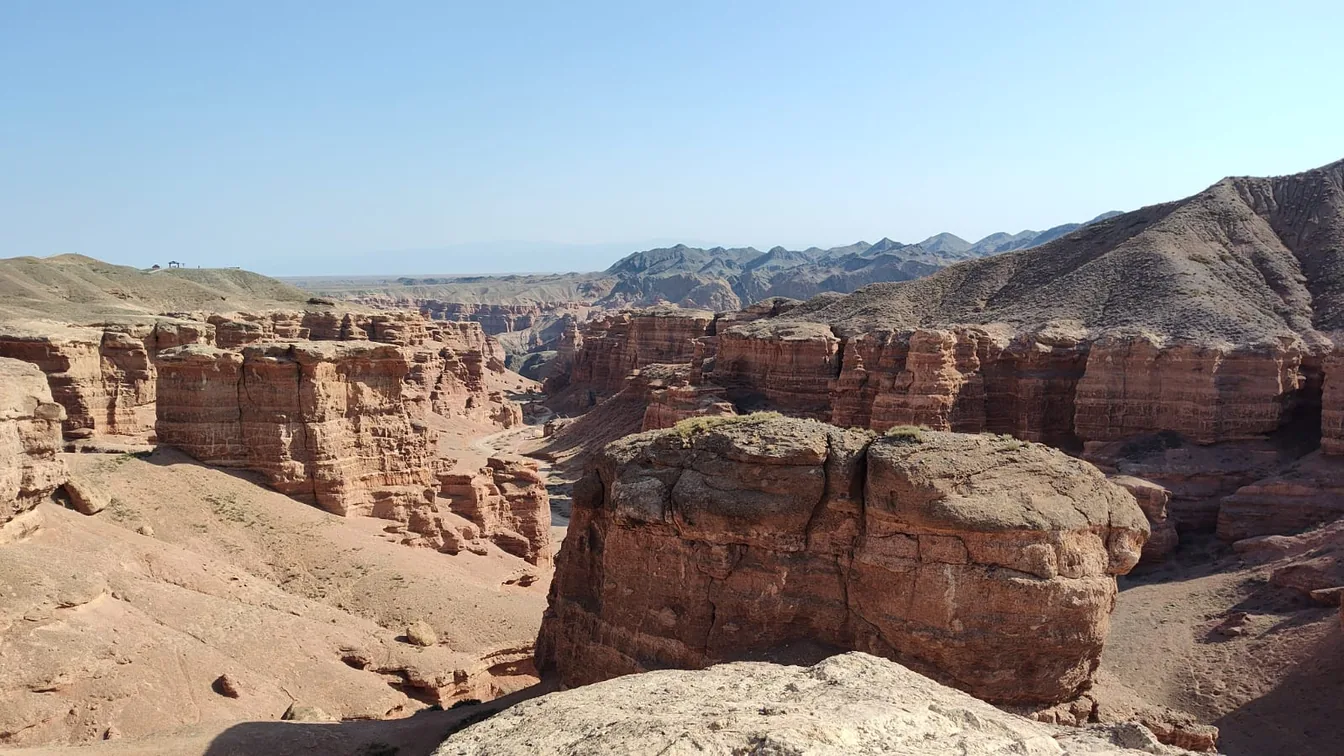
Charyn Canyon is often called Kazakhstan’s Grand Canyon. The comparison is apt: dramatic red-orange rock formations carved by the Charyn River, up to 300 metres deep in places, extending for 154 km. The most visited section — the Valley of Castles (Dolina Zamkov) — looks genuinely other-worldly.
Getting there
Charyn Canyon is 200 km east of Almaty, roughly 2.5–3 hours by road. Options:
- Organised day tour ($25–45 per person): Most efficient — transport, guide, and sometimes lunch included. Book through Almaty tour operators or GetYourGuide. Departs around 8am.
- Rental car: If you’re confident driving, the road is straightforward (M36 east, then south toward the canyon). Allow a full day.
- Marshrutka (shared taxi): Cheaper but less convenient — buses run to Saty village; the canyon is 14 km further.
At the canyon
The main trail descends into the Valley of Castles — a 3 km loop along the canyon floor. It’s not technically demanding but can be extremely hot in summer. Bring more water than you think you need (1.5–2 litres minimum).
There is a guesthouse at the canyon for those who want to camp overnight. If staying as a day trip, allow 3–4 hours at the site before returning to Almaty.
Best time: Early morning light (7–9am) hits the canyon walls beautifully. Avoid midday in July–August.
Day 4: Kolsai Lakes Day Trip
Kolsai Lakes are a series of three high-altitude mountain lakes in the Tian Shan range, near the border with Kyrgyzstan. The first and most accessible lake (1,818m) is surrounded by forest and overlooked by snow-capped peaks. The second lake (2,252m) requires a 3-hour hike but is even more spectacular.
Getting there
Kolsai Lakes are 285 km southeast of Almaty, approximately 3.5–4 hours by road. Best reached by:
- Organised day tour ($35–60): Recommended for the logistics. The journey is long enough that having transport arranged makes the day far more enjoyable.
- Rented car: Possible but tiring — you’ll cover 570 km round-trip.
Note: Many tours combine Kolsai Lakes with Kaindy Lake (a surreal submerged birch forest nearby). This combination makes for a full 12–14 hour day trip.
At the lakes
The lower lake (Kolsai 1) has a wooden path along the shore and horse rentals if you want to ride up to Kolsai 2 rather than hike. The trail to the second lake is a steady uphill through conifer forest — about 3 hours each way at a relaxed pace.
Swimming is possible in summer (the water is cold but refreshing). Yurt camps operate near the lake for those staying overnight.
Day 5: Almaty — Museums and Final Evening
After two intensive day trips, use Day 5 for Almaty’s cultural attractions and a final evening in the city.
Morning: Museums
Central State Museum of Kazakhstan on Furmanov Street is the best history museum in Kazakhstan — covering nomadic culture, the Silk Road, Soviet era, and modern Kazakhstan. Budget 2–3 hours. Entry: approximately 1,500 KZT ($3).
Kasteyev State Museum of Arts houses Central Asia’s largest art collection, including traditional Kazakh applied art, Russian classical paintings, and contemporary Kazakhstani work. Budget 1–2 hours. Entry: approximately 1,000 KZT ($2).
Afternoon: Final Almaty exploration
Almaty’s most pleasant streets for wandering are:
- Almaty Arbat (pedestrian Zhybek Zholy): Cafes, street vendors, summer terraces
- Dostyk Avenue: Wide boulevard lined with Soviet-era buildings, embassies, and upscale shops
- Panfilov Park: Shaded walks and the Eternal Flame memorial
If time permits, the A-MALL shopping centre (near Republic Square) gives a sense of how modern Almaty’s middle class lives.
Evening: Nightlife
Almaty’s nightlife scene is the best in Central Asia. Options:
- Live music: Bars like Raf Bar and Mojo Bar have regular live performances
- Clubs: Almaty’s club scene is genuinely international — RIVA, The Ritz bar, Club 101
- Evening dining: Try the restaurant row on Kazybek Bi Street for Georgian, Japanese, or upscale Kazakh cuisine
Pack your bags after dinner — you have an overnight train to catch.
Day 6: Overnight Train to Astana
Evening departure (Day 5/6)
The Talgo overnight train from Almaty to Astana departs in the late evening (typically 10–11pm) and arrives the next morning around 10–11am. Journey time: approximately 12–13 hours.
Book in advance — the train is popular, especially on weekends. Reserve through the Kazakhstan Railways website (railways.kz) or through your hotel. A kupe (4-berth compartment) berth costs 12,000–20,000 KZT ($23–38). Platzkart (open carriage) is cheaper but noisier.
The train is modern, comfortable, and air-conditioned. Meals are available from the dining car. Bring something to read or watch — there’s no WiFi.
Why take the train instead of flying? The train is roughly the same total time when you factor in airport check-in/check-out, gives you a real sense of Kazakhstan’s steppe distances, and is significantly cheaper.
Morning arrival in Astana (Day 6)
Arrive Astana in the morning. Check in to your hotel (luggage storage available if check-in isn’t until afternoon).
Have breakfast near the train station before heading to the Left Bank — Astana’s government and architectural showpiece district.
Day 7: Astana
Astana is a city unlike any other in the world. An entire capital built almost from scratch since 1997 on flat, windswept steppe — a monument to Kazakhstani ambition in glass, steel, and marble. Even if you find the aesthetics polarising, the scale and strangeness of what was achieved here is genuinely impressive.
Morning: The Left Bank Architecture Tour
The Left Bank (across the Yessil River from the old city) is where the architectural spectacle is concentrated. Walk or taxi along Nurzhol Boulevard — the main axis — and see:
-
Baiterek Tower: Astana’s defining symbol. A 105-metre steel tree topped with a golden sphere at 97 metres. The observation deck offers 360° views over the city and steppe. Inside the sphere: a golden cast of Kazakhstan’s first president’s handprint. Entry: 1,000 KZT ($2). Open daily.
-
Khan Shatyr Entertainment Centre: Norman Foster’s giant transparent tent (it’s actually a shopping centre, concert venue, and indoor beach complex). The structure alone is worth photographing — it’s one of the most unusual buildings in the world.
-
Palace of Peace and Reconciliation: Another Foster design — a 77-metre glass pyramid used for the triennial Congress of World and Traditional Religions. Not open to the public, but impressive from outside.
-
Ak Orda Presidential Palace: The gleaming white palace at the far end of the boulevard. Not open to visitors but forms the visual terminus of the whole axis.
Afternoon: National Museum of Kazakhstan
The National Museum of Kazakhstan (opened 2014) is the best museum in the country and worth 2–3 hours. 74,000 exhibits cover:
- The Golden Man (Saka warrior’s golden armour, 5th century BC) — Kazakhstan’s most important archaeological find
- Nomadic culture and artefacts
- Soviet-era Kazakhstan
- Modern independence history
Entry: approximately 1,500 KZT ($3). Located near Baiterek Tower on the Left Bank.
Late Afternoon: Fly Home
Astana International Airport (NQZ) is 15 km south of the city. Allow 90 minutes from the city centre to departure gate. Multiple airlines fly direct to European, Middle Eastern, and Asian hubs.
Budget Breakdown (7 Days)
| Category | Budget Traveller | Mid-Range | Comfortable |
|---|---|---|---|
| Accommodation (6 nights) | $120–180 | $300–500 | $600–1,000 |
| Food & drink | $80–120 | $150–250 | $300–500 |
| Transport (incl. train) | $80–100 | $120–180 | $200–300 |
| Day trips (Charyn + Kolsai) | $60–80 | $80–120 | $120–200 |
| Museums & activities | $15–25 | $30–50 | $50–100 |
| Total (excl. flights) | $355–505 | $680–1,100 | $1,270–2,100 |
Prices in USD as of 2025 (1 USD ≈ 525 KZT). Flights to Kazakhstan from Europe cost $300–600 return; from the Middle East or Central Asia, less.
Practical Tips
Visa: Most Western passport holders don’t need a visa for Kazakhstan (up to 30 days). Check current requirements before travelling — the list of visa-free countries is extensive and has expanded significantly in recent years.
Currency: Kazakhstani tenge (KZT). ATMs are widely available in both cities. Card payments work at most hotels and restaurants; smaller vendors and bazaars prefer cash.
SIM card: Buy at the airport or any mobile shop. Kcell and Beeline offer good coverage. Data is cheap — a local SIM with 10GB data costs under $5.
Language: Russian is widely understood in both cities. English is limited outside hotels and tour operators. A translation app (Google Translate with Russian downloaded for offline use) is essential.
Safety: Kazakhstan is safe for tourists. Violent crime against foreigners is rare. Standard city precautions apply.
Getting around Almaty: The metro runs east-west through the centre and is cheap and reliable. Taxis via the Yandex Go app are inexpensive ($2–5 for city trips). Avoid unmarked taxis.
Extending the Itinerary
If you have more than 7 days:
- +1–2 days in Almaty: Add a hike in Ile-Alatau National Park or a visit to the nearby town of Kaskelen
- +2 days: Add Kaindy Lake (if not done on the Kolsai day) or the village of Saty for authentic steppe culture
- +3 days: Visit Shymkent — Kazakhstan’s third city, warmer climate, more Central Asian in character, excellent for food
Frequently Asked Questions
- Is 7 days enough for Kazakhstan?
- Yes — 7 days is an excellent length for a first trip. It allows 4 days in Almaty (including day trips to Charyn Canyon and Kolsai Lakes) plus 2 days in Astana, giving you a genuine cross-section of what Kazakhstan offers. If you want to add southern cities like Shymkent or more remote destinations like Mangystau, 10–14 days is better.
- What is the best time to follow this Kazakhstan itinerary?
- May–June and September–October are the best months. These shoulder seasons offer comfortable temperatures in both Almaty and Astana, clear skies for mountain views, and comfortable conditions for day trips. July–August is busier and hotter. November–March involves extreme cold in Astana (-20°C and below) though Almaty is more manageable in winter.
- How do I get from Almaty to Astana?
- The overnight Talgo train (12–13 hours, 12,000–20,000 KZT for a compartment berth) is the most comfortable and practical option. Flights are faster (1.5 hours, $40–100) but when you factor in airport time, the total journey time is similar. The train gives you a real sense of Kazakhstan's vast steppe landscapes.
- Do I need a visa to visit Kazakhstan?
- Most Western passport holders (EU, UK, USA, Canada, Australia, Japan, South Korea, and many others) can visit Kazakhstan visa-free for up to 30 days. The list of eligible nationalities has expanded significantly in recent years. Check the official Kazakhstan Ministry of Foreign Affairs website or your country's embassy for current requirements before booking.
- Is it safe to travel to Kazakhstan?
- Yes, Kazakhstan is safe for tourists. Violent crime against foreign visitors is rare. Both Almaty and Astana are modern cities with good infrastructure. Standard travel precautions apply: use Yandex Go for taxis rather than unmarked street taxis, watch your belongings in crowded bazaars, and keep copies of your documents. The country has a significantly lower crime rate than most European capitals.
- What currency should I bring to Kazakhstan?
- The Kazakhstani tenge (KZT). As of 2025, 1 USD ≈ 525 KZT. USD and EUR are easily exchanged at banks and exchange offices in both cities. ATMs are widely available. Card payments work at hotels, restaurants, and larger shops. Carry cash for bazaars, taxis, and smaller vendors. Don't bring KZT from outside Kazakhstan — it's usually unavailable internationally.
More Stories
travel
Kazakhstan Nature: Steppes, Mountains, Deserts & National Parks
Kazakhstan's nature spans steppe, mountains, desert, and lakes. Guide to national parks, Charyn Canyon, Altyn Emel, saiga antelopes, and snow leopards.
travel
Almaty vs Astana: Which City Should You Visit in Kazakhstan?
Almaty vs Astana compared — climate, cost, attractions, nightlife, mountains, and architecture. Which Kazakhstan city is right for your trip?
travel
Best Time to Visit Almaty: Month-by-Month Guide
When to visit Almaty — complete month-by-month breakdown covering weather, crowds, mountain conditions, festivals, and practical travel tips for every season.