Eagle Hunting in Kazakhstan: Berkutchi Tradition
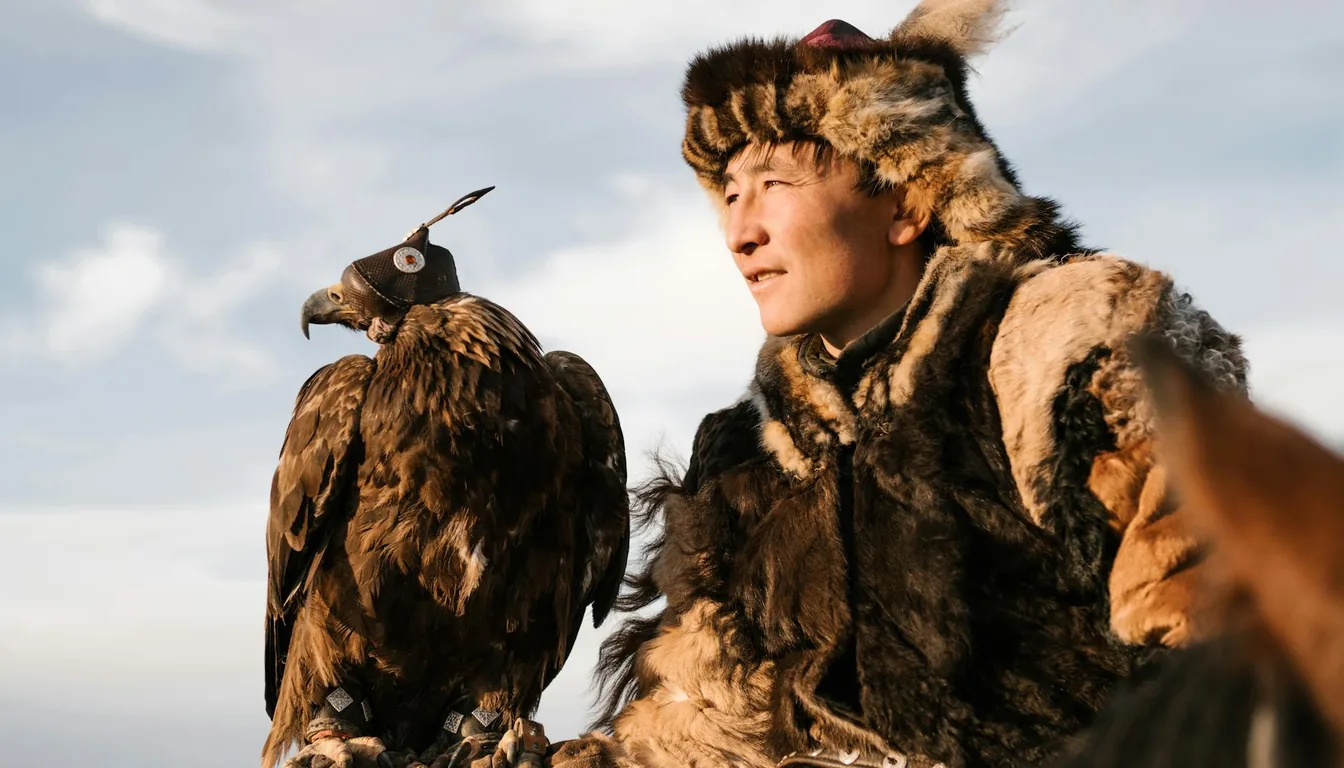
Eagle hunting in Kazakhstan is a 4,000-year-old nomadic tradition in which trained berkutchi (eagle hunters) ride on horseback with golden eagles to hunt foxes and hares across the steppe and mountains. Recognized by UNESCO as Intangible Cultural Heritage of Humanity, the practice survives today with an estimated 250 active berkutchi in Kazakhstan, mostly in the Almaty and East Kazakhstan regions. Visitors can watch demonstrations or join full-day hunting rides from Almaty year-round, with the best season running from October through February.
Eagle hunting is not a staged performance for cameras. It is a living tradition passed from father to son (and increasingly, daughter) for millennia. The berkutchi and his berkut (golden eagle) form a hunting partnership built over years of daily training, a bond that Kazakhs consider sacred. For travelers, witnessing this ancient art in person ranks among the most powerful cultural experiences Kazakhstan offers.
What Is Eagle Hunting (Berkutchi Tradition)?
Berkutchi (Kazakh: беркутші) means “eagle man,” the person who practices the art of hunting with a trained golden eagle. The tradition is also called qusbegi (құсбегі, “master of birds”) in formal Kazakh, though berkutchi is the most widely used term.
The tradition works like this: a berkutchi captures a young golden eagle, trains it over 1-3 years to hunt cooperatively with a mounted rider, hunts with the bird for 5-10 seasons, then releases it back to the wild at breeding age. The cycle then repeats with a new eagle.
Key elements of the berkutchi tradition:
- The eagle is a partner, not a pet. Berkutchi do not domesticate their birds. The eagle retains its wild instincts, and that wildness is what makes it an effective hunter.
- Horseback hunting. The berkutchi rides to elevated terrain, scans for prey, removes the eagle’s hood, and releases. The eagle strikes from above while the hunter gallops to the catch site.
- Seasonal practice. Hunting runs from October to February, when fox and hare fur is thickest and prey tracks show clearly in snow.
- Generational knowledge. Training methods, eagle-reading skills, and hunting terrain knowledge pass within families. Some berkutchi lineages trace back 10+ generations.
The tradition is central to Kazakh cultural identity. The golden eagle appears on Kazakhstan’s national flag, coat of arms, and currency, a direct reference to berkutchi heritage.
History of Eagle Hunting: 4,000+ Years of Heritage
Ancient Origins
The earliest evidence of eagle hunting in Central Asia dates to approximately 4,000 years ago. Petroglyphs at Tamgaly (a UNESCO World Heritage Site 170 km northwest of Almaty) depict mounted riders with large birds on their arms. Similar rock carvings appear across the Altai Mountains, spanning modern Kazakhstan, Mongolia, and Russia.
Chinese historical sources provide the earliest written records. Han Dynasty chronicles (206 BC - 220 AD) describe the Wusun and Kangju peoples of the Kazakh steppe hunting with trained eagles. The practice was well-established across the Turkic and Mongol worlds by the 6th century, when the Gokturk Khaganate controlled Central Asia.
Mongol and Turkic Expansion
Eagle hunting reached its peak prestige during the Mongol Empire (13th-14th centuries). Genghis Khan himself was recorded as an enthusiastic falconer, and Marco Polo described the Great Khan’s hunting parties with thousands of birds of prey. The Mongol tradition directly influenced Kazakh berkutchi practices, as both cultures share the same core training methods, equipment terminology, and hunting protocols.
Under the Kazakh Khanate (1465-1847), berkutchi held respected social status. Skilled eagle hunters served khans as providers of fur and game. Eagle hunting competitions featured at major Kazakh celebrations and traditions, alongside kokpar (horseback polo) and baige (horse racing).
Soviet Suppression and Survival
Soviet collectivization in the 1930s devastated nomadic Kazakh life. Forced settlement, livestock confiscation, and the catastrophic famine of 1931-1933 (which killed an estimated 1.5 million Kazakhs) broke the generational chain of berkutchi knowledge.
The tradition survived in pockets:
- Eastern Kazakhstan (Katon-Karagai, Altai region), where mountainous terrain preserved traditional lifeways
- Bayan-Olgii, Mongolia, where the largest Kazakh diaspora community maintained berkutchi traditions unbroken
- Kyrgyzstan, where Kyrgyz eagle hunters preserved parallel traditions in the Tien Shan mountains
Post-Independence Revival (1991-Present)
Since Kazakhstan’s independence in 1991, berkutchi culture has experienced significant revival. The government officially supports the tradition through festivals, competitions, and UNESCO nomination processes. Today an estimated 250 practicing berkutchi operate in Kazakhstan, with numbers growing as younger Kazakhs apprentice with master hunters.
How Berkutchi Train Golden Eagles
Training a golden eagle demands daily commitment over 1-3 years. The methods have remained largely unchanged for centuries.
Capturing the Eagle
Berkutchi traditionally capture young female eagles (2-4 years old) from mountain cliff nests in late spring or summer. Females are strongly preferred because they are 30-40% larger than males and significantly more powerful hunters. A mature female berkut weighs 5-7 kg with a wingspan exceeding 2 meters; males rarely exceed 4 kg.
Some modern berkutchi work with captive-bred eagles, but many practitioners insist that wild-caught birds possess superior hunting instincts. Kazakh law permits licensed berkutchi to capture eagles for traditional hunting purposes.
The Taming Process (Manning)
The first weeks are the most intensive. The freshly captured eagle is aggressive, frightened, and powerful enough to cause serious injury. The berkutchi must:
- Carry the eagle on the glove (tom-aq) for hours daily to build physical familiarity and exhaust the bird’s fear response
- Feed by hand exclusively to establish the berkutchi as the sole food source
- Expose gradually to stimuli like horses, dogs, other people, movement, and sounds
- Speak and sing to the eagle. Berkutchi traditionally sing specific songs to their birds, believing the eagle learns to associate the hunter’s voice with safety
This phase typically takes 2-4 weeks. The eagle is considered “manned” when it sits calmly on the glove, accepts food without aggression, and tolerates the berkutchi’s touch.
Recall and Lure Training
Once manned, the eagle learns to fly to the berkutchi’s glove on command. Training begins at short distances (2-3 meters) and extends to 200+ meters over weeks. A shirga (a fox-skin lure dragged behind a horse) teaches the eagle to pursue, strike, and hold prey on the ground.
Field Hunting
The final stage takes the eagle into real hunting terrain on horseback. Helpers flush foxes or hares from cover; the berkutchi releases the eagle from an elevated position. A fully trained berkut can spot prey from over a kilometer away, dive at speeds exceeding 240 km/h, and hold a struggling fox until the hunter arrives.
The entire process, from capture to reliable field hunting, typically takes 1-3 years. An exceptional berkut may hunt cooperatively for a decade before the berkutchi releases it back to the wild at breeding age (around 12-15 years old).
The Hunting Season and Process
Eagle hunting season runs from October through February, peaking in December and January. The timing is deliberate:
- Fur quality: Fox and hare pelts reach peak thickness in deep winter, making them valuable for traditional Kazakh clothing
- Visibility: Snow cover makes prey tracks easy to read and animals easier to spot against the white landscape
- Eagle condition: Golden eagles are naturally more active and aggressive hunters in cold weather
- Terrain access: Frozen rivers and hardened ground allow horseback access to remote hunting valleys
A Typical Hunting Day
A berkutchi hunting day follows a centuries-old pattern:
- Pre-dawn departure. The berkutchi rides out with the hooded eagle on his glove, accompanied by 1-3 beaters (helpers on horseback or foot).
- Positioning. The berkutchi climbs to a ridge or elevated terrain overlooking a valley or gully where prey shelters.
- Flushing. Beaters ride through the valley below, driving foxes and hares from cover.
- Release. When prey appears, the berkutchi removes the eagle’s hood (tymaq) and launches the bird with an arm thrust.
- The strike. The eagle drops from height, accelerating in a long stoop to strike prey with its talons, capable of exerting over 400 PSI of grip force.
- Recovery. The berkutchi gallops to the catch site, rewards the eagle with a piece of meat, and secures the prey.
A productive day might yield 1-3 foxes. The fur is used for traditional clothing, and the meat is shared among the hunting party. Some berkutchi also hunt corsac foxes, hares, and occasionally wolves (though wolf hunting requires an exceptionally large and brave eagle).
Where to See Eagle Hunting in Kazakhstan
Almaty Region (Most Accessible)
The easiest place for visitors to experience eagle hunting is in the villages and mountain foothills east of Almaty. Several established berkutchi offer regular demonstrations and immersive experiences:
Demonstration (1-2 hours): Watch a berkutchi work with his eagle: flying, recalling to the glove, lure chasing. Excellent photo opportunities. Cost: $30-80 per person.
Half-day experience (3-5 hours): Ride on horseback with the berkutchi into hunting terrain. See the eagle released in a natural setting, learn about training methods, and handle the eagle yourself (with guidance). Cost: $80-150 per person.
Full-day hunting ride (6-8 hours): Join a real hunting expedition in winter. Includes horseback riding, eagle hunting in action, traditional lunch, and cultural storytelling. Cost: $120-250 per person. Available October-February only.
Nura Village (Almaty Oblast)
The village of Nura (not to be confused with the Nura River in central Kazakhstan) in the Almaty region has become a hub for berkutchi tourism. Several families here have practiced eagle hunting for generations and now welcome visitors. The setting (dramatic mountain valleys with snow-capped peaks) adds to the experience.
Eagle Hunting Festivals and Competitions
Kazakhstan hosts several annual eagle hunting events:
- Sayat (Eagle Hunting Festival), held in the Almaty region each autumn (September-October), featuring competitive berkutchi demonstrations, speed and accuracy contests, and traditional games
- Nauryz celebrations (March 21-23), Kazakhstan’s biggest holiday features berkutchi demonstrations at major events in Almaty and Astana, free to attend
- World Nomad Games, held biennially (Astana hosted in 2024), featuring international berkutchi competitions with hunters from Kazakhstan, Kyrgyzstan, Mongolia, and beyond
Eastern Kazakhstan (Katon-Karagai)
For the most authentic experience, the Katon-Karagai district in the Altai Mountains of East Kazakhstan harbors the country’s most traditional berkutchi communities. The landscape of dense forests, alpine meadows, and snow-covered peaks is where eagle hunting originated. Reaching Katon-Karagai requires a domestic flight to Ust-Kamenogorsk followed by a 4-6 hour drive, but the remoteness ensures an unfiltered cultural encounter.
UNESCO Intangible Cultural Heritage Status
In 2010, UNESCO inscribed falconry as an Intangible Cultural Heritage of Humanity, a multinational nomination including Kazakhstan, along with 17 other countries. The Kazakh berkutchi tradition was specifically highlighted as one of the most significant living falconry practices in the world.
What UNESCO recognition means in practice:
- Legal protection. Kazakhstan’s government has enacted laws protecting berkutchi rights to capture and train eagles for traditional purposes.
- Cultural funding. State and international grants support berkutchi festivals, training programs, and documentation projects.
- Tourism development. UNESCO status has driven international awareness, increasing visitor interest in berkutchi experiences.
- Generational transmission. Formal apprenticeship programs connect young Kazakhs with master berkutchi, ensuring the tradition continues.
Kazakhstan has separately nominated specific elements of berkutchi culture for additional UNESCO recognition, including the traditional knowledge systems surrounding eagle training and the musical traditions associated with eagle hunting.
Kazakhstan vs. Kyrgyzstan vs. Mongolia: Eagle Hunting Compared
Eagle hunting exists across Central Asia, but each country’s tradition has distinct characteristics:
| Aspect | Kazakhstan | Kyrgyzstan | Mongolia (Bayan-Olgii) |
|---|---|---|---|
| Practitioners | ~250 berkutchi | ~100 eagle hunters | ~400 burkitshi |
| Ethnic group | Kazakh | Kyrgyz | Ethnic Kazakhs |
| Primary terrain | Steppe and mountain foothills | High mountain valleys (Tien Shan) | Altai mountain plateaus |
| Main prey | Fox, hare | Fox, hare, marmot | Fox, hare, wolf |
| Major festival | Sayat (Almaty region) | World Nomad Games host | Golden Eagle Festival (Olgii, October) |
| Tourist accessibility | High (Almaty-based) | Moderate (Bishkek-based) | Low (remote western Mongolia) |
| UNESCO status | Yes (2010, falconry) | Yes (2010, falconry) | Yes (2010, falconry) |
Key distinction: Mongolia’s Bayan-Olgii eagle hunters are ethnically Kazakh. They are the descendants of Kazakhs who migrated to western Mongolia centuries ago. Their berkutchi tradition is essentially the same as Kazakhstan’s, making Mongolia’s famous Golden Eagle Festival a Kazakh cultural event, despite being held in Mongolia.
Kyrgyz eagle hunting shares common Turkic roots with the Kazakh tradition but developed separately in the high-altitude Tien Shan environment, where different prey species and terrain shaped distinct hunting techniques.
Famous Eagle Hunters
Aisholpan Nurgaiv and The Eagle Huntress
The most internationally known berkutchi today is Aisholpan Nurgaiv (born 2001), a young Kazakh woman from Bayan-Olgii, Mongolia. The 2016 documentary The Eagle Huntress followed 13-year-old Aisholpan as she trained with her father Nurgaiv to become one of the first known female eagle hunters.
The documentary was a global hit. Narrated by Daisy Ridley, it grossed $4.1 million worldwide and introduced millions of viewers to the berkutchi tradition. Aisholpan won the eagle hunting competition at the Golden Eagle Festival in 2014, competing against 70 male hunters.
The role of women in eagle hunting: While berkutchi has been historically male-dominated, Aisholpan’s success has inspired a wave of young women across Kazakhstan and Mongolia to take up the tradition. Historians note that women likely participated in eagle hunting in earlier centuries (petroglyphs at some Central Asian sites show female figures with birds of prey), but the practice became exclusively male in recent centuries. Today, at least a dozen female berkutchi are actively training and hunting in Kazakhstan and Mongolia.
Sailau Akhmet
Sailau Akhmet is one of Kazakhstan’s most respected living berkutchi, based in the Almaty region. He has trained over 30 eagles during his career spanning four decades and has won multiple national eagle hunting competitions. He is also one of the primary berkutchi who works with international tourists and documentary filmmakers, making him an ambassador for the tradition. His family has practiced berkutchi for at least seven generations.
Dalel Manas
Based in eastern Kazakhstan, Dalel Manas is known for hunting wolves with his golden eagles, one of the most difficult and dangerous forms of berkutchi practice. Wolf hunting requires an exceptionally large and brave eagle, plus a fearless berkutchi willing to gallop into close quarters with a cornered wolf. Dalel’s exploits have been featured in Kazakh media and international wildlife documentaries.
How to Arrange an Eagle Hunting Tour
Booking an authentic berkutchi experience requires some planning. Here is a practical guide:
From Almaty (Easiest)
- Book through a reputable tour operator. Look for operators who name their specific berkutchi partners and avoid generic “eagle show” listings. GetYourGuide and Viator list several verified options.
- Best season: October-February for real hunting; demonstrations available year-round.
- Transport: Most tours include pickup from Almaty hotels. The drive to berkutchi villages is typically 1-2 hours.
- What to bring: Warm layers (winter tours can hit -20°C), camera with telephoto lens, gloves, sunglasses for snow glare.
- Budget: $50-250 per person depending on experience level and group size.
Independent Arrangement
For travelers who prefer to arrange directly:
- Contact the Almaty Tourism Board for berkutchi recommendations
- Ask guesthouses in the Almaty mountain villages (Talgar, Esik, Turgen), as locals can connect you with nearby berkutchi
- Visit during Nauryz (March 21-23) for free public demonstrations in Almaty and Astana
Multi-Day Cultural Tours
Several operators offer 3-7 day cultural tours of Kazakhstan that combine eagle hunting with other traditional experiences: yurt stays, horseback trekking, kokpar games, and visits to historical sites. These tours typically cost $500-1,500 per person and cover the Almaty region and sometimes eastern Kazakhstan.
The Berkut: Golden Eagle Facts
The golden eagle (berkut) is the foundation of the tradition. Here are the key facts about this remarkable bird:
| Characteristic | Detail |
|---|---|
| Scientific name | Aquila chrysaetos |
| Kazakh name | Беркут (Berkut) |
| Wingspan | 1.8-2.34 meters |
| Weight (female) | 5-7 kg |
| Weight (male) | 3-4.5 kg |
| Dive speed | 240-320 km/h |
| Grip force | 400+ PSI (10x human grip) |
| Eyesight | 4-8x sharper than human vision |
| Lifespan (wild) | 25-35 years |
| Hunting career | 5-12 years with berkutchi |
Golden eagles are apex predators with no natural enemies in the Kazakh ecosystem. Their combination of size, speed, intelligence, and trainability makes them uniquely suited to cooperative hunting with humans. No other bird of prey has the strength to reliably take foxes, the primary quarry of the berkutchi tradition.
The berkut holds deep symbolic meaning in Kazakh culture. It represents freedom, power, and the connection between the nomadic Kazakh people and the vast landscapes they inhabit. The eagle on Kazakhstan’s national flag flies with wings spread toward the sun, a direct reference to the berkutchi’s bird soaring above the steppe.
Eagle Hunting Vocabulary
Understanding these Kazakh terms will deepen your experience when visiting a berkutchi:
| Kazakh Term | Pronunciation | Meaning |
|---|---|---|
| Беркут (Berkut) | behr-KOOT | Golden eagle |
| Беркутші (Berkutchi) | behr-koot-SHEE | Eagle hunter |
| Құсбегі (Qusbegi) | koos-beh-GEE | Master of birds (formal title) |
| Том-ақ (Tom-aq) | tom-AHK | Leather glove/gauntlet worn on the arm |
| Тымақ (Tymaq) | tuh-MAHK | Leather hood placed over the eagle’s eyes |
| Тізгін (Tizgin) | teez-GEEN | Jesses — leather straps on the eagle’s legs |
| Ширға (Shirga) | sheer-GAH | Fox-skin lure used in training |
| Балдақ (Baldaq) | bal-DAHK | Wooden Y-shaped rest for the eagle arm, mounted on the saddle |
| Сaят (Sayat) | sah-YAHT | The hunt itself; also the name of eagle hunting festivals |
Frequently Asked Questions
- What is eagle hunting in Kazakhstan?
- Eagle hunting in Kazakhstan is the ancient berkutchi tradition of training golden eagles (berkut) to hunt foxes, hares, and other prey from horseback. The practice is over 4,000 years old, recognized by UNESCO as Intangible Cultural Heritage, and still actively practiced by approximately 250 berkutchi across Kazakhstan. The hunter captures a young eagle, trains it over 1-3 years, hunts with it for 5-10 seasons, then releases it back to the wild.
- Where can I see eagle hunting in Kazakhstan?
- The most accessible eagle hunting experiences are in the Almaty region, where several berkutchi offer demonstrations (1-2 hours, $30-80) and full-day hunting rides ($120-250). The village of Nura in Almaty Oblast is a berkutchi tourism hub. Eastern Kazakhstan (Katon-Karagai district) offers the most authentic experiences but requires more travel. Major festivals with berkutchi demonstrations include the Sayat Festival (autumn) and Nauryz celebrations (March 21-23).
- How much does an eagle hunting tour cost in Kazakhstan?
- Eagle hunting tours from Almaty range from $30-80 per person for a demonstration (1-2 hours), $80-150 for a half-day experience with horseback riding, and $120-250 for a full-day winter hunting expedition. Multi-day cultural tours that include eagle hunting alongside yurt stays and other traditional experiences cost $500-1,500 per person for 3-7 days.
- What type of eagle do Kazakh hunters use?
- Kazakh berkutchi exclusively use the golden eagle (Aquila chrysaetos), called berkut in Kazakh. Female eagles are preferred because they are significantly larger and more powerful than males — females weigh 5-7 kg with wingspans up to 2.34 meters, versus 3-4.5 kg for males. The golden eagle can dive at 240-320 km/h and exert over 400 PSI of grip force, making it powerful enough to take foxes and even wolves.
- Is eagle hunting in Kazakhstan recognized by UNESCO?
- Yes. In 2010, UNESCO inscribed falconry — including Kazakh berkutchi tradition specifically — as Intangible Cultural Heritage of Humanity. The recognition covers 18 countries and highlights the berkutchi practice as one of the world's most significant living falconry traditions. UNESCO status provides legal protection, cultural funding, and international visibility for the tradition.
- Who is the most famous eagle hunter from Kazakhstan?
- The most internationally famous eagle hunter is Aisholpan Nurgaiv, a young Kazakh woman from Mongolia's Bayan-Olgii province, whose story was told in the 2016 documentary The Eagle Huntress. In Kazakhstan itself, Sailau Akhmet (Almaty region) is one of the most respected living berkutchi, with four decades of experience training over 30 eagles. Dalel Manas (eastern Kazakhstan) is known for the rare practice of hunting wolves with golden eagles.
More Stories

culture
Famous People from Kazakhstan: Top Icons & Stars
Famous people from Kazakhstan: GGG, Dimash Kudaibergen, Abai, and 30+ icons across sports, music, science and politics. Full bios and achievements.

culture
Kazakh Language Basics: 40+ Essential Phrases
Kazakh language basics for travelers — 40+ essential phrases for greetings, food, directions, emergencies, pronunciation, and when to use Kazakh vs Russian.

culture
Kazakhstan Religion: Islam, Christianity & More
Kazakhstan religion: 70% Muslim, 17% Orthodox Christian, officially secular. How Islam shapes daily life, sacred sites, and what visitors need to know.