Religion in Kazakhstan: Census Facts, Law and Visitor Etiquette
Reported from the ground: Tugelbay Konabayev is a Kazakh native (born in Aktobe) who has lived 7 years in Almaty and 4 in Astana. About the author.
In this article11 sections
Kazakhstan is a secular state with a Muslim-majority population. In the 2021 national census, 69.3% of residents identified with Islam and 17.2% with Christianity. Buddhism and Judaism were each below 0.1%, and 11% declined to state a religion. These are affiliation answers from a census, not a measurement of worship, belief or observance in 2026.
That distinction matters. “Muslim-majority” describes the national census result; it does not tell you how a particular person dresses, eats, drinks, prays or votes.
Kazakhstan religion at a glance
The concise answer is Muslim-majority population, secular state and varied personal practice. Keep all three parts together; removing any one of them produces a stereotype.
| Question | Evidence-based answer |
|---|---|
| Is Kazakhstan a Muslim country? | It has a Muslim-majority population, but the state is constitutionally secular. |
| What did the latest census report? | 69.3% Islam and 17.2% Christianity in the 2021 census. |
| What about other or unstated responses? | Buddhism and Judaism were each below 0.1%; 11% did not state an affiliation. |
| Does the census measure religious practice? | No. It records self-reported affiliation, not frequency of prayer or observance. |
| Is there an official state religion? | No. The Constitution defines the state as secular and separates religion from the state. |
| What should visitors do at a place of worship? | Follow posted rules, dress respectfully, keep quiet during services and ask before photographing people. |
What the 2021 census does and does not say
The census measures declared affiliation, not devotion. It is the strongest nationwide denominator available, but it cannot tell us how often an individual prays, attends a service, fasts or follows a religious rule.
The Bureau of National Statistics census release is the best nationwide source for religious affiliation. It reported:
- Islam: 69.3%
- Christianity: 17.2%
- Buddhism: below 0.1%
- Judaism: below 0.1%
- Declined to state: 11%
These are the headline categories verified for this guide, not a closed distribution that assigns every respondent to one of the bullets. Consult the linked BNS tables for the full category set. Do not relabel the 11% as atheist. “Declined to state” is its own census response and does not establish what those respondents believe. The published totals also should not be converted into claims such as “69.3% actively practice Islam.” The census did not ask that question.
Ethnicity is not a substitute for religion either. Kazakhstan’s population includes Kazakhs, Russians, Uzbeks, Ukrainians, Uyghurs and many other communities, but an ethnic label does not prove an individual’s affiliation or level of observance.
The size of the undeclared category is another reason to resist neat conclusions. Eleven percent declining to state a religion is a reported result, not missing material that an editor may redistribute among Islam, Christianity and atheism. The safest summary preserves the category exactly as BNS published it.
Comparisons with older censuses also need care. A change in the share selecting a category may reflect demographic change, response behavior or both. It does not by itself prove that a particular community became more or less observant. For a broader demographic picture, use the separate Kazakhstan population guide rather than asking religion data to explain the entire country.
The legal framework changed in 2026
The Constitution effective July 1, 2026 is now the controlling constitutional source. Kazakhstan adopted it by referendum on March 15, 2026. Pages still citing the 1995 Constitution as current are out of date.
The current Constitution provides the essential framework:
- Article 1 defines Kazakhstan as a democratic, secular, legal and social state.
- Article 7 states that religion is separated from the state.
- Article 25 protects freedom of conscience.
The separate Law on Religious Activity and Religious Associations contains more detailed rules. Among other things, it establishes registration categories for religious associations, requires registration for missionary activity and regulates where religious literature may be distributed. Activities outside religious buildings can also fall under notification rules.
This guide refers to the consolidated Adilet text available on the last-verified date below, not the law’s original 2011 wording in isolation.
This is useful context, not individualized legal advice. A tourist quietly visiting a mosque or cathedral is not the same legal situation as organizing religious events, distributing literature or conducting missionary activity.
The law’s registration provisions should not be compressed into “religion is banned” or “all religious activity is unrestricted.” It distinguishes national, regional and local religious associations and sets registration procedures for them. It separately addresses missionary activity, including registration, and limits distribution of religious literature to specified settings such as religious buildings, religious education institutions and designated premises.
Those distinctions matter in practical reporting. A visitor reading about restrictions on organized activity should not assume that ordinary personal belief is prohibited. Conversely, constitutional freedom of conscience should not be described as permission to ignore the statutory rules for public or organized religious activity.
What the law means for an ordinary visitor
Ordinary respectful tourism is different from conducting religious activity. Seeing architecture, entering during visitor hours and learning about history generally presents a different set of questions from preaching, handing out literature, arranging a public gathering or acting as a missionary.
If your purpose goes beyond tourism, read the current law and obtain qualified local advice. This is especially important for organized groups, imported religious materials, public events or any activity presented as teaching or missionary work. The law also addresses worship outside religious buildings and notification procedures, so a private assumption based on another country’s rules is not enough.
For ordinary travelers, the useful principle is narrower: visit only when admitted, follow the site’s dress and photography rules, and do not interrupt worship. Nothing in a generic travel article can replace a current instruction from the site itself.
Islam in everyday Kazakhstan
Islam is nationally important, but daily observance is personal rather than uniform. Mosques are visible across the country. Some people observe prayer and fasting closely; others identify as Muslim mainly through family, culture or heritage; many lives do not fit a neat label.
That is why broad statements such as “all Kazakhs are Muslim,” “alcohol is forbidden in Kazakhstan,” or “women must cover their hair” are misleading. Visitors should respond to the actual place and person in front of them, not a national stereotype.
During Ramadan, do not assume that every restaurant closes or every colleague is fasting. Public life continues, but it is considerate to ask before scheduling a food-centered meeting with someone who may be observing the fast.
Food and clothing are common sources of overgeneralization. Kazakhstan has halal restaurants and people who avoid alcohol, but this does not make every menu halal or every person abstinent. Check a venue’s stated practice when it matters to you. Likewise, modest dress at an active mosque is a site rule and a gesture of respect, not evidence of one mandatory public dress code for the whole country. The traditional clothing guide explains cultural garments without presenting them as everyday religious uniforms.
Religious vocabulary can overlap with custom, family life and national tradition. When a local person describes a practice as “our tradition,” it is better to listen to their own distinction than to force it into a simple religious or secular box. The broader culture of Kazakhstan guide covers that overlap in more depth.
Christianity and other communities
Christianity is the second-largest census affiliation, not a single undifferentiated group. Orthodox churches are prominent in cities with large Russian-speaking communities, while Catholic and Protestant communities are also present. Kazakhstan additionally has Jewish, Buddhist and other religious communities, though the census percentages for Judaism and Buddhism were each below 0.1%.
The most accurate way to describe this landscape is not “two religions living in perfect harmony” or “a uniformly devout society.” It is a secular country with a Muslim majority, a substantial Christian minority and varied individual practice under a regulated legal framework.
The BNS top-line category “Christianity” should not be silently replaced with “Russian Orthodoxy.” Orthodoxy is important, but the published census headline used in this article is broader. The same evidence discipline applies to smaller categories: a national percentage establishes scale, not the history, legal experience or present life of every community inside it.
Visitors therefore gain more from specific questions than from a national label. Ask what a particular building is, which community uses it and whether a service is underway. This produces a more accurate visit and avoids treating active sacred places as interchangeable monuments.
Visitor etiquette at mosques, churches and sacred sites
The site’s own instructions are the visitor’s primary rule. Requirements vary, so signs and staff directions outrank any generic checklist. These habits are a safe baseline:
- Check whether visitors are admitted at that time. Services, Friday prayers, weddings or funerals may limit access.
- Wear clean, non-revealing clothing. A site may provide or request additional covering; follow its rule rather than assuming one national dress code.
- Remove shoes where directed. This is common in prayer areas of mosques but not a rule for every building.
- Keep voices and phones quiet. Do not walk in front of people who are praying.
- Ask before photographing people or a service. Permission to photograph architecture is not permission to photograph worshippers.
- Treat shrines as active sacred spaces. The Mausoleum of Khoja Ahmed Yasawi, for example, is both a UNESCO World Heritage property and a place of religious significance.
For clothing and social customs beyond religious sites, use the Kazakhstan travel tips. For a few useful phrases, see Kazakh language basics.
Plan time rather than rushing in. If a prayer or service has begun, wait for guidance instead of walking through the congregation to obtain a photograph. When an attendant lends a covering or asks you to use a different entrance, treat it as a local operating instruction, not an invitation to debate national policy.
Children are welcome in many community settings, but parents should still prevent running, shouting or touching sacred objects. Accessibility also differs between historic and modern buildings; contact the site directly when step-free access is essential.
Ramadan, holidays and food planning
Religious dates can affect individual routines without shutting down the whole country. During Ramadan, some Muslims fast and others do not. A traveler should neither pressure someone to eat nor make a spectacle of avoiding food in every public setting.
Restaurant hours, tours and attraction access can change around holidays or major services. Check the exact venue rather than copying an annual schedule from an old article. If you are invited to an iftar, ask the host what time to arrive and what, if anything, to bring.
Dietary needs should be handled directly. Look for a venue that identifies itself as halal if halal preparation is important; do not infer it from the owner’s ethnicity or the presence of Kazakh dishes. The popular food in Kazakhstan guide explains dishes and ingredients, while the restaurant remains the source for current preparation.
The same approach works for alcohol. Availability in a city does not tell you whether a particular host drinks, and religious identity does not authorize a stranger to question someone’s choice. Offer and decline politely without turning the moment into a test of authenticity.
Common claims that need correction
Most errors come from collapsing census, law and personal practice into one statement. Use the correction on the right when you encounter the shortcut on the left.
| Shortcut | More accurate version |
|---|---|
| “Kazakhstan is an Islamic state.” | Kazakhstan is constitutionally secular and has a Muslim-majority population. |
| “69.3% are practicing Muslims.” | 69.3% selected Islam in the 2021 census; practice was not measured. |
| “The remaining 11% are atheist.” | Eleven percent declined to state a religion. |
| “All Christians are Orthodox.” | The cited BNS top-line category is Christianity and includes more than one tradition. |
| “Women must cover everywhere.” | Ordinary public space has no such general visitor rule; active sites may set dress requirements. |
| “Freedom of conscience means no regulation.” | The Constitution protects conscience, while legislation regulates associations and specified public activities. |
These corrections are not semantic caution for its own sake. They keep a travel page from assigning belief to millions of people, and they help a visitor distinguish respect from stereotype. Related family and social customs are covered in the Kazakhstan traditions guide.
Three places that show the country’s religious landscape
Astana, Almaty and Turkestan offer three different contexts: a contemporary mosque, an Orthodox cathedral and a UNESCO-listed mausoleum. They are examples, not a ranking or a complete map of faith communities.
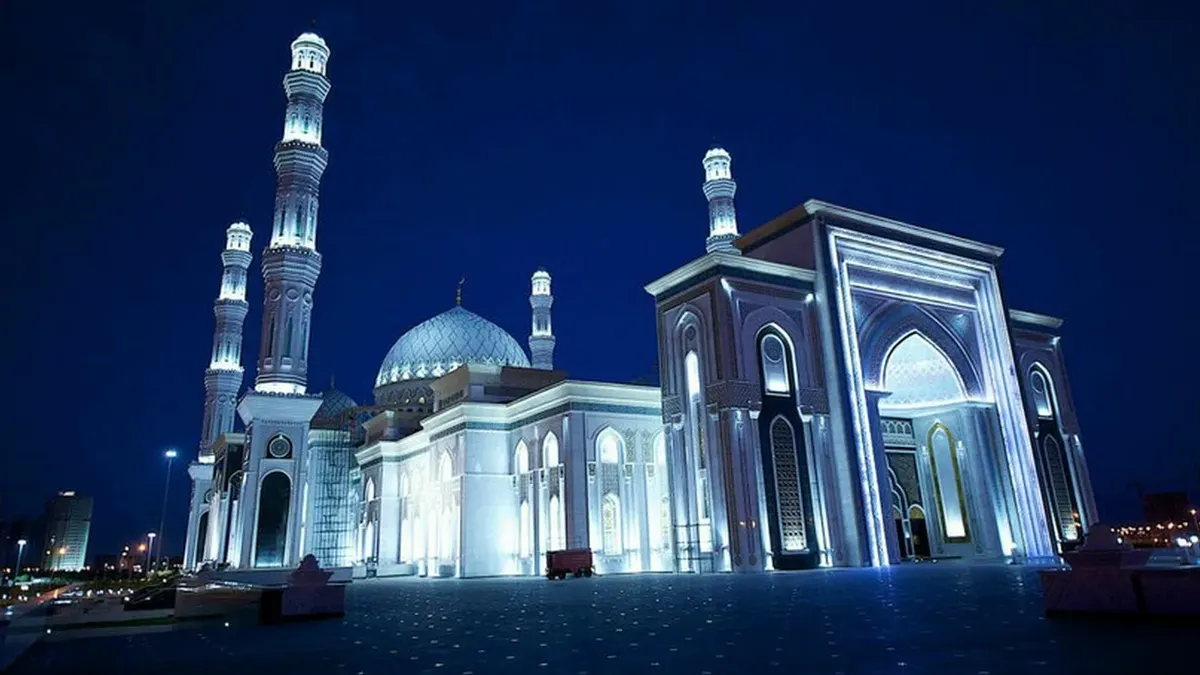
Hazret Sultan Mosque, Astana
One of Astana’s major mosques, useful for seeing contemporary Islamic architecture. Check current visitor access and prayer times locally.
Ascension Cathedral, Almaty
The cathedral in Panfilov Park is an active Orthodox Christian site as well as a city landmark. Plan a respectful visit around services.
Mausoleum of Khoja Ahmed Yasawi, Turkestan
The UNESCO-listed mausoleum is central to Turkestan’s history and remains a sacred destination. Dress and behavior should reflect that it is more than a photo stop.
Frequently Asked Questions
What is the main religion in Kazakhstan?
Islam is the largest self-reported affiliation. The 2021 census recorded 69.3% Islam and 17.2% Christianity, while 11% declined to state a religion.
Is Kazakhstan an Islamic state?
No. Kazakhstan has a Muslim-majority population, but Article 1 of the Constitution defines it as a secular state and Article 7 separates religion from the state.
Are all ethnic Kazakhs Muslim?
No individual belief should be inferred from ethnicity. The census records ethnicity and religion separately, and religious practice varies from person to person.
Do women need to cover their hair in Kazakhstan?
There is no general visitor rule requiring a head covering in ordinary public space. An active mosque or another sacred site may set its own dress requirements, which visitors should follow.
Can tourists enter mosques in Kazakhstan?
Many mosques admit respectful visitors outside restricted times, but access and dress rules vary. Check signage or ask staff, avoid disrupting prayer and ask before taking photographs.
What changed in Kazakhstan's Constitution in 2026?
A new Constitution adopted by referendum on March 15, 2026 took effect on July 1, 2026. It continues to define Kazakhstan as secular, separates religion from the state and protects freedom of conscience.
Primary sources
Official statistics and current Kazakh law are the evidence base for the national claims. UNESCO is used only for the status of the Yasawi mausoleum.
- Bureau of National Statistics: 2021 census release on ethnicity, religion and languages
- Adilet: Constitution of the Republic of Kazakhstan, effective July 1, 2026
- Adilet: Law on Religious Activity and Religious Associations
- UNESCO: Mausoleum of Khoja Ahmed Yasawi
Last verified: August 5, 2026
Google Preferred Sources
See more Kazakhstan stories in Google
Add About Kazakhstan as a preferred source to find more of our fresh, relevant stories in Google Search.
More Stories
culture
Kazakhstan Culture: Traditions, Etiquette & Living Heritage
A practical guide to Kazakhstan culture: hospitality, language, dombra and kuy, Nauryz, family customs, food, etiquette, and UNESCO-listed heritage.
culture
Dombra Guide: The Two-String Kuy Tradition of Kazakhstan
Source-checked dombra guide: what a kuy is, how tökpe and shertpe differ, works to hear, UNESCO context, National Dombra Day, lessons, and buying.
culture
Kazakhstan Traditional Clothing: Complete Guide
Complete guide to Kazakhstan traditional clothing: chapan robes, saukele headdresses, tymak fur hats. History, meaning, and where to buy authentic pieces.
culture
Eagle Hunting in Kazakhstan: Ethical Berkutchi Guide
Understand Kazakh berkutchi tradition, UNESCO falconry status, ethical animal encounters, live booking checks, and responsible travel.
Plan the Next Step
travel
Kazakhstan Tourist Attractions: Choose the Right First-Trip Route
Compare Kazakhstan tourist attractions by base and logistics: Almaty nature, Turkestan heritage, Mangystau, Astana, Baikonur, and more.
food
Beshbarmak Recipe: How Kazakh Et Is Served
A source-checked guide to Kazakh et, widely called beshbarmak: what is on the platter, a practical home recipe, regional differences, and guest etiquette.
culture
Women in Kazakhstan: Rights, Work and Daily Life in 2026
Source-checked guide to women in Kazakhstan: current legal rights, dated work and wage data, marriage statistics, safety, and respectful language.
culture
Dombra Guide: The Two-String Kuy Tradition of Kazakhstan
Source-checked dombra guide: what a kuy is, how tökpe and shertpe differ, works to hear, UNESCO context, National Dombra Day, lessons, and buying.
culture
Eagle Hunting in Kazakhstan: Ethical Berkutchi Guide
Understand Kazakh berkutchi tradition, UNESCO falconry status, ethical animal encounters, live booking checks, and responsible travel.
culture
Kazakhstan Traditions: 15 Living Customs From the Steppe
Kazakhstan traditions: 15 living customs from dastarkhan hospitality and eagle hunting to Nauryz, horse games, and wedding rituals still practiced today.

Travel Writer & Local Expert · Almaty, Kazakhstan
Tugelbay Konabayev is a Kazakhstan-based travel writer who has lived in Almaty for 7+ years and Astana for 4+ years. He grew up in Aktobe, Kazakhstan and has covered Kazakh travel, food, culture, and visa policy with first-hand reporting since 2023.