Beshbarmak Recipe: How Kazakh Et Is Served
Reported from the ground: Tugelbay Konabayev is a Kazakh native (born in Aktobe) who has lived 7 years in Almaty and 4 in Astana. About the author.
In this article9 sections
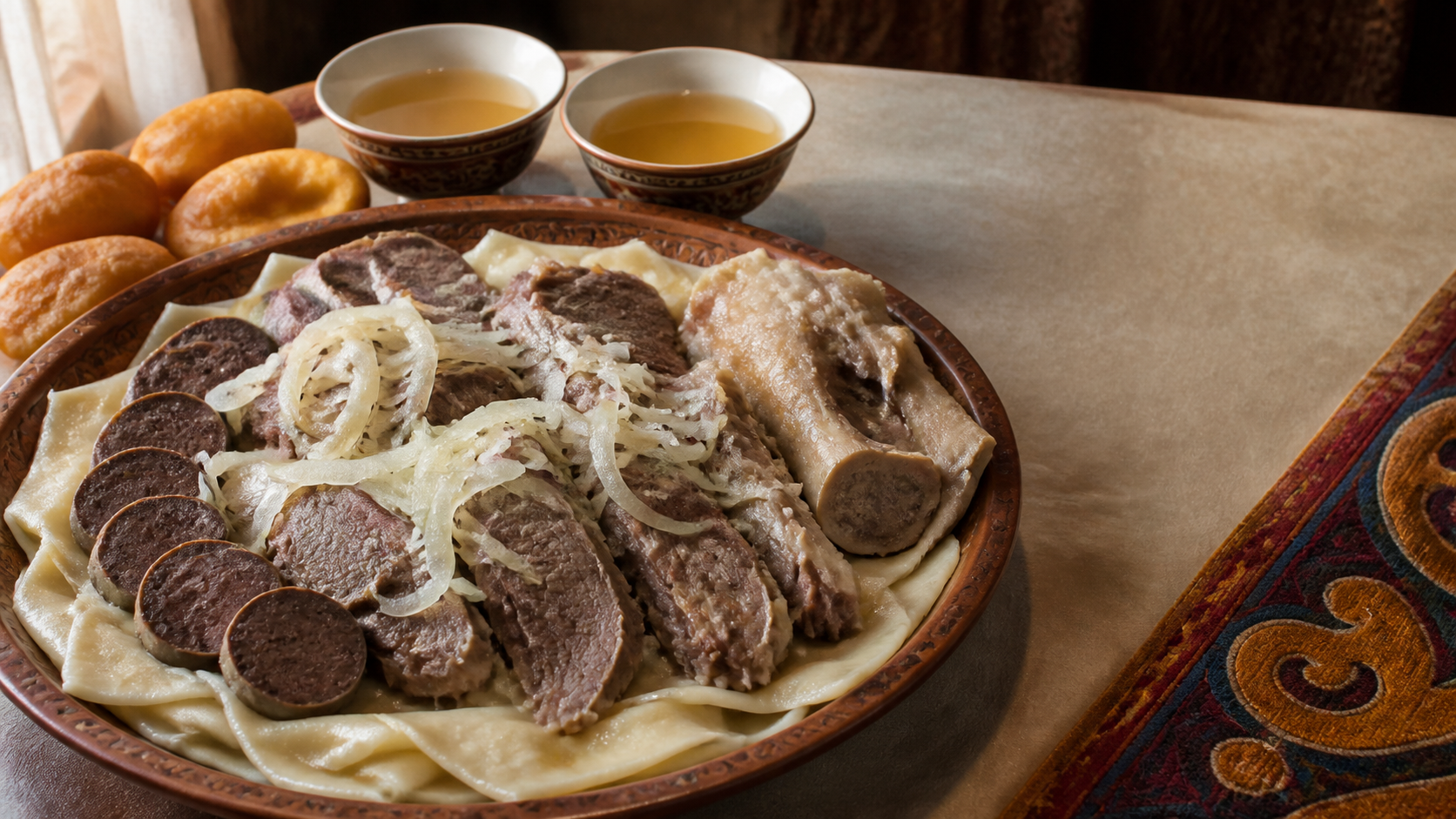
Beshbarmak is the widely recognized name for Kazakhstan’s celebratory platter of boiled meat, broad sheets of dough, onion sauce and broth. In Kazakh, however, you will also hear the more culturally precise names et (meat), et asu (to boil or prepare meat) and tabak et (a platter of meat).
That naming distinction matters. It keeps a useful search term without pretending that every Kazakh family calls the dish the same thing. It also points to the heart of the meal: the meat and the way it is served to guests, not a single fixed noodle recipe.
This guide gives you a practical six-person home version, explains what can change by region and separates useful guest manners from invented universal rules.
Quick answer: what is beshbarmak?
At its simplest, the platter has boiled meat, broad dough, onion sauce and broth. These are four working parts rather than four rigid recipes:
| Part | What it is | What to notice |
|---|---|---|
| Meat | Usually boiled lamb, beef or horse meat; kazy may be added | The cuts and presentation vary with occasion and household |
| Zhaima | Broad pieces of unleavened dough cooked in broth | They should hold together while carrying the broth |
| Tuzdyk | Sliced onion softened with hot broth, salt and pepper | It moistens the platter without turning it into soup |
| Sorpa | The clear meat broth, served in bowls | It may be served with or after the platter |
Kazakhstan’s government overview of national dishes describes the familiar version as sheep, beef or horse meat with homemade noodles and broth, served as a festive symbol of hospitality. The Assembly of the People of Kazakhstan gives a more detailed local account: boiled meat, broad shelpek or zhaima, onion tuzdyk and strong broth, with substantial regional variation.
That is the dependable core. Potatoes, carrots, fermented dairy in the broth, fish, particular cuts and exact dough-to-meat ratios belong to specific homes or regions rather than to one national formula.
Is the correct name beshbarmak or et?
Both names will get you to the right conversation, but they carry different context. “Beshbarmak” is the international and restaurant-friendly term. Et and et asu are the Kazakh terms many people prefer when discussing the meat-serving tradition itself.
The familiar explanation says besh plus barmak means “five fingers,” referring to eating by hand. The government overview and the Assembly article both present that account. In contrast, a Kazakh-language Tengrinews interview with ethnographer Bolat Bopayuly says Kazakhs historically used et, et asu or bir tabak et. Bopayuly specifically attributes the later spread of the name and dough layer in Kazakh cooking to neighbouring Turkic cuisines.
These sources do not establish one uncontested origin story. The honest conclusion is practical:
- use beshbarmak when searching menus or explaining the dish to visitors;
- recognize et and et asu when Kazakh hosts use them;
- do not correct a family about the name of its own food;
- avoid presenting “five fingers” as the only scholarly explanation.
A practical beshbarmak recipe for six
This is a workable home recipe, not a claim that every Kazakh household uses the same quantities. The meat cut, pot, flour and preferred broth strength all change the timing and hydration.
Ingredients
For the meat and broth:
- 1.5 to 2 kg bone-in lamb, beef or a mixture
- optional kazy from a reputable butcher, cooked according to the supplier’s directions
- about 3 litres cold water, or enough to cover the meat comfortably
- salt
- 2 large onions
- freshly ground black pepper
For the dough:
- 400 g plain flour, plus more for rolling
- 2 eggs
- 120 to 160 ml water, added gradually
- 1 teaspoon salt
The safest substitution is also the simplest: if horse meat is unavailable, use lamb or beef. Do not buy unlabelled cured meat or improvise with a product whose cooking requirements you do not know.
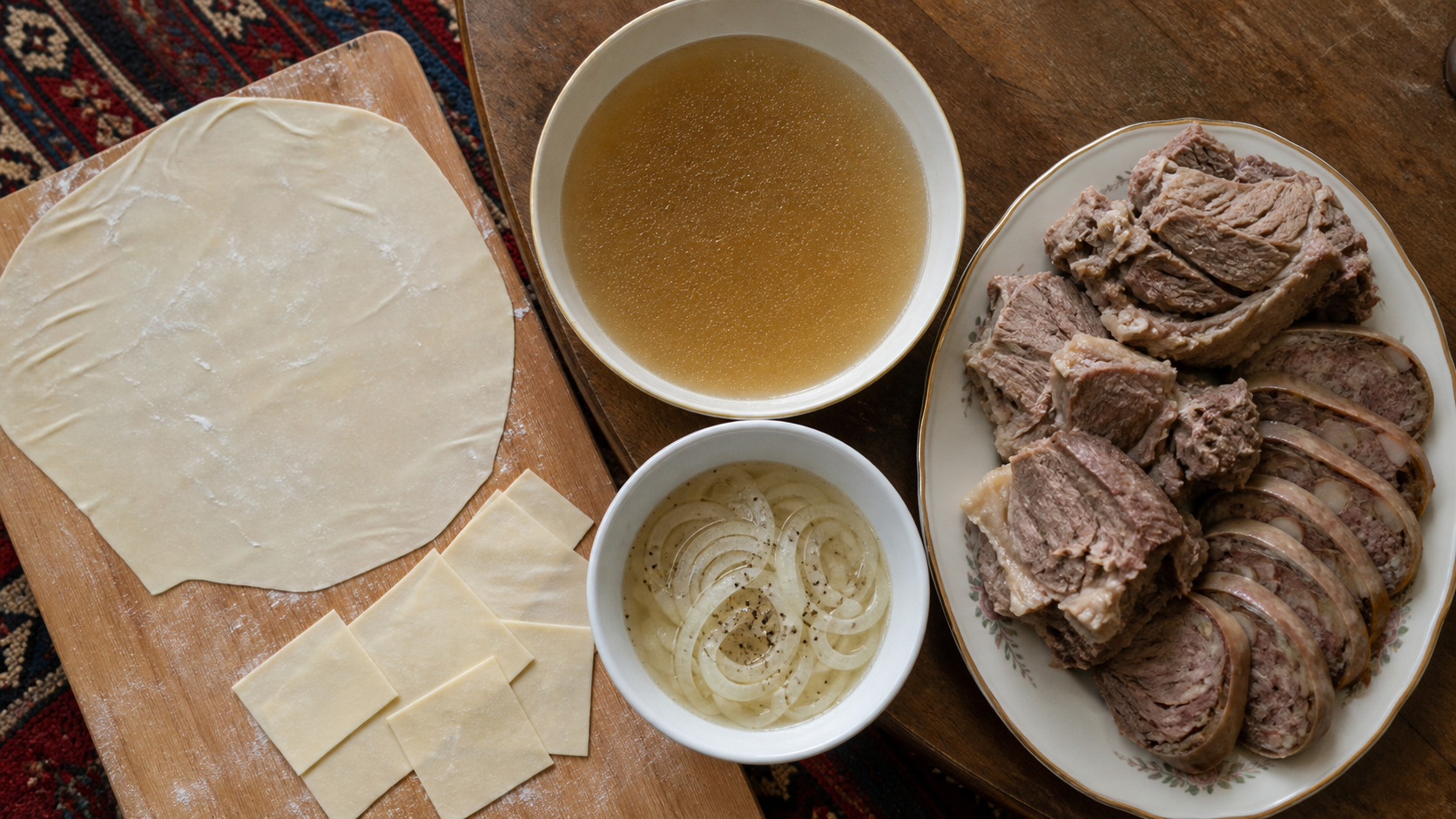
The working structure: dough, broth, onion tuzdyk and meat. The exact cuts and proportions belong to the household preparing them.
1. Cook the meat and make the broth
Put the meat in a large pot and cover it with cold water. Bring it slowly to a boil, skim the foam, then lower the heat to a quiet simmer. Salt lightly at first because the broth will concentrate.
Cook until the meat is fully done and tender enough to separate easily. For large bone-in cuts this often takes 2 to 3 hours, but the cut matters more than the clock. If you add kazy, follow its preparation instructions and account for its salt when seasoning the broth.
Lift out the cooked meat and keep it covered. Strain the broth if you want a clearer sorpa. Reserve most of it for the dough and serving.
2. Mix and roll the dough
Mix the flour and salt. Add the eggs, then enough water to form a firm dough. Knead until smooth, cover and rest for about 30 minutes.
Divide the dough so it is easier to handle. Roll each piece thinly on a floured surface, then cut it into broad squares or diamonds. The sheets do not need to be mathematically identical. Even thickness matters more because it helps them cook at the same rate.
3. Make the onion tuzdyk
Slice the onions into half-rings and put them in a small saucepan or heatproof bowl. Add black pepper and a small pinch of salt. Pour over enough very hot broth to soften the onion, then cover for 10 to 15 minutes.
The Assembly’s description uses the upper, slightly fatty layer of broth because it carries flavour into the onion. The result should be soft and aromatic, not browned like fried onions.
4. Cook the zhaima
Bring a wide pot of broth to a gentle boil. Cook the dough in batches so the pieces do not fuse into one mass. Fresh thin sheets may need only a few minutes; test one rather than relying on a universal time.
Lift the cooked pieces out carefully and spread them over a warm platter. A little overlap is normal. If they sit too long before assembly, spoon over a small amount of broth to keep them supple.
5. Assemble and serve
Arrange the meat over the dough. Slice some pieces for easy sharing, but do not assume every formal platter should arrive fully carved. Spoon the onion tuzdyk over the top and serve hot sorpa in bowls beside it.
For a relaxed home meal, this is enough. A formal feast can involve named platters, particular bone-in cuts and a host who knows how to distribute them. That cultural layer is tabak tartu, not a decorating step in the recipe.
Tabak tartu: why the meat cuts matter
Tabak tartu is the practice of arranging and presenting meat in ways that express respect, kinship, age and the occasion. It is real, but it is not one nationwide seating chart printed in bone.
The Tengrinews interview lists many named platters for elders, in-laws, children and other guests. A 2024 Almaty TV report on tabak tartu records detailed examples from practitioners and ethnographers. Crucially, that report also says the placement of cuts changes by region. One interviewee describes encountering different rules after moving from Karakalpakstan, while ethnographer Tattigul Kartaeva distinguishes the older meat-only platter from the now-familiar additions of dough, potato and sauce.
This is why a universal table such as “this cut always goes to this person” misleads visitors. The following ideas are safer:
- a head or valued bone-in cut can mark honour, but the host decides what is appropriate;
- named platters and their contents can change with region, family and occasion;
- a wedding, memorial meal and ordinary family dinner do not use identical protocol;
- modern restaurants often simplify or omit ceremonial distribution;
- if a host gives you a particular piece, accept the gesture and ask how they would like it shared.
You do not need to perform expertise. Let the most experienced person at the table guide the cutting and distribution.
How to eat it as a guest
Follow the table rather than a tourist checklist. Some families may share from a central platter; others portion the food. Some guests use their hands, some use utensils and some alternate. The name’s conventional “five fingers” explanation does not create a requirement for a visitor to discard a fork.
Useful manners are simple:
- Wait for the host or eldest guest to begin.
- Take food from the area nearest you unless someone offers another piece.
- Accept a specially offered cut graciously; ask for help if you are unsure what to do with it.
- Drink the sorpa at the pace of the meal.
- Mention dietary limits before a home invitation, especially if you do not eat horse meat, lamb or animal fat.
- Thank the cook and host without turning the meal into an etiquette test.
If a sheep’s head appears, do not panic and do not assume that refusing one bite automatically creates a grave insult. The head may have a formal recipient who then shares selected parts. Watch, listen and explain any dietary boundary politely.
Regional versions are a feature, not a mistake
Regional versions change the protein, dough ratio, broth and presentation without making the dish unrecognizable. The Assembly article, published in 2018, records more than a dozen regional habits. It describes fish replacing meat in parts of Atyrau, potato appearing in Aktobe and some Almaty home versions, fermented dairy being added to broth around Oral and Taldykorgan, and different balances of meat, dough, onion and vegetables elsewhere.
Treat those examples as a dated snapshot, not a permanent culinary border map. Families move, restaurant styles spread and regional practices overlap. The better takeaway is that the dish has a stable structure and flexible local expression:
| Question | What can vary |
|---|---|
| Which protein? | Horse meat, lamb, beef, mixed meats or a regional fish version |
| Is there potato? | Common in some homes and regions, absent in others |
| How much dough? | From a supporting layer to a major part of the platter |
| Is the meat sliced? | Fully sliced, partly sliced or presented in larger cuts |
| How is sorpa served? | Plain or with a local fermented dairy addition |
| How formal is tabak tartu? | Full ceremonial distribution, simplified sharing or restaurant plating |
So a potato on one family’s platter is not proof of inauthenticity. It is simply not part of every version. The same caution applies to claims that only horse meat is “real” or that one city owns the definitive recipe.
Ordering beshbarmak in Kazakhstan
Ask about the meat, platter size and advance-order requirement before you commit. A Kazakhstan Ministry of Foreign Affairs overview notes that beshbarmak and other Kazakh dishes are available in many urban cafes and restaurants, but the best format for one traveller is not always obvious. Ask these questions before ordering:
- Is the menu item called beshbarmak, et or et asu?
- Which meats are included?
- Is the listed price for one portion or a communal platter?
- Does it need to be ordered in advance?
- Is kazy included or charged separately?
- Will the sorpa arrive with the platter or afterward?
Avoid planning around an old online price or a single named restaurant. Menus, branches and portion sizes change. For a broader food plan, use the guide to popular food in Kazakhstan and ask a local host or your accommodation for a current nearby option.
For the social setting around a shared table, read the guide to Kazakhstan traditions. If the meal is part of a spring celebration, the Nauryz guide separates the fixed holiday dates from annual city programs.
What else may be on the dastarkhan?
The surrounding table is generous but not standardized. A dastarkhan can include tea, baursak, salads, pickles, sweets, fruit, kazy and other meat dishes before or around the main platter. The exact sequence depends on the host and event. Beshbarmak is associated with celebrations and welcoming guests, including some Nauryz gatherings, but it is not guaranteed at every holiday table.
Do not confuse the surrounding foods with required components of the platter. Kumis, shubat, kurt, baursak, manty and kuyrdak are distinct foods with their own preparation and social contexts.
Sources
Five exact Kazakhstan sources define what this guide can safely claim.
- the Kazakhstan government page for the basic national-dish description;
- the Ministry of Foreign Affairs overview for current, general restaurant availability rather than any venue or price claim;
- the Assembly of the People of Kazakhstan for components and regional examples;
- Tengrinews’ interview with Bolat Bopayuly for the et / et asu naming argument and named platters;
- Almaty TV’s reporting with practitioners and ethnographers for regional variation in tabak tartu and the historical distinction between meat-only and modern layered service.
They do not agree on every historical claim. None supports the old article’s claims that the dish has a proven 500-year chronology, that 40% of Kazakhstan’s horse meat goes into it, that the average family cooks it two or three times a month, or that a fixed restaurant price and venue list remains current in 2026. Those claims have been removed rather than softened into false precision.
Frequently Asked Questions
What does beshbarmak mean?
The conventional explanation translates the name as 'five fingers' and connects it with eating by hand. Kazakh ethnographer Bolat Bopayuly argues that the more historically appropriate Kazakh names are et, et asu and tabak et. The origin is therefore better presented as debated, not settled.
Is beshbarmak the same as Kazakh et?
In everyday travel and restaurant use, the words often point to the same meat-and-dough platter. Et or et asu emphasizes the Kazakh meat-serving tradition, while beshbarmak is the widely recognized name used on many menus and in other Turkic cuisines.
What meat is used in beshbarmak?
Common Kazakhstan versions use horse meat, lamb, beef or a mixture. Kazy may be added. Some western regional versions use fish. The choice depends on household, region, occasion and availability.
Can I make beshbarmak without horse meat?
Yes. Lamb or beef makes a practical home version and fits the range described by Kazakhstan's government overview. Use bone-in cuts for a fuller broth, and treat kazy as optional rather than mandatory.
Does authentic beshbarmak contain potatoes?
There is no single national answer. Kazakhstan sources document potato in some regional and home versions and its absence in others. The stable core is boiled meat, broad dough, onion sauce and broth.
Do I have to eat beshbarmak with my hands?
No universal rule requires a visitor to avoid utensils. Follow the host and the setting. At a formal home meal, wait for guidance before taking or distributing particular cuts; in restaurants, forks are routine.
How long does beshbarmak take to make?
Allow roughly three hours for a home version using large bone-in cuts, plus assembly time. Tenderness and safe cooking matter more than a fixed clock, and smaller or different cuts may finish sooner.
Last verified: August 22, 2026
Google Preferred Sources
See more Kazakhstan stories in Google
Add About Kazakhstan as a preferred source to find more of our fresh, relevant stories in Google Search.
More Stories

travel
Almaty Travel Guide 2026: Things to Do & 3-Day Plan
Plan Almaty with a practical 3-day route through central sights, food and the mountains, plus live checks for airport, metro, weather and day trips.
travel
Is Kazakhstan Safe to Travel in 2026? Practical Risk Guide
Is Kazakhstan safe to visit in 2026? Current official advice, emergency numbers, road and taxi risks, documents, health, and a practical checklist.

travel
Best Time to Visit Kazakhstan: Month-by-Month Guide (2026)
Choose when to visit Kazakhstan with a 12-month route planner, regional season advice, mountain-access checks, and sourced public holiday dates.
food
Popular Food in Kazakhstan: 15 Foods and Drinks to Try
Popular food in Kazakhstan explained: 15 Kazakh dishes and drinks, what each contains, how meals are served, and what to ask before ordering.
Plan the Next Step
travel
Kazakhstan Tourist Attractions: Choose the Right First-Trip Route
Compare Kazakhstan tourist attractions by base and logistics: Almaty nature, Turkestan heritage, Mangystau, Astana, Baikonur, and more.
culture
Women in Kazakhstan: Rights, Work and Daily Life in 2026
Source-checked guide to women in Kazakhstan: current legal rights, dated work and wage data, marriage statistics, safety, and respectful language.
food
Popular Food in Kazakhstan: 15 Foods and Drinks to Try
Popular food in Kazakhstan explained: 15 Kazakh dishes and drinks, what each contains, how meals are served, and what to ask before ordering.
history
Kazakhstan History Timeline: 10 Source-Checked Turning Points
A careful Kazakhstan history timeline from Botai and the Kazakh Khanate to the 1930s famine, Semipalatinsk, independence, and January 2022.
travel
Things to Do in Kazakhstan: 13 Places Worth Your Time
Choose the best things to do in Kazakhstan by trip length: Almaty, Charyn, Kolsai, Astana, Turkestan, Tamgaly, Altyn-Emel, food, and Nauryz.
culture
Dombra Guide: The Two-String Kuy Tradition of Kazakhstan
Source-checked dombra guide: what a kuy is, how tökpe and shertpe differ, works to hear, UNESCO context, National Dombra Day, lessons, and buying.

Travel Writer & Local Expert · Almaty, Kazakhstan
Tugelbay Konabayev is a Kazakhstan-based travel writer who has lived in Almaty for 7+ years and Astana for 4+ years. He grew up in Aktobe, Kazakhstan and has covered Kazakh travel, food, culture, and visa policy with first-hand reporting since 2023.