eSIM Kazakhstan: Setup, Coverage & Local SIM Guide
Reported from the ground: Tugelbay Konabayev is a Kazakh native (born in Aktobe) who has lived 7 years in Almaty and 4 in Astana. About the author.

In this article13 sections
For most short trips, install a data-only travel eSIM before departure and enable it according to the provider’s activation rule. Choose a local Kazakhstan operator product when you need a local number or longer-term account and can complete that operator’s onboarding. Prices change too quickly to hard-code here; use the live Kazakhstan eSIM comparison immediately before buying.
The useful distinction is not a brand ranking. It is whether you need data only, a Kazakhstan number, or support from a local operator. A local subscription has its own subscriber-onboarding rules; separately, the physical phone may be subject to Kazakhstan’s mobile-device verification process.
| If you need | Start with | Verify before paying |
|---|---|---|
| Data immediately after landing | A travel eSIM installed before the trip | Host network, validity start, tethering and refund |
| A Kazakhstan phone number | A local operator product | Identification, subscriber ownership and tariff term |
| SMS on your existing home number | Home line plus a separate data eSIM | Home-carrier roaming charges and data switching |
| Service on a remote road or hiking day | The best host network for that route | Current operator map, local advice and offline backup |
Travel eSIM or local Kazakhstan eSIM?
Use a travel eSIM for immediate data and a local operator product when a Kazakhstan number or longer-term account matters more than pre-arrival convenience. Both products may ultimately use the same Kazakhstan mobile network. The seller’s brand tells you less about likely coverage than the host network listed in the plan details.
The GSMA’s current eSIM overview explains that an eSIM profile is downloaded into an embedded secure element and that a device can store multiple operator profiles. That storage fact alone does not establish how many lines a particular device and operating system can keep active or which providers a regional model supports. Confirm the exact phone and chosen plan before payment.
Step 1: Check the Exact Phone, Not Just the Model Name
The exact regional phone model and carrier-lock state decide whether installation will work. Regional variants matter: two phones with the same marketing name can have different SIM capabilities. On iPhone, follow Apple’s current travel-eSIM guidance and check Settings → General → About. Apple says an unlocked phone shows No SIM Restrictions beside Carrier Lock. On Android, use the manufacturer’s current support page for the exact model number and market.
Before buying:
- Confirm that Add eSIM or an equivalent option exists.
- Confirm that the phone is not restricted to your home carrier.
- Check whether the provider starts validity at purchase, installation, or first network connection.
- Save the installation instructions somewhere available offline.
- Do not delete a working eSIM profile while troubleshooting unless the provider explicitly tells you it can be reinstalled.
Step 2: Choose the Product by Host Network and Rules
Choose by host network, validity rule, and support terms rather than by the marketplace logo. A travel eSIM normally sells roaming access on one or more Kazakhstan networks. The marketplace name is not the same thing as the host network carrying your data. Before payment, verify:
- which Kazakhstan network or networks are listed;
- whether tethering is allowed;
- whether the plan is data-only;
- when validity begins;
- whether top-ups are supported;
- whether data roaming must be enabled;
- the refund rule if installation fails.
Use the live price page for current packages. This guide deliberately avoids fixed dollar prices because provider offers and exchange rates change.
What a local operator eSIM involves
Kcell’s official eSIM replacement page says its SIM-to-eSIM flow requires a supported phone, stable Wi-Fi, sufficient account balance, and a number registered to the customer. It also says that conversion from a physical Kcell SIM is unavailable while roaming. That is a local subscriber workflow, not the same as buying an international travel eSIM before arrival.
Do not infer another operator’s onboarding, identity checks, tariffs or remote-activation rules from Kcell’s page. Use that operator’s own current app, site or service centre rather than an old comparison article.
How Much Data Should You Buy?
Buy for the applications you will actually use, then add a margin for navigation and transport changes. Messaging and pre-downloaded maps consume far less than video, cloud backup or laptop tethering. Check your phone’s recent cellular-data history before choosing a package instead of accepting a generic “gigabytes per day” rule.
Use these as workload categories, not promises from a provider:
- Light use: messaging, email, taxi apps, and pre-downloaded maps. Keep video autoplay and cloud photo backup off.
- Normal travel use: live maps, social feeds, translation, attraction research, and daily photo sharing. Compare the package with your own recent usage and leave a buffer.
- Heavy use: video calls, streaming, hotspot use, or remote work. Confirm tethering, any fair-use threshold, speed reduction and top-up support before buying.
Phones can consume data silently through photo backup, app updates, and background sync. Before the flight, disable mobile-data access for the largest applications and download the relevant Kazakhstan areas in your map app. An offline map keeps a weak roadside signal from becoming a navigation failure.
If the trip changes, buying a top-up is usually safer than paying for an oversized package based on an old “unlimited” label. Read whether the provider throttles speed after a threshold and whether unlimited use excludes tethering.
Buying a Local SIM or eSIM After Arrival
Use an official operator channel when you need a local number, account support, or a plan designed for longer use. Bring the identification requested by the operator and make sure the number is registered to you. Do not accept a pre-registered anonymous number from an unmarked seller; ask the official operator what identification and subscriber ownership it requires before relying on the number.
If you buy in person, use an official operator channel and ask four direct questions before paying:
- Is this a physical SIM or eSIM?
- Does the tariff include calls and SMS, or only data?
- When does the package renew or expire?
- Which official app manages balance and support?
Test the line while still at the desk. Open a map, place a call if calls are included, and confirm that the account appears under your own identity. Keep the receipt or digital contract until the trip ends.
Step 3: Install Before Departure, Activate at the Right Time
Install on reliable Wi-Fi, but start the paid validity period only according to the provider’s rule. During installation, label the lines clearly, for example Home and Kazakhstan, so you do not accidentally use expensive home roaming.
Do not assume that installation and activation mean the same thing. Some plans begin only when the eSIM first connects in Kazakhstan; others begin earlier. Follow the specific provider’s rule. Apple’s current setup page documents carrier activation, QR code, carrier link, app and manual-entry methods for iPhone; Android steps depend on the manufacturer and device version.
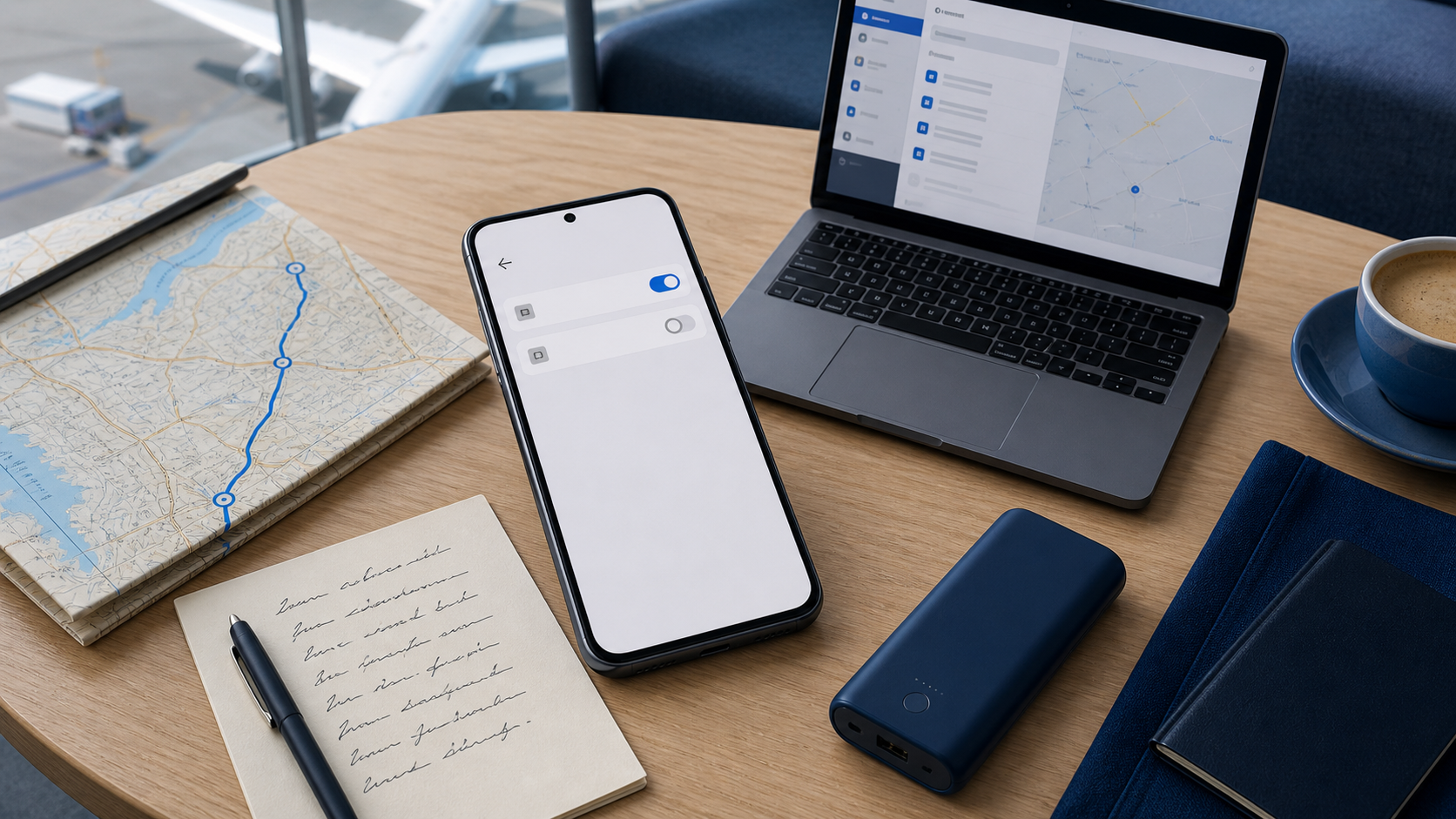
Editorial preparation illustration, not a real settings screen. Use your provider’s current instructions, keep a second screen available for setup, and save the first route offline.
After landing:
- Keep the home line enabled only if you need calls or SMS.
- Select the Kazakhstan eSIM for cellular data.
- Disable cellular-data switching to prevent the phone falling back to the home SIM.
- Enable data roaming only when the travel eSIM instructions require it.
- Turn airplane mode on and off once, then restart if the network does not appear.
- Test a map and a message before leaving the terminal.
Device and IMEI Verification in Kazakhstan
Do not invent a pre-registration task, but do not ignore an official operator warning about the device. Kazakhstan’s Ministry of Digital Development says the verification rules that took effect on March 24, 2025 apply only to new devices imported into Kazakhstan after that date. Its official explanation describes white, grey, and black lists. A grey-listed device receives 30 days of temporary access while lawful import is confirmed; operators send an SMS with a form link during that period.
The government’s January 2026 QazETA information page says the platform is operating in pilot mode and lists a border-crossing certificate for foreign citizens, including for mobile-device IMEI verification, among the services available at that stage.
For a normal short visit, wait for an operator or official-service instruction instead of creating a registration task yourself. If you receive an IMEI warning SMS, follow the official link or ask the local operator, not an unofficial reseller, to confirm the required process. Keep the identification requested by the operator and your border-crossing date or entry record available. No official guidance in the retained evidence says a travel eSIM exempts the physical phone from device rules.
Coverage: Cities Are Easier Than the Route Between Them
Coverage depends on the host network and exact route; a plan labeled “Kazakhstan” does not promise a continuous signal. Check the network named in the travel-eSIM offer, then inspect that operator’s current map. For example, Kcell’s official 5G page has a city selector, coverage map and an explicit out-of-coverage state. That map is a planning aid for Kcell 5G, not proof of service on every road or trail.
Before a remote trip:
- ask the driver or guide which local network works on the exact route;
- download offline maps and translation data;
- save accommodation and emergency contacts locally;
- share the route before departure;
- do not rely on mobile data as the only safety system.
For a city-to-city journey, see Almaty to Astana transport options. For mountain planning, use the Kazakhstan hiking guide and download the route before leaving the city.
Keep a No-Signal Arrival Backup
Assume that activation may fail and prepare the first journey without mobile data. Save the accommodation name and address in both English and Russian, take a screenshot of the booking, and download the airport-to-hotel area in an offline map. Write down the official taxi or pickup instruction supplied by the hotel.
Do not make terminal Wi-Fi the only copy of your arrival information. Keep the eSIM order number and support link offline. If the provider uses a QR code and displays it on the same phone being configured, open it on a second device or use the provider’s supported in-app or link-based installation method.
For a remote departure, add the driver’s contact, vehicle details, destination coordinates, and expected arrival time. Mobile service is a convenience layer, not a replacement for route planning.
Troubleshooting After Landing
When a connection fails after landing, start with the selected data line, roaming rule, APN and provider activation status. Work through those checks before deleting the profile or buying a second plan.
The eSIM shows “No Service”
Connect to Wi-Fi and check that the correct line is enabled, selected for cellular data, and allowed to roam if the provider requires it. Confirm the APN in the provider instructions. Try automatic network selection first; then test a listed host network manually.
Data works, but calls and SMS do not
Many travel eSIMs are data-only. Use internet calling or keep the home SIM active for SMS. If a local number is essential, buy a registered local product rather than assuming the travel plan includes one.
The plan runs out
Use the provider’s app or website on Wi-Fi. Some eSIMs support top-ups; others require a new package or profile. Check before deleting anything.
Nothing works and you need to leave the airport
If the terminal offers Wi-Fi, use it to retrieve the hotel address and arrange transport, or visit an official operator desk. Avoid handing an unlocked phone or passport to an unmarked reseller.
Security and Cost Controls
Protect the home line from accidental roaming charges and treat public Wi-Fi as an untrusted network. Disable cellular-data switching, confirm which line handles calls, and review the home carrier’s roaming settings before departure. An eSIM does not automatically stop the other SIM from receiving chargeable calls or using data.
Use a screen lock and the provider’s official app. Do not install a profile sent by an unknown person in a chat, and do not share a reusable QR code publicly. If support asks for diagnostics, redact passport, payment, and full activation credentials unless the verified provider channel explicitly requires them.
Public airport or café Wi-Fi can be useful for setup, but avoid sensitive account changes on a network you do not trust. Prefer encrypted apps and disconnect after activation. The safe sequence is stable Wi-Fi, official provider instructions, correct data-line selection, a simple connection test, and an offline fallback.
Practical Recommendation
For a short city trip, install a travel eSIM before departure; for a long stay or local number, compare registered local products after arrival. For remote travel, host-network coverage and offline preparation matter more than the marketplace brand.
Sources and freshness
- Kazakhstan Ministry of Digital Development: mobile-device verification for the March 24, 2025 scope, white/grey/black lists, 30-day grey-list period and operator SMS process.
- GOV.KZ: QazETA for foreign citizens for the January 2026 pilot status and border-crossing certificate for IMEI verification.
- Kcell: SIM-to-eSIM replacement for the supported-phone, Wi-Fi, registered-number and no-conversion-while-roaming conditions.
- Apple: travel eSIM and Apple: eSIM setup for iPhone carrier-lock and setup behavior.
- GSMA: eSIM overview for the embedded-profile definition.
Plan prices, host networks, fair-use limits, validity rules and refund terms remain volatile. They belong on the live comparison page and should be checked again at checkout.
Frequently Asked Questions
Does eSIM work in Kazakhstan?
Yes. International travel eSIMs sell Kazakhstan data access, and local operators such as Kcell support eSIM for eligible registered subscribers. Compatibility, host network, activation, and roaming rules depend on the exact plan and phone.
Should I buy an eSIM before travelling to Kazakhstan?
For immediate maps, messaging, and airport transport, installing a travel eSIM on Wi-Fi before departure is convenient. Check when the plan validity starts and activate mobile data only according to the provider's instructions.
Do I need to register my phone's IMEI in Kazakhstan?
Kazakhstan verifies newly imported mobile devices and may notify a user by SMS when action is required. Short-term visitors should follow an official operator or government instruction if one appears rather than assuming that every phone needs the same manual process.
Will a Kazakhstan eSIM work in the mountains or steppe?
No country plan can guarantee continuous service on every mountain or steppe route. Confirm the host network, inspect its current map for the exact journey, and download maps, addresses, and emergency information for offline use.
Is a local SIM cheaper than a travel eSIM?
Sometimes, but only current tariffs can answer. Compare the total data, validity, renewal terms, onboarding effort and support you need rather than relying on an old fixed-price table.
Last reviewed: August 22, 2026. Kazakhstan’s device-verification guidance, QazETA pilot information, Kcell workflow, Apple setup links and both editorial images were rechecked; provider prices and terms still require a live checkout review.
Google Preferred Sources
See more Kazakhstan stories in Google
Add About Kazakhstan as a preferred source to find more of our fresh, relevant stories in Google Search.
More Stories

travel
Atyrau, Kazakhstan: Things to Do & Saraishyq Guide
Plan a short Atyrau stay around the Zhayyk riverfront and Saraishyq, with honest sightseeing scope, live transport checks, hotels, weather, and local sources.

travel
Cities in Kazakhstan: 90 Cities and Major City Guide
Cities in Kazakhstan ranked by size and travel value: Almaty, Astana, Shymkent, Karaganda and more, with May 2026 stat.gov.kz population data.

travel
Karaganda, Kazakhstan: City Guide & Dolinka Planning
Plan a thoughtful Karaganda visit around the modern city, industrial history, live logistics and a separate respectful trip to the Karlag museum.

travel
Kostanay, Kazakhstan: City Guide & Naurzum Planning
Plan Kostanay around the Tobol, active local museums and live logistics, while treating Naurzum Nature Reserve as a separate confirmed journey.
Plan the Next Step
travel
Kazakhstan Tourist Attractions: Choose the Right First-Trip Route
Compare Kazakhstan tourist attractions by base and logistics: Almaty nature, Turkestan heritage, Mangystau, Astana, Baikonur, and more.
food
Beshbarmak Recipe: How Kazakh Et Is Served
A source-checked guide to Kazakh et, widely called beshbarmak: what is on the platter, a practical home recipe, regional differences, and guest etiquette.
culture
Women in Kazakhstan: Rights, Work and Daily Life in 2026
Source-checked guide to women in Kazakhstan: current legal rights, dated work and wage data, marriage statistics, safety, and respectful language.
travel
Things to Do in Kazakhstan: 13 Places Worth Your Time
Choose the best things to do in Kazakhstan by trip length: Almaty, Charyn, Kolsai, Astana, Turkestan, Tamgaly, Altyn-Emel, food, and Nauryz.
travel
12 Best Day Trips from Almaty: Complete Guide 2026
Best Almaty day trips — Charyn Canyon, Big Almaty Lake, Kolsai Lakes, Tamgaly petroglyphs, Altyn-Emel. Distances, costs, and how to get there.
travel
Shymkent Travel Guide: City Sights, Food & Day Trips
Plan a Shymkent visit with reliable city clusters, food choices, Turkestan and Sayram options, live transport checks, and heat-aware itineraries.

Travel Writer & Local Expert · Almaty, Kazakhstan
Tugelbay Konabayev is a Kazakhstan-based travel writer who has lived in Almaty for 7+ years and Astana for 4+ years. He grew up in Aktobe, Kazakhstan and has covered Kazakh travel, food, culture, and visa policy with first-hand reporting since 2023.