Kazakhstan Population 2026: Official Data & Regional Guide
Reported from the ground: Tugelbay Konabayev is a Kazakh native (born in Aktobe) who has lived 7 years in Almaty and 4 in Astana. About the author.
In this article9 sections
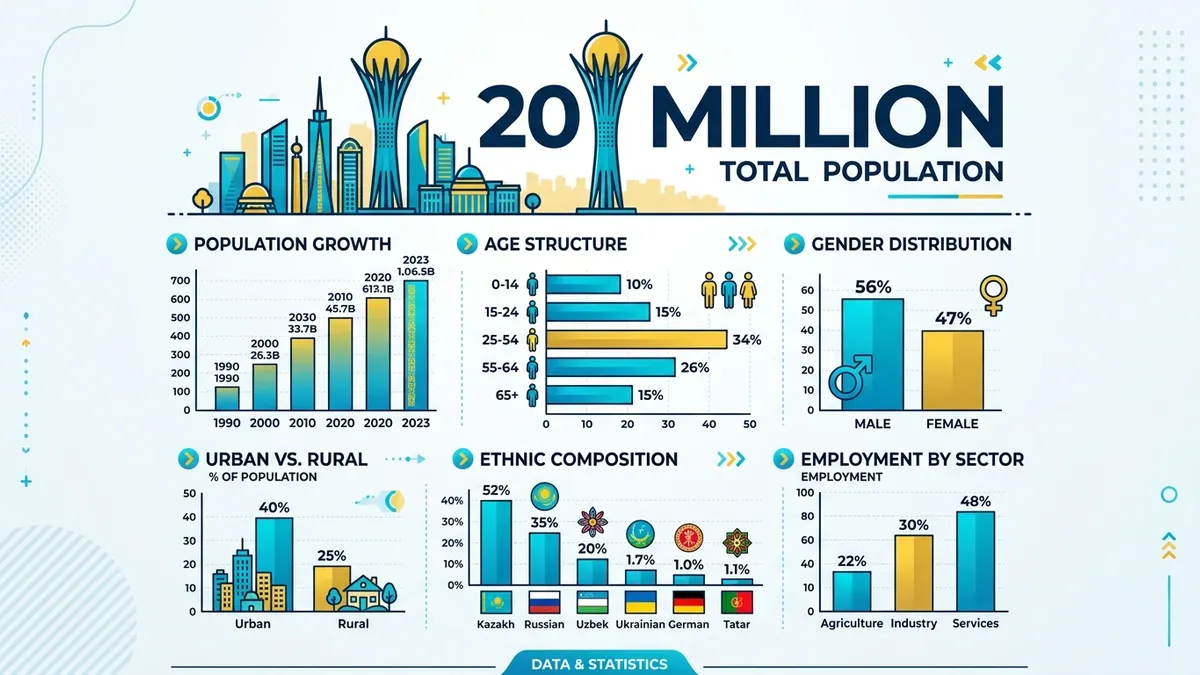
Kazakhstan had 20,590,589 residents on July 1, 2026. This guide preserves that dated snapshot from Kazakhstan’s Bureau of National Statistics regional dashboard.
Newer release: the 1 August 2026 city-population comparison uses a national total of 20,604,819 and updated counts for Almaty, Astana and Shymkent. It includes the exact BNS workbook, January–July growth, a chart and CSV/JSON downloads. The regional tables below retain their July reference date.
The date matters. Population totals, ethnic composition and census results are different datasets with different reference dates. This page keeps them separate so a current population number is not accidentally presented as a new census.
If your question is about identity, languages or everyday life rather than head counts, use our guide to the people of Kazakhstan. This page owns the narrower job: how many people live in Kazakhstan, where they live and what the official numbers measure.
Last verified: August 6, 2026.
Kazakhstan population at a glance
The July snapshot records 20,590,589 residents on July 1, 2026. The city figures in the same table share that reference date, while the ethnicity figures use a separate dated BNS release.
| Measure | Official figure | Reference date |
|---|---|---|
| Kazakhstan total | 20,590,589 | July 1, 2026 |
| Almaty city | 2,373,772 | July 1, 2026 |
| Astana city | 1,682,721 | July 1, 2026 |
| Shymkent city | 1,310,681 | July 1, 2026 |
| Kazakh ethnic population | 14,456,709 (71.3%) | January 1, 2025 |
| Russian ethnic population | 2,963,938 (14.6%) | January 1, 2025 |
| Uzbek ethnic population | 678,487 (3.3%) | January 1, 2025 |
The first four rows come from the live BNS regional dashboard. The ethnicity rows come from the BNS publication on population by selected ethnic groups and age groups at the beginning of 2025. They should not be combined into a fictional July 2026 ethnic breakdown.
What the July 2026 number measures
The BNS total is a current administrative estimate, not a head count conducted on July 1. BNS explains that current population estimates start with the latest census and then add registered births and permanent arrivals while subtracting deaths and permanent departures.
That distinction resolves three common contradictions:
- A census total describes the population counted through a census process.
- A current estimate updates that base with demographic records.
- A projection models a future population under assumptions about fertility, mortality and migration.
All three can be legitimate, but they cannot share one date label. A source that says “Kazakhstan population in 2026” without a reference day may be using a mid-year estimate, an annual forecast or an older number rounded to 20.6 million.
When quoting this snapshot, use 20,590,589 on July 1, 2026 and keep the date beside the number. The newer August total is linked above.
The method also explains why the latest number can change after a source has published an article or graphic. A January figure may have been correct on its reference date and still be out of date by July. That is not necessarily an error; it becomes an error only when the older number is described as the latest one without its date.
Official estimates are usually more useful than a rounded live “population counter” when the task is to cite a defensible figure. The dashboard states the geography and date, while a counter may interpolate between releases. For an essay, report or data comparison, preserve the exact BNS value. For ordinary travel context, “about 20.6 million” is reasonable as long as the source date remains nearby.
What changed since the beginning of 2025
The beginning-of-2025 population base in the ethnicity publication is 20,283,399. Compared with the July 1, 2026 dashboard total, the later figure is 307,190 higher, or roughly 1.5%. This is a calculation from two official dated totals, not a separately published BNS growth rate.
That difference should not be described as births alone. The current-estimate method incorporates births, deaths and migration, and the two figures are eighteen months apart. A formal demographic explanation requires the component tables for each period. The comparison here answers only a narrower question: how far apart are the two official snapshots used on this page?
The three largest city administrations
Almaty, Astana and Shymkent are the three city administrations above one million residents in the July dashboard. Together they account for 5,367,174 people in the same dated dataset, but that total does not represent every resident of their wider commuter areas.
Almaty: 2,373,772
Almaty remains the country’s largest city administration. Its population is larger than Astana’s by 691,051 in the same dated dataset. That comparison describes administrative scale; it does not by itself measure jobs, universities, services or the wider metropolitan area.
Population alone does not tell you which city suits a trip. Compare the two directly in Almaty vs Astana or use the Almaty city guide for practical planning.
Astana: 1,682,721
Astana is the second-largest city administration and the national capital. Its political role, planned districts and fast residential expansion make it different from Almaty’s older urban fabric. Our Astana guide covers the visitor-facing consequences of that difference.
Shymkent: 1,310,681
Shymkent is the third city above one million. It anchors the more densely populated south and works as a base for Turkestan and nearby cultural routes. See the Shymkent guide before treating it as a smaller version of Almaty; the climate, pace and regional connections are different.
Why city and region names cause confusion
Almaty and Astana are city administrations with their own entries. Almaty Region is a separate administrative unit, even though the names are closely connected. Shymkent is also separate from Turkestan Region. A comparison that adds one city’s number to a region, but does not do the same for another city, produces an inconsistent ranking.
Search results sometimes use “city population” for three different areas: the administrative city, the continuously built-up urban area or a broader metropolitan labour market. BNS dashboard entries answer the first question. They should not be relabelled as metro populations unless a separate source defines the metro boundary and publishes a compatible estimate.
Population by region on July 1, 2026
Turkestan is the largest region by population in the July 2026 dashboard, while Ulytau is the smallest. The table lists current totals for all 17 regions; the three city administrations are shown separately above.
| Region | Population |
|---|---|
| Turkestan | 2,145,680 |
| Almaty Region | 1,612,393 |
| Zhambyl | 1,212,698 |
| Karaganda | 1,130,377 |
| Aktobe | 958,183 |
| Kyzylorda | 845,972 |
| Mangystau | 824,887 |
| Kostanay | 819,617 |
| Akmola | 793,020 |
| Pavlodar | 743,233 |
| Atyrau | 718,526 |
| East Kazakhstan | 716,459 |
| West Kazakhstan | 694,644 |
| Zhetisu | 684,834 |
| Abai | 592,895 |
| North Kazakhstan | 511,982 |
| Ulytau | 218,015 |
These are administrative populations, not rankings of continuous built-up areas. Almaty city and Almaty Region, for example, are separate entries. Adding them together may be useful for a metropolitan or regional question, but it does not create an official “Almaty metro population.”
The table also shows why a single national density figure can mislead. Kazakhstan covers 2,724,900 square kilometres, yet people are not spread evenly across that land. The three largest cities and the populous south hold far more people than Ulytau or the northern and central steppe. Read where Kazakhstan is for the physical geography behind that pattern.
Regional totals are useful for public-service planning, market sizing and broad comparisons, but they do not reveal how people are distributed within each region. A large regional population may be concentrated in one city and a chain of settlements, while much of the territory remains sparsely inhabited. The table therefore supports administrative comparisons, not claims that every part of Turkestan or Almaty Region is densely settled.
The same caution applies to a national average. Dividing 20,590,589 residents by the official country area gives roughly 7.6 people per square kilometre. That derived average is helpful for global context, but it does not describe a neighbourhood in Almaty, a village in the south or an expanse of central steppe. Local density requires a local boundary and a matching local population figure.
Ethnic composition: use the correct date
The latest ethnicity release used here is dated January 1, 2025, not July 2026. BNS published these beginning-of-year estimates on March 27, 2025:
- Kazakhs: 14,456,709, or 71.3%
- Russians: 2,963,938, or 14.6%
- Uzbeks: 678,487, or 3.3%
These are estimates based on the census and subsequent demographic records. They are not the result of a new 2025 or 2026 census.
This wording matters because two different statements often get collapsed online:
- “71.3% of the beginning-2025 population estimate was Kazakh” is a dated statistical claim.
- “Kazakhstan is 71.3% Kazakh in July 2026” silently moves the percentage to a date the source does not cover.
The second sentence may look harmless, but it changes the evidence. When the exact date is important, link the BNS table and state “at the beginning of 2025.”
Ethnicity also does not determine language use, religion or political outlook. For those subjects, continue to languages spoken in Kazakhstan, religion in Kazakhstan and Kazakhstan culture.
The published counts cover more groups than the three largest figures reproduced here. Listing only Kazakhs, Russians and Uzbeks is a concise summary, not a claim that Kazakhstan has only three ethnic communities. Anyone using the data for academic, policy or community work should open the BNS release and retain its classifications rather than reconstructing a complete table from a short web summary.
Percentages also need a denominator. The stated shares use the beginning-of-2025 national population base in that BNS publication. Recalculating them against the July 2026 total would mix dates and subtly lower each share. A sound chart keeps the counts, percentages and denominator from the same release.
Urban and rural residents: another dated snapshot
At the beginning of 2025, BNS classified 12,773,115 residents as urban and 7,510,284 as rural. The same publication reports the corresponding shares below:
| Residence | People | Share of the beginning-2025 total |
|---|---|---|
| Urban | 12,773,115 | about 63.0% |
| Rural | 7,510,284 | about 37.0% |
It also lists 9,910,837 men and 10,372,562 women. The urban and rural figures sum to the beginning-of-2025 population base, and the male and female figures independently sum to that same base. Neither pair uses the July 2026 dashboard total.
This is the cleanest way to discuss urbanisation without manufacturing a mixed-date percentage: name the dataset first, then give its numbers. The large urban share helps explain the pull of Almaty, Astana and Shymkent, while the rural total remains substantial enough that village and regional life cannot be treated as a footnote.
“Urban” and “rural” are statistical residence categories, not descriptions of a person’s occupation, lifestyle or cultural identity. A resident of a small town can be counted as urban, while someone living near a major agricultural centre may be counted as rural under the administrative classification. The totals are valuable for describing settlement, but they do not by themselves measure access to services, income or mobility.
The sex totals in the same release show 461,725 more women than men at the beginning of 2025. As with the other derived comparisons on this page, that difference is arithmetic based on official inputs. Explaining why the gap exists would require age-specific mortality, migration and population tables rather than a guess based on the headline total.
How to fact-check a Kazakhstan population claim
Check the date, measure and geography before deciding that two population figures conflict. Use this four-step process:
- Find the reference date. “2026” is not precise enough. Look for January 1, July 1 or a census year.
- Identify the measure. Is it a census, a current estimate or a projection?
- Check the geography. City, region and metropolitan area are not interchangeable.
- Keep derived numbers labelled. A density or percentage calculated from official inputs is still a calculation, not a separately published BNS figure.
The BNS regional statistics dashboard is the best starting point for the latest national and regional total. For annual demographic tables, use the BNS demography publications and record their exact reference dates.
A worked example
Suppose one page says Kazakhstan has 20.3 million people and another says 20.59 million. First, inspect the dates: the smaller figure may describe the beginning of 2025, while the larger one describes July 1, 2026. Next, check whether either figure is a projection. Finally, verify that both refer to the country rather than citizens, permanent residents abroad or a regional subtotal.
If the two sources still claim the same reference date and measure, prefer the latest BNS release and look for a correction or revision note. Do not average the numbers. An average of incompatible figures has no official meaning and hides the exact disagreement that needs resolving.
For reproducible work, save four fields beside every value: publisher, publication title or dashboard, reference date and access date. Those fields make it possible for another reader to find the same table even after the dashboard advances to a newer month.
Sources and verification notes
Every changing figure on this page is attached to an official source and reference date. The three sources below serve different roles rather than being blended into one undated estimate.
- Bureau of National Statistics regional dashboard for the national, city and regional totals dated July 1, 2026.
- BNS population by selected ethnic groups and age groups for the beginning-of-2025 ethnicity, urban/rural and sex figures, plus the bureau’s explanation of current population estimates.
- Official Kazakhstan country profile for the national land area used only as geographic context.
The page was checked against the live BNS dashboard on August 6, 2026. Changing figures remain labelled with their source date instead of being presented as timeless facts.
Frequently asked questions
Frequently Asked Questions
What was the population of Kazakhstan on July 1, 2026?
Kazakhstan had 20,590,589 residents on July 1, 2026, according to the Bureau of National Statistics regional dashboard. Keep the reference date with the number because BNS updates current estimates during the year.
What is the largest city in Kazakhstan?
Almaty is the largest city administration, with 2,373,772 residents on July 1, 2026. Astana had 1,682,721 and Shymkent had 1,310,681 in the same BNS dataset.
What percentage of Kazakhstan is ethnically Kazakh?
The BNS beginning-of-2025 estimate counted 14,456,709 Kazakhs, or 71.3% of that dated population base. This is not a July 2026 census percentage.
Is Kazakhstan densely populated?
No. Kazakhstan has a large land area and a population of about 20.6 million, but settlement is highly uneven. Almaty, Astana, Shymkent and the south are much more populous than large parts of the central and northern steppe.
Why do population websites show different totals?
They may use different dates or measures. Kazakhstan's BNS publishes current administrative estimates, while other sites may show a January total, a UN mid-year estimate or a projection. Compare the date and method before comparing the number.
Google Preferred Sources
See more Kazakhstan stories in Google
Add About Kazakhstan as a preferred source to find more of our fresh, relevant stories in Google Search.
More Stories
facts
Kazakhstan by the Numbers 2026: 50+ Statistics & Facts
Kazakhstan by the Numbers 2026: 50+ sourced statistics on population, economy, tourism, visas, cities, costs, and culture with a CSV.
facts
Kazakhstan City Population 2026: Almaty, Astana & Shymkent
Compare Almaty, Astana and Shymkent populations on 1 August 2026, January–July growth and national shares. Official BNS figures, chart, CSV and JSON.
facts
Kazakhstan Public Holidays 2026–2027: Dates & CSV
Kazakhstan holiday dates under current law, including Constitution Day on 15 March. Download the CSV; compare archived calendars and preliminary 2027 dates.
facts
Kazakhstan Time Now: UTC+5 Time Zone & Date Converter
Check the current time in Kazakhstan and convert an Almaty or Astana date to London, New York, Dubai and more. UTC+5 nationwide, with no seasonal clock change.
Plan the Next Step
travel
Kazakhstan Tourist Attractions: Choose the Right First-Trip Route
Compare Kazakhstan tourist attractions by base and logistics: Almaty nature, Turkestan heritage, Mangystau, Astana, Baikonur, and more.
food
Beshbarmak Recipe: How Kazakh Et Is Served
A source-checked guide to Kazakh et, widely called beshbarmak: what is on the platter, a practical home recipe, regional differences, and guest etiquette.
culture
Women in Kazakhstan: Rights, Work and Daily Life in 2026
Source-checked guide to women in Kazakhstan: current legal rights, dated work and wage data, marriage statistics, safety, and respectful language.
facts
Kazakhstan Economy in 2026: GDP, Trade, Oil and Growth
Kazakhstan's economy in 2026: 2025 GDP, sector shares, oil and uranium exports, trade partners, inflation, agriculture and the IMF outlook.
facts
Silk Road Kazakhstan: Cities, Routes & Sites
Explore Kazakhstan Silk Road sites: Turkistan, Otyrar, Sauran, Taraz, UNESCO distinctions, route planning, and responsible visits.
food
Popular Food in Kazakhstan: 15 Foods and Drinks to Try
Popular food in Kazakhstan explained: 15 Kazakh dishes and drinks, what each contains, how meals are served, and what to ask before ordering.

Travel Writer & Local Expert · Almaty, Kazakhstan
Tugelbay Konabayev is a Kazakhstan-based travel writer who has lived in Almaty for 7+ years and Astana for 4+ years. He grew up in Aktobe, Kazakhstan and has covered Kazakh travel, food, culture, and visa policy with first-hand reporting since 2023.