Is Kazakhstan in Europe or Asia? The Accurate Answer
Reported from the ground: Tugelbay Konabayev is a Kazakh native (born in Aktobe) who has lived 7 years in Almaty and 4 in Astana. About the author.
In this article11 sections
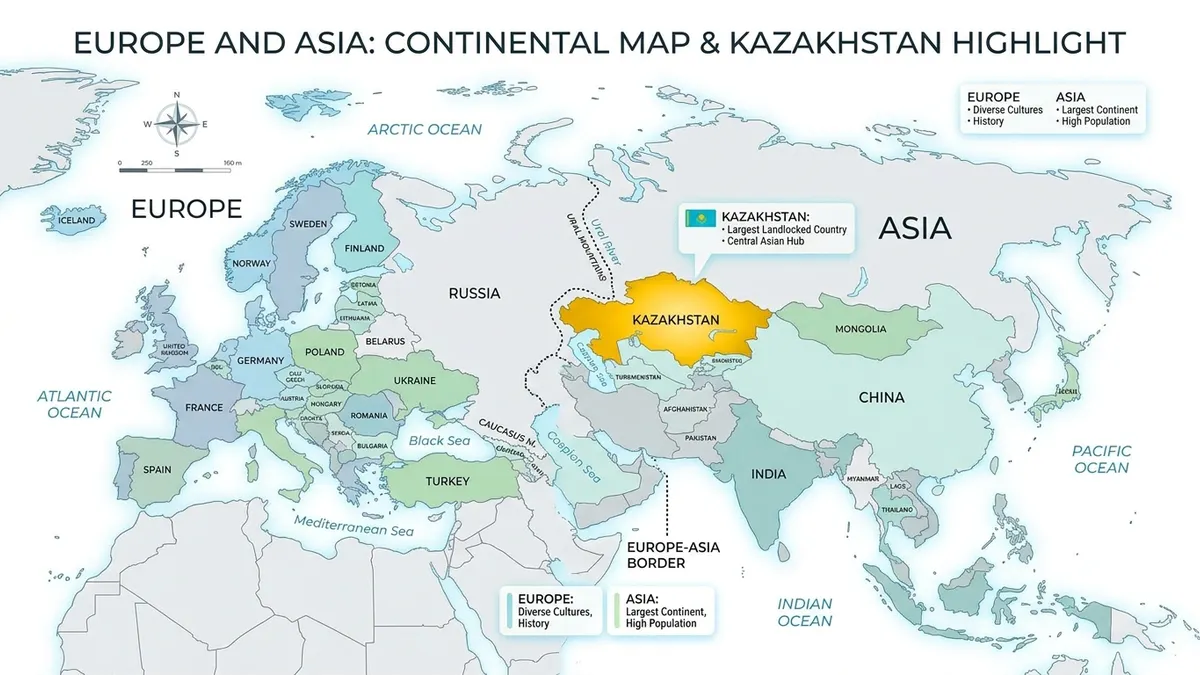
Kazakhstan is normally classified as a Central Asian country. The United Nations M49 statistical standard places Kazakhstan in Asia, within the subregion Central Asia. A small part of western Kazakhstan can be described as European only when a particular physical boundary, usually the Ural River, is used to divide Europe from Asia.
That produces the accurate short answer:
- Standard regional classification: Central Asia
- UN statistical region: Asia
- Possible geographic exception: land west of the Ural River under one common continent-boundary convention
- European Union member: no
- UEFA member: yes, since 2002
Why the Answer Is Not Simply “Both”
“Both” requires a named physical boundary. Europe and Asia form one continuous landmass. Their dividing line is a human geographic convention, not an ocean boundary. Different maps have used the Ural Mountains, Ural River, Emba River, Caspian coast or other lines.
If the Ural River convention is used, part of western Kazakhstan lies on the European side. That is why Atyrau is often described as a transcontinental city. It does not mean that the whole Atyrau Region is European, and there is no single official percentage that every geographic authority accepts. The practical Atyrau city guide applies that distinction to the riverfront and bridge walk without presenting the convention as a settled international border.
For country-level comparison and statistics, the more useful answer is the UN classification: Kazakhstan is in Central Asia.
The distinction matters because the word “continent” is used for several different tasks. A classroom map may show a physical boundary. A database needs one region for every country. A sports federation chooses members according to its own statutes. A political organization has a formal membership list. Those systems can produce different labels without any of them moving Kazakhstan on the map.
Kazakhstan’s Official Geographic Context
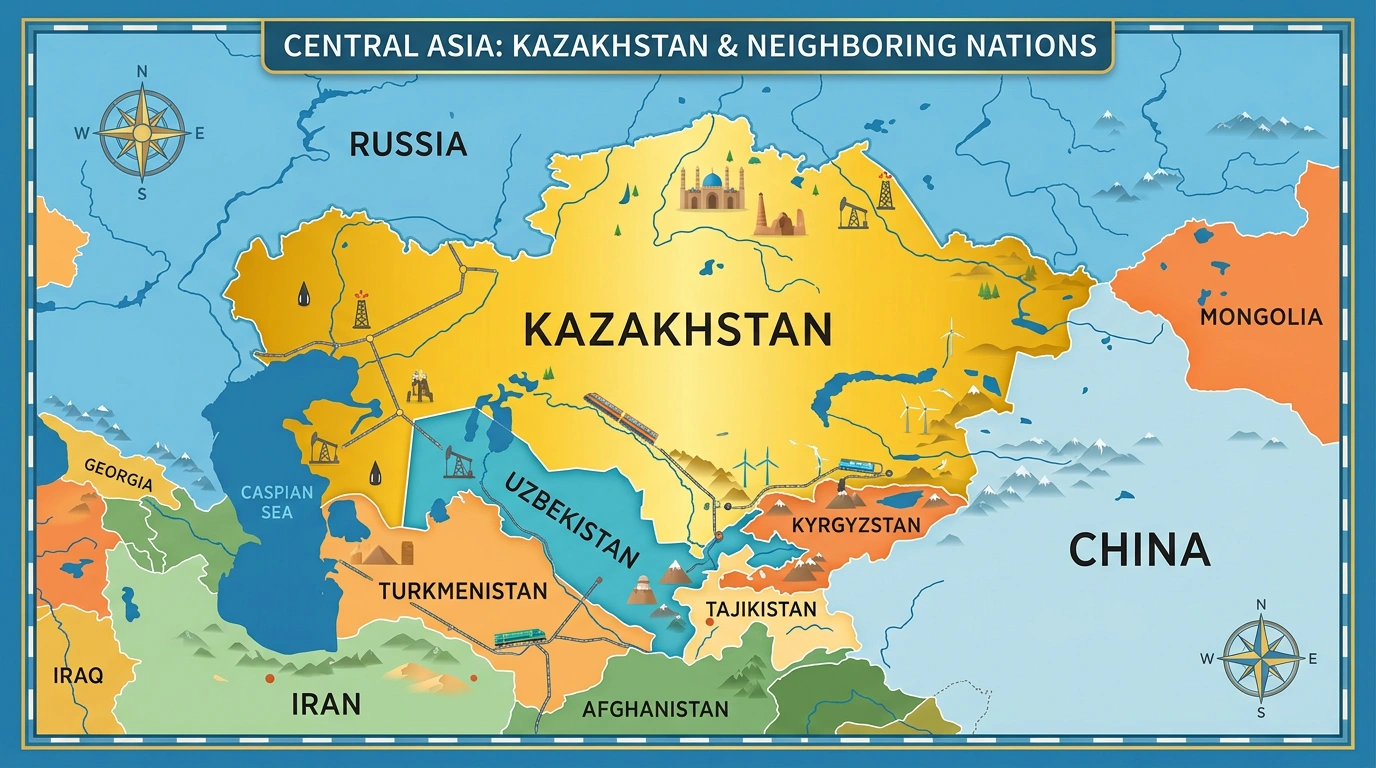
Kazakhstan has five land neighbors. Its official country profile describes a vast state at the center of the Eurasian landmass. The Government of Kazakhstan reports a total area of 2,724,900 km². Kazakhstan borders five countries: Russia, China, Kyrgyzstan, Uzbekistan and Turkmenistan. It also has a coast on the Caspian Sea but no access to the open ocean.
All of Kazakhstan’s largest cities, including Almaty, Astana and Shymkent, are east of the usual Ural River boundary and are unambiguously in Asia. For the country’s exact location, borders and major geographic regions, see Where Is Kazakhstan?.
| Question | Answer |
|---|---|
| Which continent is Kazakhstan in? | Asia under the UN M49 classification |
| Which Asian subregion? | Central Asia |
| Is any land sometimes counted as Europe? | Yes, a small western area under the Ural River convention |
| Is Kazakhstan in the EU? | No |
| Does Kazakhstan border Russia? | Yes, along its north and west |
Kazakhstan stretches roughly 3,000 km from west to east and includes steppe, desert, mountains and the Caspian coast. That scale is one reason a single continent label can feel incomplete. It is still not a reason to replace the standard regional label with an unsupported territory percentage.
The same official profile reports roughly 13,200 km of land borders. The longest is with Russia; the others connect Kazakhstan to China and its Central Asian neighbors. None of those administrative borders follows a simple Europe-Asia dividing line through the whole country.
Kazakhstan’s internal administration also cannot be used to calculate a continental share. The country has 17 regions and 3 cities of republican significance, but the Ural River does not follow those boundaries. Counting a whole western region as European would therefore include land on both sides of the convention.
This is the practical evidence hierarchy:
- use the official 2,724,900 km² figure for total country area;
- use UN M49 for the country’s regional classification;
- use a named geographic boundary dataset for any west-of-river calculation;
- do not infer an official percentage from a regional map.
That approach answers the main question without manufacturing precision. It also remains stable if an atlas prefers a different Caspian or Caucasus segment of the continental boundary.
What the Ural River Convention Means in Practice
The Ural River convention places land west of the river in Europe. The river enters Kazakhstan from Russia, passes through Oral and Atyrau, and reaches the Caspian Sea. The boundary therefore cuts through a small western part of the country rather than following an administrative regional border.
This is why statements such as “Atyrau Region is in Europe” are too broad. The region extends on both sides of the river. The city of Atyrau itself has districts on both banks, which makes “transcontinental city” a useful shorthand under this convention. It does not create an official European zone with a separate visa regime, currency or government.
Other boundary proposals use the Emba River or different lines around the Caspian and Caucasus. A percentage calculated under one proposal cannot be presented as universal. This page therefore avoids the frequently repeated “5% in Europe” figure unless a source supplies a reproducible boundary dataset and method.
How Kazakhstan Compares with Other Transcontinental States
Transcontinental comparisons require context. Kazakhstan’s boundary question resembles Russia and Turkey only at the level of physical geography. The political and demographic balance is different in each case.
| Country | Why it is called transcontinental | Standard practical label |
|---|---|---|
| Kazakhstan | A western area can fall west of the Ural River | Central Asia |
| Russia | Territory extends across the Ural Mountains | Europe and Northern Asia, depending on context |
| Turkey | Territory lies on both sides of the Bosporus | Western Asia, with a European part |
| Georgia and Azerbaijan | Caucasus boundary conventions vary | Caucasus / Western Asia in many datasets |
The comparison shows why a yes-or-no answer should name the system. “Where is Kazakhstan classified?” and “Does any land fall west of a chosen boundary?” are different questions.
Why Kazakhstan Competes in European Football
Kazakhstan joined UEFA in 2002. Football membership is an institutional choice, not proof of continental geography. Kazakhstan previously competed in the Asian Football Confederation and became a UEFA member in 2002, a date recorded in UEFA’s official history. Its national team and clubs therefore play in UEFA competitions.
The same distinction applies elsewhere: membership in a European sports or political institution does not redraw a physical continent boundary.
Kazakhstan’s clubs can therefore appear in UEFA Champions League, Europa League or Conference League qualifying rounds while the country remains in the UN Central Asia region. This is not a contradiction. UEFA is an association, not a geographic standards body.
Is Kazakhstan European Culturally or Politically?
“Eurasian” is useful culturally, not as an EU label. Kazakhstan is a sovereign Central Asian state with Kazakh as the state language and a history shaped by the Eurasian steppe, Turkic cultures, the Russian Empire and the Soviet Union. Russian is also widely used, and Soviet urban history creates visible connections with Eastern Europe and Russia.
“Eurasian” is often a useful cultural or geopolitical description because the country has strong relationships in several directions. It should not replace the standard geographic classification when someone asks which region to use on a map, dataset or travel form: choose Asia / Central Asia.
Kazakhstan participates in institutions that point in different directions. It is a member of the Organization for Security and Co-operation in Europe, maintains extensive trade with the European Union, and also belongs to regional organizations centered in Eurasia and Asia. Institutional participation describes diplomacy; it is not a continent test.
For cultural context, read the separate guides to the Kazakh steppe, Kazakh language and history of Kazakhstan. Those subjects explain the country better than forcing every custom into a Europe-versus-Asia binary.
Common Claims That Need Qualification
Narrow facts should not define the whole country. These are the corrections worth remembering:
- “Kazakhstan is European because it is in UEFA.” UEFA membership is a sports affiliation established in 2002.
- “Exactly 5% of Kazakhstan is European.” The result depends on the boundary line and measurement method; no universal percentage should be assumed.
- “All of Atyrau Region is in Europe.” A Ural River boundary divides territory within western Kazakhstan rather than following the region’s border.
- “Kazakhstan is in the EU.” It is neither an EU member nor a candidate.
- “Kazakhstan is part of Russia.” Kazakhstan has been an independent sovereign state since 1991 and shares a border with Russia.
- “Central Asia means the Middle East.” Central Asia and Western Asia are separate UN M49 subregions.
These corrections preserve the interesting transcontinental detail without erasing Kazakhstan’s standard identity as a Central Asian country.
Which Answer to Use in Different Contexts
The right answer depends on what the question is measuring. A regional database, a physical-geography discussion and a football tournament do not use the word Europe in the same way.
Use Central Asia for a country profile, school assignment, market report or regional comparison. This matches UN M49 and keeps Kazakhstan alongside Kyrgyzstan, Tajikistan, Turkmenistan and Uzbekistan. M49 identifies Central Asia with code 143 and Kazakhstan with country code 398.
Use transcontinental under the Ural River convention when the question is specifically about the physical Europe-Asia line. Name the convention so the reader understands why part of western Kazakhstan is being discussed differently from the country as a whole.
Use UEFA member for football. Do not shorten that to “European country,” because the federation’s membership list is the evidence and the intended meaning.
Use not an EU member for customs, regulation, roaming, political membership or travel questions. European Union, Europe and UEFA are three different categories.
| Context | Best answer | Why |
|---|---|---|
| UN or international dataset | Asia / Central Asia | standard M49 grouping |
| Physical boundary discussion | partly transcontinental under a named convention | the Ural line crosses western Kazakhstan |
| Football | UEFA member since 2002 | federation membership |
| EU policy or roaming | non-EU country | Kazakhstan is outside the Union |
| Travel region | Central Asia | clearest destination grouping |
Why Central Asia Is the Strongest Default
Central Asia answers geography without denying Kazakhstan’s Eurasian links. It identifies a coherent region of five independent states with connected steppe, mountain, desert, Silk Road and Soviet histories. It is also specific enough to be useful to travelers and researchers.
Calling Kazakhstan simply “Asian” is correct under UN M49 but broad. Asia also contains East Asia, South-eastern Asia, Southern Asia and Western Asia. Central Asia narrows the answer while avoiding an invented claim that every square kilometer must fall on one side of every possible physical boundary.
The label also keeps the distinction between country classification and land classification. A country can be assigned to one statistical region even when a boundary convention crosses its territory. Statistical systems do this because rows need stable groupings; they are not declaring a cultural essence or legal status.
For a visitor, Central Asia is the useful planning region. Routes, climate, languages, overland distances and neighboring-country combinations make more sense in that frame than under a generic Europe category. The guide to where Central Asia is explains the regional map and the five-country definition.
What Travelers Should Select on Forms
For forms, select Asia or Central Asia. Do not select the European Union: Kazakhstan is not an EU member or candidate country. If a form offers only continent-level options, choose Asia. If it offers subregions, choose Central Asia.
The continent question does not change Kazakhstan’s entry rules. Check the current Kazakhstan visa guide and official government guidance for your passport before travel.
Source Method and Limits
This answer uses three separate evidence layers. UN M49 supplies the standard statistical classification. Kazakhstan’s government supplies area and border facts. UEFA supplies its own membership history. The physical Europe-Asia line remains a geographic convention, so the page describes the Ural River version without publishing a false universal percentage.
The page does not use sports, trade volume, religion, architecture or personal impressions as a substitute for geography. Those can explain why Kazakhstan feels connected to several regions, but they cannot answer a statistical classification question.
Frequently Asked Questions
Is Kazakhstan in Europe or Asia?
Kazakhstan is classified in Asia, specifically Central Asia, by the UN M49 standard. Under the common Ural River boundary, a small part of western Kazakhstan can be described as geographically European.
Is Kazakhstan a transcontinental country?
It can be called transcontinental when the Ural River is used as the Europe-Asia boundary. Because continent boundaries are conventional, Central Asian country is the clearer standard classification.
Why does Kazakhstan play in UEFA?
Kazakhstan became a UEFA member in 2002. Sports-federation membership is an institutional decision and does not change the UN classification of Kazakhstan as Central Asian.
Is Kazakhstan in the European Union?
No. Kazakhstan is not an EU member or candidate country. It is a sovereign Central Asian state.
Which continent should I choose for Kazakhstan on a form?
Choose Asia or Central Asia. Use Europe only when a question specifically asks about the small area west of a stated Europe-Asia boundary.
Last verified: July 14, 2026
Google Preferred Sources
See more Kazakhstan stories in Google
Add About Kazakhstan as a preferred source to find more of our fresh, relevant stories in Google Search.
More Stories
facts
Where Is Kazakhstan? Map, Borders, Size & Central Asia Location
Where is Kazakhstan? Map, Central Asia location, borders with Russia and China, 2.7 million km2 size, nearby countries, capitals, and regions.

facts
Astana Hub: 0% Tax for IT Companies in Kazakhstan (2026)
Astana Hub: 0% corporate tax, 0% VAT for IT companies until 2029. Registration, requirements, 1,700+ members, comparison with Dubai and Estonia.
facts
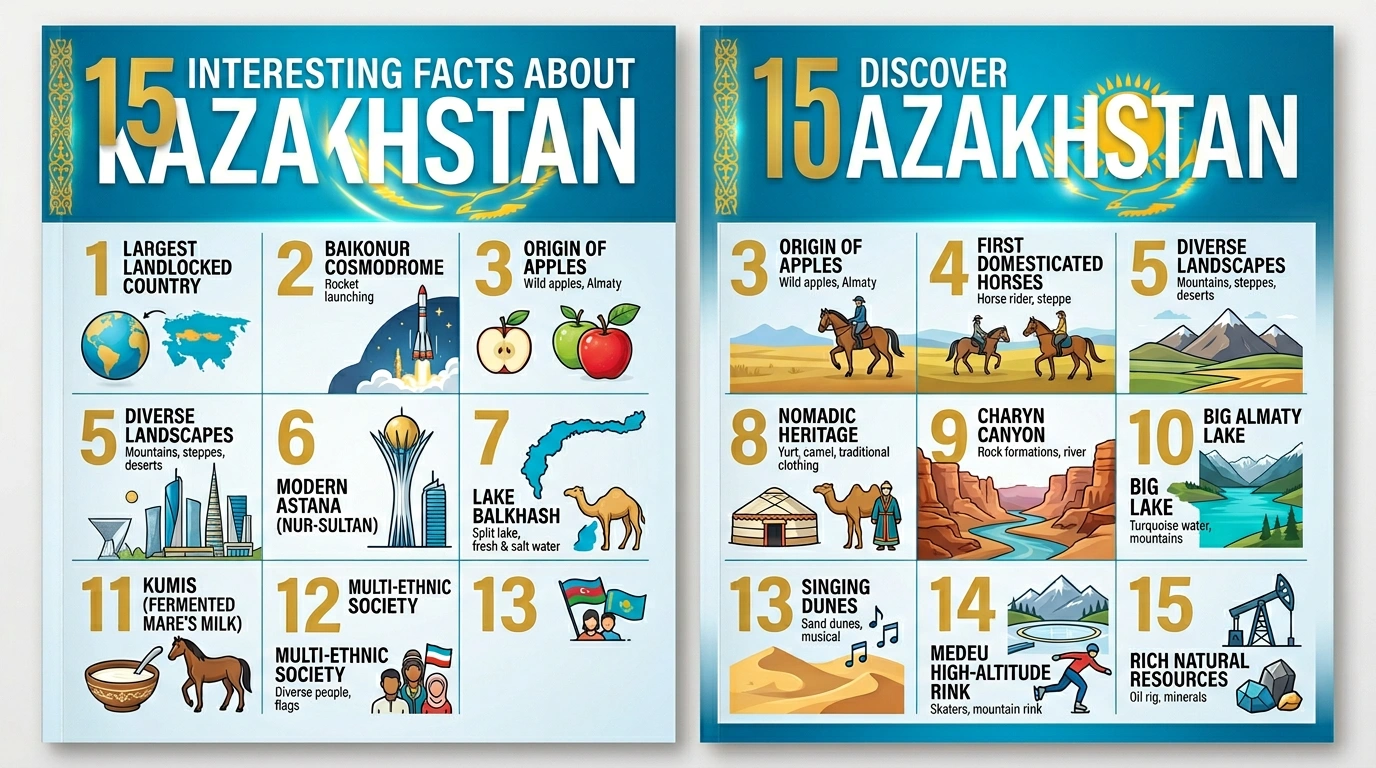
10 Interesting Facts About Kazakhstan (2026)
Ten sourced facts about Kazakhstan for 2026: vast scale, Baikonur, wild apples, saiga, uranium, UNESCO heritage, population and a new Constitution.
facts
Kazakhstan by the Numbers 2026: 50+ Statistics & Facts
Kazakhstan by the Numbers 2026: 50+ sourced statistics on population, economy, tourism, visas, cities, costs, and culture with a CSV.
Plan the Next Step
travel
Kazakhstan Tourist Attractions: Choose the Right First-Trip Route
Compare Kazakhstan tourist attractions by base and logistics: Almaty nature, Turkestan heritage, Mangystau, Astana, Baikonur, and more.
food
Beshbarmak Recipe: How Kazakh Et Is Served
A source-checked guide to Kazakh et, widely called beshbarmak: what is on the platter, a practical home recipe, regional differences, and guest etiquette.
culture
Women in Kazakhstan: Rights, Work and Daily Life in 2026
Source-checked guide to women in Kazakhstan: current legal rights, dated work and wage data, marriage statistics, safety, and respectful language.
facts
Kazakhstan Economy in 2026: GDP, Trade, Oil and Growth
Kazakhstan's economy in 2026: 2025 GDP, sector shares, oil and uranium exports, trade partners, inflation, agriculture and the IMF outlook.
facts
Silk Road Kazakhstan: Cities, Routes & Sites
Explore Kazakhstan Silk Road sites: Turkistan, Otyrar, Sauran, Taraz, UNESCO distinctions, route planning, and responsible visits.
food
Popular Food in Kazakhstan: 15 Foods and Drinks to Try
Popular food in Kazakhstan explained: 15 Kazakh dishes and drinks, what each contains, how meals are served, and what to ask before ordering.

Travel Writer & Local Expert · Almaty, Kazakhstan
Tugelbay Konabayev is a Kazakhstan-based travel writer who has lived in Almaty for 7+ years and Astana for 4+ years. He grew up in Aktobe, Kazakhstan and has covered Kazakh travel, food, culture, and visa policy with first-hand reporting since 2023.