Kazakhstan Economy in 2026: GDP, Trade, Oil and Growth
Reported from the ground: Tugelbay Konabayev is a Kazakh native (born in Aktobe) who has lived 7 years in Almaty and 4 in Astana. About the author.

In this article10 sections
Kazakhstan’s economy produced 159.6 trillion tenge, or about $306.0 billion, in 2025 according to preliminary official data. Real GDP grew 6.5%, and GDP per person reached $15,005. Kazakhstan remained Central Asia’s largest economy by nominal GDP, but its output and its exports tell different stories: services generated 57.6% of GDP, while crude oil and related raw petroleum products made up 50.5% of merchandise exports.
That distinction is the key to reading the country. Kazakhstan is not an economy in which oil literally produces half of GDP. It is an economy with a broad domestic service base and an export account still anchored to oil, uranium and metals. Fast growth in 2025 did not remove that dependence, and 10.2% annual inflation in July 2026 made the expansion less comfortable than the headline GDP number suggests.
Kazakhstan economy at a glance
The table uses the latest complete official year for GDP and trade, plus the latest available inflation reading. Periods are not mixed silently: 2025 GDP is preliminary, 2025 trade is full-year merchandise trade, and inflation is a July 2026 year-on-year rate.
| Indicator | Latest figure | Reference period | Source |
|---|---|---|---|
| Nominal GDP | 159.584 trillion tenge / $305.956 billion | 2025, preliminary | BNS |
| Real GDP growth | 6.5% | 2025, preliminary | BNS |
| GDP per capita | $15,005 | 2025, preliminary | BNS |
| Services share of GDP | 57.6% | 2025 | BNS |
| Industry share of GDP | 26.6% | 2025 | BNS |
| Mining and quarrying share | 11.9% | 2025 | BNS |
| Agriculture, forestry and fishing share | 3.8% | 2025 | BNS |
| Merchandise trade | $143.888 billion | 2025 | BNS |
| Merchandise exports | $79.041 billion | 2025 | BNS |
| Annual inflation | 10.2% | July 2026 | BNS |
The Bureau of National Statistics GDP release was published on April 22, 2026 and labels the annual figures preliminary. That label matters. Later national-account revisions may change the exact tenge total, growth rate or sector shares.
The dollar figure is also not interchangeable with purchasing-power-parity GDP. BNS converted the 2025 nominal total using the National Bank’s average exchange rate. Exchange-rate movements can therefore change dollar GDP even when real production moves differently.
What actually makes up Kazakhstan’s GDP?
Services are the largest part of measured output, not mining. BNS divided 2025 GDP into 57.6% services, 36.6% goods production and 5.8% net product taxes.
Within services, wholesale and retail trade plus vehicle repair was the largest named activity at 19.9% of GDP. Real estate accounted for 9.2%, transport and storage 6.1%, finance and insurance 3.6%, and information and communications 2.3%.
Within goods production, industry accounted for 26.6% of GDP. Manufacturing was 13.0%, slightly larger than mining and quarrying at 11.9%. Construction contributed 6.2%, while agriculture, forestry and fishing contributed 3.8%.
| Selected activity | Share of 2025 GDP | Real change from 2024 |
|---|---|---|
| Wholesale and retail trade; vehicle repair | 19.9% | +9.0% |
| Manufacturing | 13.0% | +6.7% |
| Mining and quarrying | 11.9% | +9.3% |
| Real estate activities | 9.2% | +0.4% |
| Construction | 6.2% | +15.9% |
| Transport and storage | 6.1% | +20.2% |
| Agriculture, forestry and fishing | 3.8% | +5.8% |
| Finance and insurance | 3.6% | +3.0% |
These figures correct a common shortcut. Calling Kazakhstan a resource economy is useful when discussing exports, fiscal exposure and investment. Calling its entire GDP “oil-based” erases the much larger service economy in which most daily commercial activity occurs.
Why oil and uranium still shape the external economy
Oil matters most at the border. In the full-year 2025 merchandise-trade release, crude oil and raw petroleum products represented 50.5% of exports. Radioactive chemical elements and isotopes represented 5.3%, refined copper and unwrought copper alloys 5.2%, copper ores and concentrates 3.6%, and ferroalloys 2.6%.
That concentration creates a channel from commodity markets into export earnings, the exchange rate and public finances. The article does not convert an export share into a GDP share or a government-revenue share: those are different denominators and require different data.
Uranium is the other exceptional mineral story. Kazatomprom’s 6M 2025 operating review, citing UxC, says all production in Kazakhstan represented about 39% of global uranium production volume in 2024. Kazatomprom’s attributable production was about 21% of global primary supply that year. The national total and company-attributable total should not be merged.
Mining also includes copper, ferroalloys, zinc, gold, coal and other materials, but this page avoids a parade of global rankings. Production rank, reserves, export value and contribution to GDP are separate measures. A country can rank highly in one without holding the same position in the others.
Trade: what Kazakhstan sells and who buys it
Kazakhstan’s merchandise trade reached $143.888 billion in 2025, up 1.3% in nominal terms from 2024. Exports fell 3.2% to $79.041 billion, while imports rose 7.4% to $64.847 billion. The resulting merchandise surplus was about $14.194 billion.
The partner pattern is different on each side of the ledger:
| Direction | Leading 2025 partners | What the shares show |
|---|---|---|
| Exports | Italy 19.8%; China 19.2%; Russia 10.3%; Netherlands 7.6%; Turkey 4.9%; Uzbekistan 4.5% | Oil and metals link Kazakhstan to European and Asian buyers |
| Imports | Russia 29.7%; China 29.2%; Germany 4.8%; South Korea 3.5%; United States 3.3%; France 2.4% | Russia and China together supplied nearly three-fifths of recorded merchandise imports |
Italy’s position is mainly an export-market fact; Russia and China matter on both trade and logistics. None of these percentages means one partner “controls” the whole economy. They measure shares of recorded 2025 merchandise flows, not services trade, investment ownership or transit dependence.
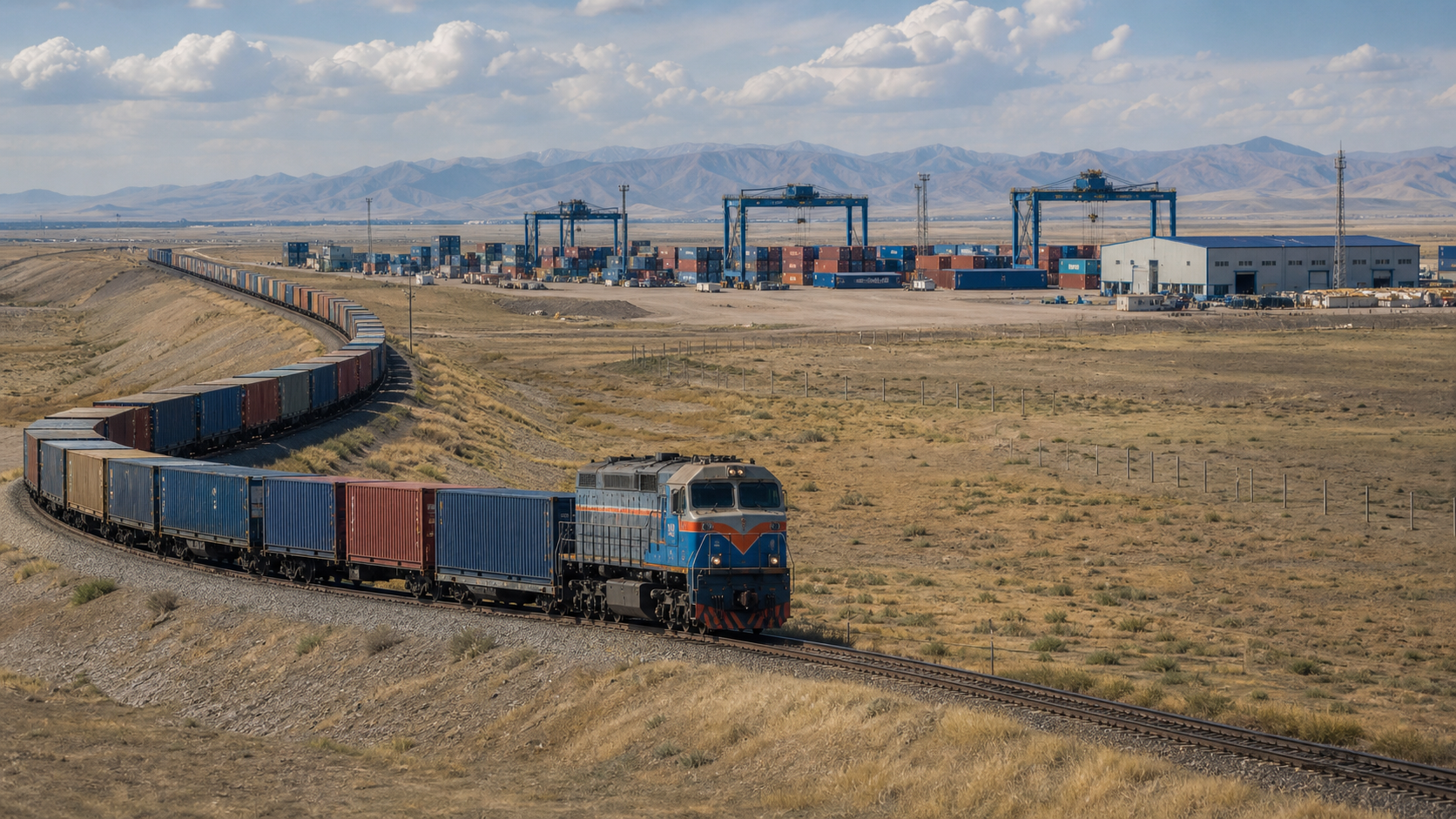
Editorial illustration: Kazakhstan’s landlocked position turns rail, terminals and border procedures into economic infrastructure. It does not depict a named facility.
For readers comparing the economy with geography, where Kazakhstan is explains why trade must cross a neighbouring state or the Caspian before reaching an ocean port. The tenge guide covers the currency rather than treating a dollar GDP total as a household budget.
Agriculture is smaller in GDP than in land and identity
Agriculture, forestry and fishing generated 3.8% of 2025 GDP. That is far below industry or services, but the sector remains important to northern land use, rural employment, food supply and regional trade.
Kazakhstan’s Agriculture Ministry reported a 2025 grain harvest of 27.1 million tonnes in initial weight, including 20.3 million tonnes of wheat. The same official update reported 4.5 million tonnes of oilseeds. These are harvest volumes, not export values or GDP contributions.
The distinction prevents another common exaggeration. Kazakhstan can have a record grain harvest while agriculture remains a single-digit share of national output. A large physical crop and a large monetary share are not the same claim.
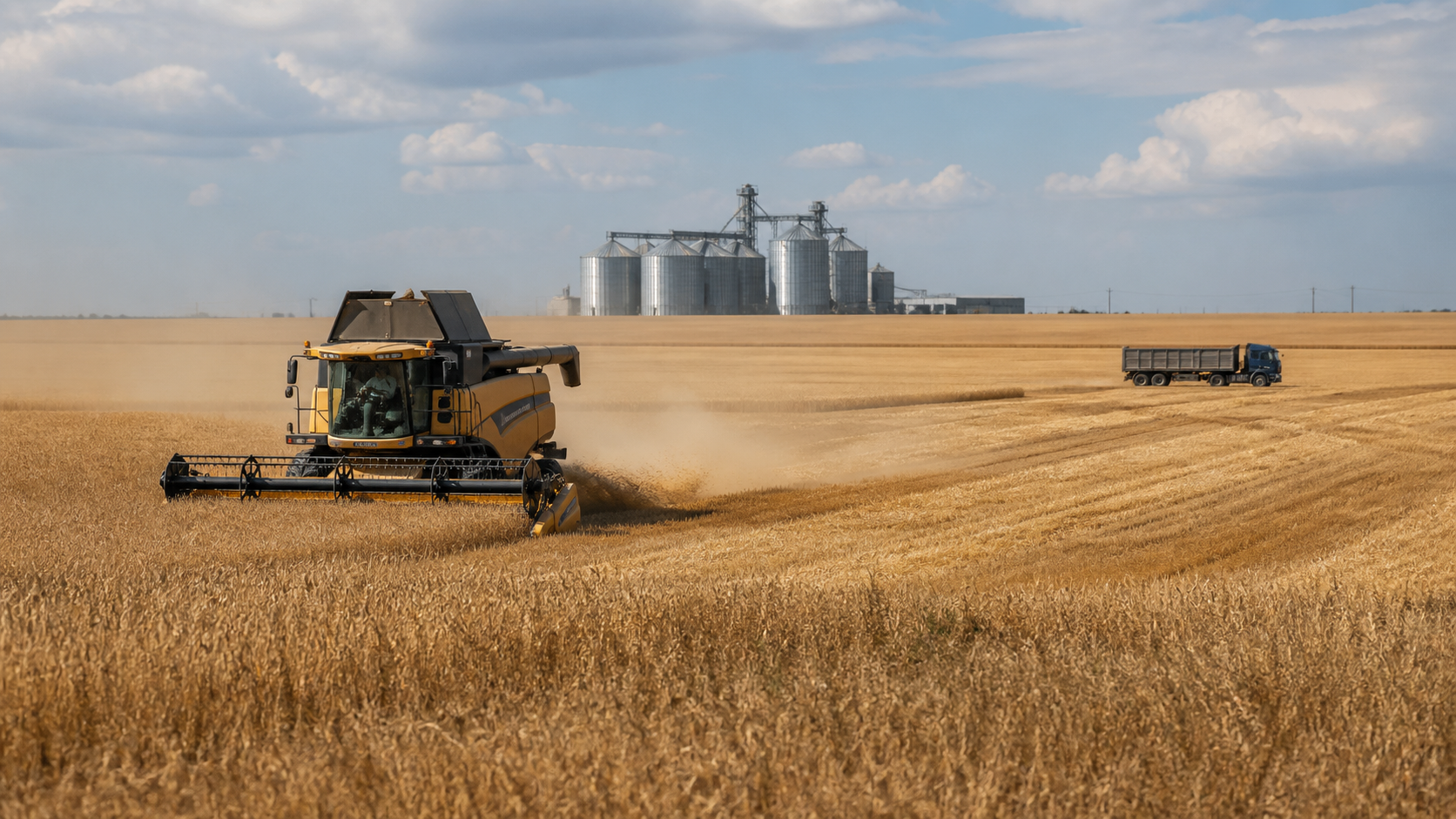
Editorial illustration of a generic northern steppe harvest. Grain matters to land use and trade even though agriculture was 3.8% of 2025 GDP.
Growth was fast; inflation remained high
BNS currently estimates 2025 real GDP growth at 6.5%. An IMF assessment published in January 2026 used a 6.2% estimate for 2025, so the two figures should not be presented as a contradiction: the IMF table was an estimate with an earlier information cutoff, while the BNS release is the later preliminary national account.
The IMF’s 2025 Article IV conclusion attributed the rapid expansion to rising oil output, robust non-oil activity and strong domestic demand. It also described signs of overheating, a loose overall public-sector stance and rapid consumer-credit growth.
The IMF projected real growth of 4.4% in 2026 and about 3.5% in the medium term. That is a forecast, not an outcome. It may change with oil output, prices, infrastructure spending, external demand and later data.
Inflation is already observed rather than forecast. BNS reported 10.2% year-on-year inflation in July 2026 and 0.6% for the month. Food prices were up 10.1% from a year earlier, non-food goods 11.7% and paid services 9.2%.
For households and visitors, this is why the Kazakhstan cost-of-living guide should be read with a date. A 6.5% real-growth figure does not mean every wage, pension or travel budget rose by the same amount.
The diversification problem, stated precisely
Kazakhstan has diversified production more than it has diversified exports. Manufacturing was 13.0% of GDP and services were 57.6% in 2025, yet crude oil and raw petroleum products still made up half of merchandise exports.
The IMF identified several structural constraints rather than reducing the problem to a slogan:
- a large state footprint that can constrain private-sector development;
- quasi-fiscal activity by state-owned enterprises that can offset formal budget tightening;
- rapid consumer-credit growth and household over-indebtedness risks;
- a need for stronger legal protections, property rights and a lower cost of doing business;
- the need to pair investment in education, health, digitalisation and infrastructure with market and governance reforms.
This framing is more useful than declaring diversification either a success or a failure. Kazakhstan has substantial non-oil output and modern service businesses. It also remains exposed to commodity export concentration and public-sector influence. Both statements can be true at once.
Is Kazakhstan still Central Asia’s largest economy?
Yes, by the latest comparable World Bank nominal-GDP series used here. For 2024, the World Bank recorded Kazakhstan at about $291.5 billion, more than Uzbekistan, Turkmenistan, Kyrgyzstan and Tajikistan combined.
| Economy | 2024 nominal GDP, current US$ |
|---|---|
| Kazakhstan | $291.5 billion |
| Uzbekistan | $121.4 billion |
| Turkmenistan | $44.2 billion |
| Kyrgyz Republic | $18.2 billion |
| Tajikistan | $14.4 billion |
This table uses one provider, one indicator and one year so that the comparison is coherent. It does not mix BNS’s later 2025 Kazakhstan total with 2024 figures for its neighbours. International databases can also revise historical values, especially where national statistical systems or exchange rates change.
The comparison explains Kazakhstan’s regional weight, not its distribution of wealth. National GDP does not show who receives the income, how expensive a city is or whether a particular region is growing. For population context, use the dated Kazakhstan population guide.
How to read Kazakhstan economy claims
Check four labels before trusting a number: period, unit, status and denominator. Most misleading economy summaries fail on one of them.
- Period: 2025 annual GDP is not a live 2026 figure.
- Unit: tenge, current US dollars and purchasing-power-parity dollars answer different questions.
- Status: preliminary GDP can be revised; an IMF projection is not an observed result.
- Denominator: 50.5% of merchandise exports is not 50.5% of GDP or government revenue.
The same discipline applies to company data. Kazatomprom’s attributable uranium production is not all production in Kazakhstan. A large harvest is not the same as agricultural export revenue. A trade-partner share is not a measure of ownership or political control.
When two sources appear to disagree, check whether they measure the same period and concept before choosing one. A calendar-year national account can coexist with a quarterly release, a company report and a forecast without any of them being false. Keep the source date beside the number, preserve whether it is preliminary or final, and avoid silently converting currencies. For a business decision, return to the latest release from the responsible statistical or regulatory body instead of treating this guide’s dated snapshot as a live dashboard.
Frequently Asked Questions
What is Kazakhstan's economy based on?
Kazakhstan has a service-led domestic economy and a commodity-led export account. Services generated 57.6% of 2025 GDP, industry 26.6%, mining and quarrying 11.9%, and agriculture 3.8%. Crude oil and raw petroleum products nevertheless made up 50.5% of merchandise exports.
What was Kazakhstan's GDP in 2025?
Preliminary BNS data put 2025 GDP at 159.584 trillion tenge, or $305.956 billion using the National Bank's average exchange rate. Real GDP grew 6.5%, and GDP per capita was $15,005.
How fast is Kazakhstan's economy growing in 2026?
The IMF projected 4.4% real GDP growth for 2026 in its January 2026 Article IV assessment. That is a forecast, not a completed-year result. BNS currently estimates that real GDP grew 6.5% in 2025.
What does Kazakhstan export?
In 2025, crude oil and raw petroleum products were 50.5% of merchandise exports. Radioactive elements and isotopes were 5.3%, refined copper and unwrought copper alloys 5.2%, copper ores and concentrates 3.6%, and ferroalloys 2.6%.
Is Kazakhstan the largest economy in Central Asia?
Yes by the World Bank's comparable 2024 nominal-GDP series. Kazakhstan was about $291.5 billion, more than Uzbekistan, Turkmenistan, Kyrgyzstan and Tajikistan combined in that dataset and year.
What are the main risks to Kazakhstan's economy?
The main risks are concentrated commodity exports, persistent inflation, a large state footprint, quasi-fiscal activity, rapid consumer-credit growth and the need for stronger conditions for private investment. The IMF also expects growth to moderate from the unusually fast 2025 pace.
Primary sources
These links are the evidence trail for the figures above. Forecasts and preliminary estimates are labeled as such in the article.
- Bureau of National Statistics: 2025 GDP by production method
- Bureau of National Statistics: full-year 2025 merchandise trade
- Bureau of National Statistics: July 2026 inflation
- IMF: 2025 Article IV consultation conclusion and 2026 forecast
- Kazakhstan Agriculture Ministry: 2025 grain and oilseed harvest
- Kazatomprom: 6M 2025 operating review with 2024 uranium shares
- World Bank: GDP in current US dollars
Last verified: August 22, 2026
Google Preferred Sources
See more Kazakhstan stories in Google
Add About Kazakhstan as a preferred source to find more of our fresh, relevant stories in Google Search.
More Stories

facts
Astana Hub: 0% Tax for IT Companies in Kazakhstan (2026)
Astana Hub: 0% corporate tax, 0% VAT for IT companies until 2029. Registration, requirements, 1,700+ members, comparison with Dubai and Estonia.
facts
10 Interesting Facts About Kazakhstan (2026)
Ten sourced facts about Kazakhstan for 2026: vast scale, Baikonur, wild apples, saiga, uranium, UNESCO heritage, population and a new Constitution.
facts
Kazakhstan by the Numbers 2026: 50+ Statistics & Facts
Kazakhstan by the Numbers 2026: 50+ sourced statistics on population, economy, tourism, visas, cities, costs, and culture with a CSV.
facts
Kazakhstan City Population 2026: Almaty, Astana & Shymkent
Compare Almaty, Astana and Shymkent populations on 1 August 2026, January–July growth and national shares. Official BNS figures, chart, CSV and JSON.
Plan the Next Step
travel
Kazakhstan Tourist Attractions: Choose the Right First-Trip Route
Compare Kazakhstan tourist attractions by base and logistics: Almaty nature, Turkestan heritage, Mangystau, Astana, Baikonur, and more.
food
Beshbarmak Recipe: How Kazakh Et Is Served
A source-checked guide to Kazakh et, widely called beshbarmak: what is on the platter, a practical home recipe, regional differences, and guest etiquette.
culture
Women in Kazakhstan: Rights, Work and Daily Life in 2026
Source-checked guide to women in Kazakhstan: current legal rights, dated work and wage data, marriage statistics, safety, and respectful language.
facts
Silk Road Kazakhstan: Cities, Routes & Sites
Explore Kazakhstan Silk Road sites: Turkistan, Otyrar, Sauran, Taraz, UNESCO distinctions, route planning, and responsible visits.
food
Popular Food in Kazakhstan: 15 Foods and Drinks to Try
Popular food in Kazakhstan explained: 15 Kazakh dishes and drinks, what each contains, how meals are served, and what to ask before ordering.
history
Kazakhstan History Timeline: 10 Source-Checked Turning Points
A careful Kazakhstan history timeline from Botai and the Kazakh Khanate to the 1930s famine, Semipalatinsk, independence, and January 2022.

Travel Writer & Local Expert · Almaty, Kazakhstan
Tugelbay Konabayev is a Kazakhstan-based travel writer who has lived in Almaty for 7+ years and Astana for 4+ years. He grew up in Aktobe, Kazakhstan and has covered Kazakh travel, food, culture, and visa policy with first-hand reporting since 2023.