Countries Ending in -stan: The 7 Names Explained
Reported from the ground: Tugelbay Konabayev is a Kazakh native (born in Aktobe) who has lived 7 years in Almaty and 4 in Astana. About the author.
In this article11 sections
Seven sovereign countries have English short names ending in “-stan”: Afghanistan, Kazakhstan, Kyrgyzstan, Pakistan, Tajikistan, Turkmenistan, and Uzbekistan. Five are the countries the United Nations names as Central Asia; Afghanistan and Pakistan are classified by the UN in Southern Asia.
The shared ending is linguistic, not a claim that all seven belong to one culture, political system, economy, or travel region. That distinction matters more than any ranking table.
Which seven countries end in -stan?
Here is the complete list, with regional labels used only as a practical geographic reference:
| Country | UN regional grouping used in this guide | What the shared ending does not imply |
|---|---|---|
| Afghanistan | Southern Asia | That it is part of the five-country Central Asian group |
| Kazakhstan | Central Asia | That its language, institutions, or history match every other “stan” |
| Kyrgyzstan | Central Asia | That mountain geography defines the whole country |
| Pakistan | Southern Asia | That its modern name formed in the same way as the older regional names |
| Tajikistan | Central Asia | That a Persian-related language makes it interchangeable with Afghanistan |
| Turkmenistan | Central Asia | That neighboring countries share one set of entry rules |
| Uzbekistan | Central Asia | That a shared Soviet past makes the five Central Asian states identical today |
The ordering above is alphabetical. It is deliberately not a league table. Population, gross domestic product, visa access, security conditions, and even official terminology change on different schedules. Combining them into one undated “stan countries” scorecard creates an impressive-looking answer that soon becomes unreliable.
For this article, “country” means a sovereign state whose familiar English short name ends with the letters stan. It does not include provinces, republics within another state, cultural regions, imagined places, or informal nicknames.
What does -stan mean?
“Land” or “place” is the useful short translation, but the linguistic story is wider than a one-word formula. Encyclopaedia Britannica’s explanation of the suffix connects the Persian and Urdu form to the idea of a place where one stands. It also traces the element through older Indo-Iranian and Indo-European roots related to standing.
That history helps explain why similar-looking elements occur across a broad zone influenced by Persian language and culture. It does not prove that every modern place name was coined at the same time, by the same authority, or through a simple “people + land” equation.
“Land of” can therefore be a good first gloss for a learner. It should not be treated as a complete translation of each country name. To explain Kazakhstan, Afghanistan, or Pakistan properly, one must also investigate the first part of the name, the language in which the compound formed, spelling changes, and the political context in which the modern state adopted it.
The suffix is also productive beyond sovereign-country names. Its appearance in another name is not evidence that the place is independent or even that its legal status resembles another “stan.” Grammar is not a sovereignty test.

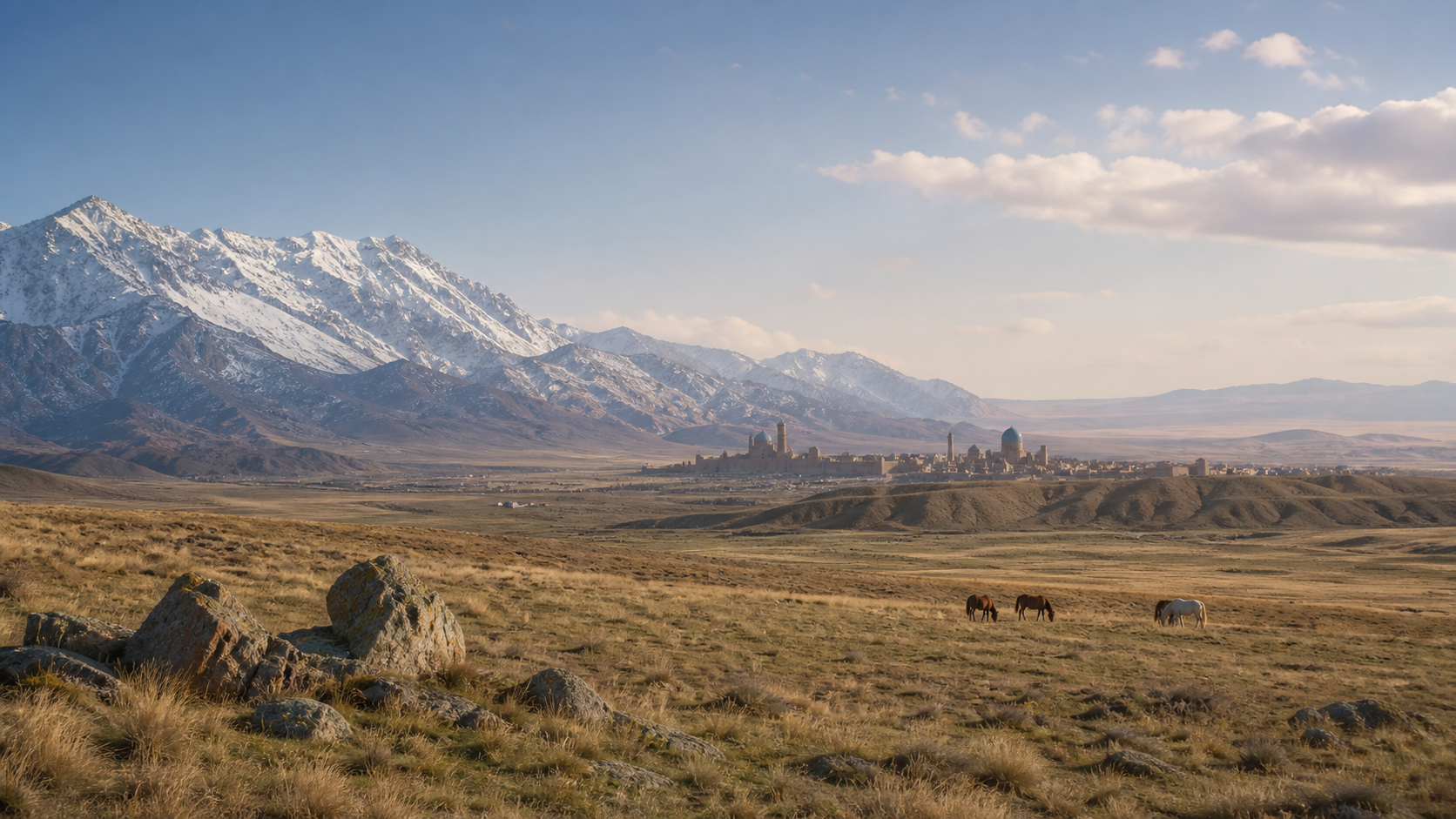
A conceptual illustration of language carried between older manuscripts and modern reference works. It is not a real historical document or a geographic map.
Why are five of the seven called Central Asian countries?
Kazakhstan, Kyrgyzstan, Tajikistan, Turkmenistan, and Uzbekistan are the five countries in the UN’s Central Asia grouping. A UN address about the region names those five explicitly.
This is the cleanest answer to “Which stans are in Central Asia?” It is more precise than treating every country with the suffix as Central Asian. The five-country grouping is also the one most useful for reading regional policy, transport, environmental, and development material.
The classification does not erase connections beyond those boundaries. Languages, trade routes, empires, religious traditions, migration, and mountain systems cross modern borders. “Central Asia” is a tool for organizing geography and institutions, not a wall around a single uniform culture.
It also helps to separate two statements that are often collapsed:
- Five modern countries ending in -stan form the standard five-country Central Asian group.
- The wider history of Central Asia reaches beyond the borders and national names of those five states.
Both can be true. Our guide to where Central Asia is explains the regional boundary in more detail, while where Kazakhstan is places the largest of the five in its continental setting.
Why are Afghanistan and Pakistan treated separately here?
The UNData country profiles classify both Afghanistan and Pakistan in Southern Asia. See the entries for Afghanistan and Pakistan. That is why this guide does not call them two additional Central Asian states merely because their names end in -stan.
Regional classifications are designed for particular kinds of comparison. They are not verdicts on identity, and they do not deny Afghanistan’s many historical links with Central Asia or the long movement of people and ideas between the regions.
Pakistan presents another important distinction: its modern state name has a documented twentieth-century political history. It should not be placed in a table that implies all seven names emerged through the same naming process.
In the primary text commonly known as Now or Never, dated January 28, 1933, Choudhary Rahmat Ali advocated a proposed homeland and used the name “PAKISTAN.” The transcription of the 1933 pamphlet ties the proposal to Punjab, the North-West Frontier or Afghan Province, Kashmir, Sind, and Baluchistan.
The pamphlet is valuable primary evidence for the proposal and its political argument. It is not a neutral dictionary entry, and it should not be stretched into a claim that every detail of the word’s origin is uncontested. This guide therefore does not label one sentence the indisputable instant when the name was “first coined,” nor does it reduce the name to a tidy slogan without explaining the political source.
Does every -stan name mean “land of a people”?
No. That pattern is common, but it is not a safe universal translation rule. Even where the first element refers to a people, its spelling, historical meaning, and relationship to present citizenship may be more complicated than an English label suggests.
Modern country names also function at several levels at once:
- a name can preserve an older linguistic element;
- the modern state can have adopted or standardized it much later;
- the first element can refer to an ethnonym, political idea, or older regional term;
- citizens of the state may include many communities not named in the word;
- an English spelling can conceal distinctions visible in local scripts and pronunciation.
Britannica uses “land of the Tajiks” as an approximate explanation of Tajikistan, but even that kind of shorthand is not a complete account of identity, citizenship, or state formation. The Kazakh language basics guide is a better next step for pronunciation and current language context than a list of literal-name translations.
The same caution applies when a viral graphic assigns each name one poetic English meaning. Such graphics frequently mix folk etymology, modern national symbolism, and historical linguistics without indicating which is which.
Are Tatarstan, Dagestan, and other “stans” countries?
Not every place whose name ends in -stan is a sovereign country. Names such as Tatarstan, Dagestan, Bashkortostan, Karakalpakstan, and Balochistan appear in different present-day administrative settings. Other uses refer to historical or cultural regions whose boundaries and political meanings may be disputed.
This produces a simple verification rule: never infer legal status from the suffix. Ask instead whether the name appears in a current sovereign-state list, a national constitution, an official administrative register, or only in historical and cultural writing.
The distinction also prevents two opposite errors. A region inside a larger country should not be counted as an eighth sovereign “stan.” At the same time, saying it is not a country should not be used to dismiss the real language, culture, institutions, or history associated with that regional name.
Writers should be especially careful with expressions such as “Kurdistan” or “Hindustan.” Their meanings shift with language, period, speaker, and context. A short suffix explainer cannot settle modern territorial or identity questions.
What does the suffix tell us, and what does it not?
The ending is evidence of language history and the movement of naming conventions. By itself, it is weak evidence for almost everything else.
| Question | Can “-stan” answer it? | Better evidence |
|---|---|---|
| Is this one of the seven sovereign-country names? | Only after checking a current country list | UN or another current intergovernmental list |
| Is the country in Central Asia? | No | A stated regional classification |
| What language do people speak? | No | Current census, constitution, and language sources |
| What religion do citizens follow? | No | Carefully dated demographic research |
| Is the government a particular type? | No | Current constitutional and institutional sources |
| Is a passport visa-free? | No | The destination’s official immigration authority |
| Is travel safe today? | No | Current official advisories and local emergency information |
| Is one country richer or more populous? | No | Dated, like-for-like statistical series |
This is also why the seven should not be bundled into a combined population or combined GDP as though “the stans” were a recognized economic bloc. The calculation may be arithmetically possible, but it usually answers no meaningful geographic or policy question. It combines two UN regions and countries with very different statistical conditions, then starts aging as soon as the underlying datasets update.
If you do need a comparison, define the question first. Use one reference year, one provider, one unit, one geographic classification, and a retrieval date. A current figure without those labels is not more useful than an older figure whose scope is clear.
Were all seven part of the Soviet Union?
No. The five Central Asian countries in this list were Soviet republics; Afghanistan and Pakistan were not. That shared twentieth-century institutional history helps explain why the five are often discussed together today, but the suffix itself is much older than the Soviet period.
The opposite shortcut is misleading too: the five did not begin in 1991. Their territories contain much older cities, communities, states, trade networks, and cultural traditions. Independence changed the sovereign political framework; it did not create the region’s entire history from nothing.
For Kazakhstan specifically, our Kazakhstan history timeline separates archaeology, the Kazakh Khanate, imperial incorporation, the Soviet period, and independence. It is a better foundation than projecting one “stan countries” story onto seven different national histories.
Can the seven countries be planned as one trip?
No single travel rule covers all seven, and this naming list is not a safety or entry guide. A valid visa answer depends on the traveler’s passport, purpose, length of stay, entry point, and date. A valid security decision depends on the exact destination and route, not on a suffix or a regional reputation.
For any of the seven:
- Check the destination government’s immigration or consular source for your passport and purpose.
- Read your own government’s current travel advice, including regional exclusions and insurance implications.
- Verify border crossings and transport with a current official or operating source.
- Recheck shortly before departure; an evergreen article cannot certify today’s rule.
Avoid rankings such as “safest stan” or “easiest stan.” They compress city-level, regional, legal, health, transport, and political risks into a label that may be wrong for the reader’s actual itinerary. They also become stale without a visible review date and defined methodology.
If Kazakhstan is the country you are considering, continue with the current Kazakhstan tourism guide, Kazakhstan visa guide, and Kazakhstan safety guide. Those pages can answer route-specific questions without pretending to assess six other countries in one paragraph.
How should I compare the five Central Asian countries?
Compare them by the decision you need to make, not by a universal winner. A language learner, rail traveler, mountain trekker, architecture student, and business researcher need different evidence.
A useful comparison might ask:
- Which official and commonly used languages affect my route?
- Which border crossings operate for my passport and vehicle?
- Which cities connect the sites I actually want to visit?
- What elevation, climate, and road conditions apply on those dates?
- Which statistics come from the same year and definition?
For a first Kazakhstan itinerary, the practical sequence is narrower: choose a city base, check entry and onward transport, then add one landscape region. The Almaty guide covers the southern city base, the things to do in Kazakhstan guide helps narrow the country-wide list, and the Kazakhstan mountains guide explains why distant ranges cannot be treated as neighboring day trips.
Sources and verification
- Encyclopaedia Britannica: origin and meaning of the “-stan” suffix.
- United Nations in Turkmenistan: the five countries named as Central Asia.
- UNData: Afghanistan, used only for its Southern Asia classification.
- UNData: Pakistan, used only for its Southern Asia classification.
- Choudhary Rahmat Ali, Now or Never (1933 transcription), a primary political document used for its date, spellings, and stated territorial proposal.
Frequently Asked Questions
How many countries end in "stan"?
Seven sovereign countries have familiar English short names ending in -stan: Afghanistan, Kazakhstan, Kyrgyzstan, Pakistan, Tajikistan, Turkmenistan, and Uzbekistan.
What does "stan" mean?
“Land” or “place” is the useful short gloss. The suffix comes through Persian and related linguistic history connected with a place where one stands, but each complete country name needs its own etymological and historical explanation.
Are all seven stan countries in Central Asia?
No. The UN names Kazakhstan, Kyrgyzstan, Tajikistan, Turkmenistan, and Uzbekistan as the five Central Asian countries. UNData classifies Afghanistan and Pakistan in Southern Asia.
Were all seven part of the Soviet Union?
No. The five Central Asian countries in the list were Soviet republics. Afghanistan and Pakistan were not. The -stan suffix is not a Soviet invention.
Does every place ending in stan count as a country?
No. The suffix also occurs in names for republics, provinces, and historical or cultural regions. Legal status must be checked independently; it cannot be inferred from the ending.
Which stan country is safest or easiest to visit?
There is no durable suffix-based ranking. Check passport-specific entry rules, current official travel advice, the exact regions on your route, transport operations, and insurance terms immediately before booking and departure.
Last reviewed: August 22, 2026. The language, regional classification, and 1933 primary-source claims were checked against the sources above. Population, GDP, visa, and safety rankings were intentionally removed because they require separate current datasets and route-specific review.
Google Preferred Sources
See more Kazakhstan stories in Google
Add About Kazakhstan as a preferred source to find more of our fresh, relevant stories in Google Search.
More Stories

facts
Central Asia: Map, 5 Countries, Capitals & Borders
Central Asia includes Kazakhstan, Uzbekistan, Kyrgyzstan, Tajikistan, and Turkmenistan. Explore a map, capitals, borders, area and population.
facts
Kazakhstan Visa-Free Countries 2026: MFA Policy Data
Kazakhstan visa-free countries 2026 from the MFA table: Russia 90 days, Western countries 30 days, 87 ordinary-passport rows, CSV dataset.

facts
Astana Hub: 0% Tax for IT Companies in Kazakhstan (2026)
Astana Hub: 0% corporate tax, 0% VAT for IT companies until 2029. Registration, requirements, 1,700+ members, comparison with Dubai and Estonia.

facts
How to Send Money to Kazakhstan: Best Methods Compared 2026
Compare the best ways to send money to Kazakhstan — Wise, Western Union, Remitly, bank wire. Fees, exchange rates, speed, and step-by-step guide.
Plan the Next Step
travel
Kazakhstan Tourist Attractions: Choose the Right First-Trip Route
Compare Kazakhstan tourist attractions by base and logistics: Almaty nature, Turkestan heritage, Mangystau, Astana, Baikonur, and more.
food
Beshbarmak Recipe: How Kazakh Et Is Served
A source-checked guide to Kazakh et, widely called beshbarmak: what is on the platter, a practical home recipe, regional differences, and guest etiquette.
culture
Women in Kazakhstan: Rights, Work and Daily Life in 2026
Source-checked guide to women in Kazakhstan: current legal rights, dated work and wage data, marriage statistics, safety, and respectful language.
facts
Kazakhstan Economy in 2026: GDP, Trade, Oil and Growth
Kazakhstan's economy in 2026: 2025 GDP, sector shares, oil and uranium exports, trade partners, inflation, agriculture and the IMF outlook.
facts
Silk Road Kazakhstan: Cities, Routes & Sites
Explore Kazakhstan Silk Road sites: Turkistan, Otyrar, Sauran, Taraz, UNESCO distinctions, route planning, and responsible visits.
food
Popular Food in Kazakhstan: 15 Foods and Drinks to Try
Popular food in Kazakhstan explained: 15 Kazakh dishes and drinks, what each contains, how meals are served, and what to ask before ordering.

Travel Writer & Local Expert · Almaty, Kazakhstan
Tugelbay Konabayev is a Kazakhstan-based travel writer who has lived in Almaty for 7+ years and Astana for 4+ years. He grew up in Aktobe, Kazakhstan and has covered Kazakh travel, food, culture, and visa policy with first-hand reporting since 2023.