Kazakhstan Tourism Guide: Routes, Visas & Best Places
Reported from the ground: Tugelbay Konabayev is a Kazakh native (born in Aktobe) who has lived 7 years in Almaty and 4 in Astana. About the author.
In this article13 sections
Kazakhstan is worth visiting if you want mountain scenery, Silk Road history or vast steppe and desert landscapes without forcing them into one rushed circuit. For a first trip, start with one region instead of trying to cross the whole country. With seven days, use Almaty as the base and choose either two mountain days or a short Astana add-on. With ten days or more, add Turkestan for Silk Road heritage or Mangystau for desert landscapes, but not both unless you are comfortable spending a large part of the trip in airports, trains and cars.
That route advice matters because Kazakhstan is the world’s ninth-largest country by area. Almaty, Astana, Turkestan and Mangystau are not stops on a compact loop; they are separate travel regions. The most common planning mistake is treating the map as if it were Western Europe.
Kazakhstan tourism: the quick decision
The best first route matches one main interest and limits the trip to one or two regions. Use the trade-offs below before buying a domestic flight or committing to a long road transfer.
| Your priority | Sensible first route | Time to allow | What you give up |
|---|---|---|---|
| Mountains and food | Almaty + Charyn + Kolsai or Shymbulak | 6–8 days | Astana’s architecture |
| Two-city contrast | Almaty + Astana | 7–9 days | A slower mountain itinerary |
| Silk Road history | Almaty + Shymkent + Turkestan | 8–10 days | Northern Kazakhstan |
| Remote landscapes | Almaty + Aktau + Mangystau | 10–14 days | Easy logistics and a low transport budget |
If you have only three or four days, stay in one city. Almaty is the stronger all-round first base; Astana makes more sense when architecture, museums or business are the main reason for the trip. See the day-by-day Kazakhstan 7-day itinerary and compare the best hotels in Kazakhstan only after choosing the route.
How to read Kazakhstan tourism statistics
Do not treat every Kazakhstan tourism headline as a count of unique holidaymakers. Border crossings, guests in registered accommodation and trips classified by purpose are different measures. They cover different populations and periods, and repeat movements may be counted more than once.
The Bureau of National Statistics tourism section is the official starting point. Before quoting a figure, check its unit, date range and whether it includes domestic visitors. For a source-by-source explanation of the definitions, use our Kazakhstan tourism statistics page.
For a recent regional comparison, see H1 2026 accommodation visitors and room occupancy across 20 regions and cities. It separates registered accommodation activity from border arrivals and includes the BNS source and CSV downloads.
Visa and arrival rules
Visa requirements depend on the passport, and the airline or border officer will apply the current rule rather than a travel blog’s summary. Treat the official ordinary-passport table as the decision source.
Check the ordinary-passport column in the live MFA table before buying a non-refundable ticket. The Kazakhstan Ministry of Foreign Affairs visa table, updated 21 August 2026, shows up to 30 days visa-free for ordinary passport holders from Australia and Japan, the examples checked on 6 September. Other nationalities have different limits or require a visa; these examples are not the complete visa-free list.
Do not copy a rule written for another passport, and do not assume “visa-free” always means the same number of days or the same cumulative-stay limit. Our visa guide and visa checker are planning aids; the MFA table is the authority at the time of travel.
Under the current rule, host notification is not a registration task that every visitor completes personally. The Visa and Migration Portal says the receiving person or organization must notify the authorities within three working days of arrival. A hotel normally handles this as the receiving organization. For an apartment or private stay, ask the host who is filing the notice and keep confirmation.
Use the free Kazakhstan travel tools to estimate a trip budget and look up the published visa rules for your passport. The calculator uses fixed planning estimates; confirm current fares, hotel quotes and entry requirements before booking.
Before you book: five live checks
A workable route is not ready until its time-sensitive parts have been checked for your exact dates. Before making a non-refundable payment:
- Check the MFA ordinary-passport row for your nationality.
- Confirm who will submit the host notification if you are not staying in a hotel.
- Price the domestic flight or train that connects your chosen regions.
- Ask a mountain or desert operator what happens if weather, roads or park access change.
- Keep the first hotel and major transfer flexible until those checks agree.
This is the point where a plausible itinerary becomes a bookable one. Attraction lists belong in things to do in Kazakhstan; this guide keeps the country-level sequence and trade-offs in one place.
When to go: choose by region, not by country
Late spring and early autumn are the easiest general windows, but altitude and region matter more than a single national weather average. A city day in Almaty, a high mountain route and a Mangystau drive can have different workable seasons.
Kazakhstan spans steppe, desert and high mountains, so a single national temperature table is misleading.
| Route | Strong travel window | Why | Main trade-off |
|---|---|---|---|
| Almaty city + foothills | May–June, September–October | Comfortable city days and clearer shoulder-season hiking choices | High routes can still be snowbound early or close after storms |
| High Tian Shan trips | July–August, subject to checks | Starting window for researching specific routes | Confirm route conditions, permissions and guide advice |
| Astana + Burabay | Late May–September | Longer daylight and easier outdoor days | Astana is exposed to wind; winters are severe |
| Turkestan + Shymkent | April–May, late September–October | Avoids the strongest summer heat | Spring weather can be unsettled |
| Mangystau | April–May, September–October | Better conditions for long desert drives | Summer heat makes remote itineraries harder and riskier |
| Ski trip | December–March | Check the resort’s announced season and open pistes | City and road conditions can disrupt tight schedules |
These are editorial planning windows, not confirmation that a route or ski run is open. For a month-by-month comparison, use the best time to visit Kazakhstan. For an Almaty-only trip, use the separate Almaty timing guide because city weather and high-mountain access are not the same thing.
Where to go on a first trip
Choose one gateway and one regional theme before adding secondary stops. The four bases below solve different trips and should not be compressed into one fast circuit.
Almaty
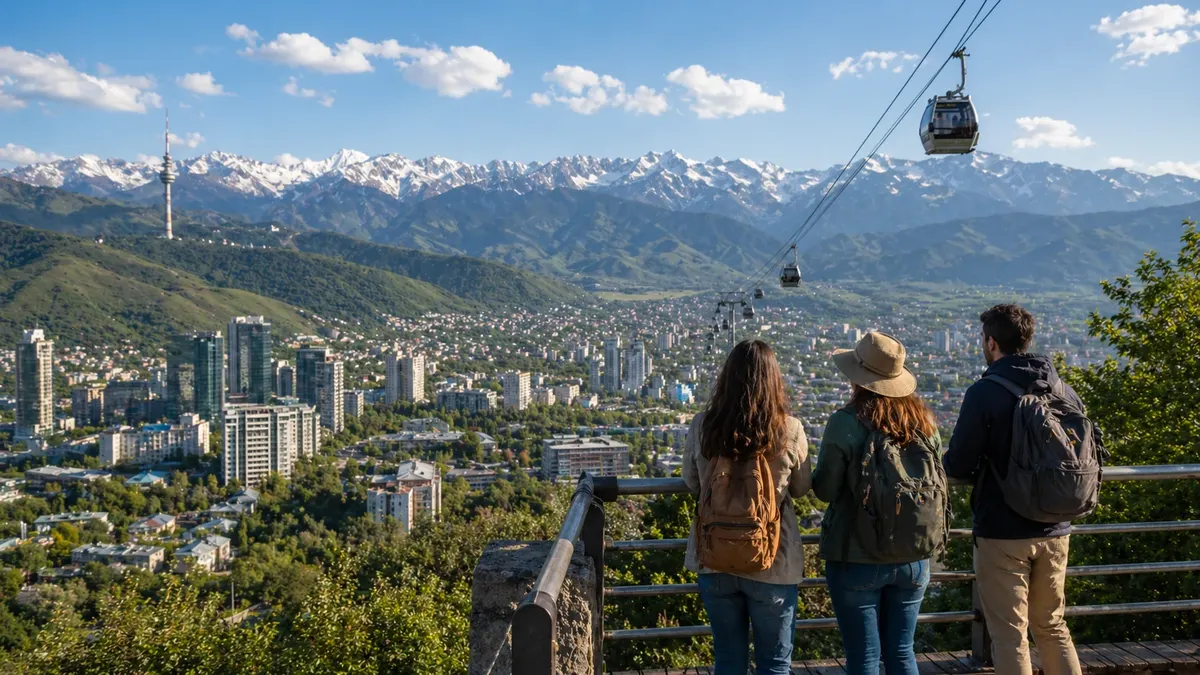
Choose Almaty for the broadest first-trip mix: food, museums, nightlife and quick access to the northern Tian Shan. Allow two city days plus one or two nature days. Charyn Canyon and the Kolsai area can be combined on a very long organized day, but an overnight route is less rushed. Shymbulak skiing is much closer to the city.
Astana
Choose Astana for contemporary architecture, national museums and a very different view of the country. Two full days are enough for a first visit. Burabay is the logical nature add-on from Astana, not an Almaty day trip, and deserves extra time rather than being squeezed between flights.
Shymkent
Use Shymkent as the practical southern base and Turkestan as the heritage focus. The Mausoleum of Khoja Ahmed Yasawi is a UNESCO World Heritage site, but the region is more rewarding when it is treated as a two- or three-day stop rather than a same-day flight connection.
Aktau and Mangystau
Mangystau is the outlier: dramatic desert formations, underground mosques and long off-road distances. It is not a casual rental-car extension from Almaty. Use Aktau as the gateway, allow several days and book a driver or operator with a credible vehicle, water plan and contingency for breakdowns.
What the trip will cost
Price the route in tenge from live quotes; there is no honest universal daily budget for Kazakhstan. A city-only stay, a shared Charyn tour and a private Mangystau expedition have completely different cost structures. Exchange-rate conversions also become stale quickly.
Build the budget in tenge and separate four items:
- Accommodation: compare the actual dates in Almaty, Astana or your regional base.
- Long-distance transport: price domestic flights or trains before committing to a multi-region route.
- Nature access: a seat on a shared day tour is not comparable with a private 4×4 and driver.
- Food and city transport: these are usually the flexible part of the budget, not the reason a remote itinerary becomes expensive.
Use the trip cost calculator as a fixed planning estimate, replace the budget items with actual quotes and read the tenge guide before converting the result to your home currency. A shorter route with fewer domestic moves often saves more than choosing a cheaper hotel.
Getting there and around
Use Almaty or Astana as the main gateway, then price every domestic transfer before finalizing the route. Check the Kazakhstan airports guide and flight-planning guide for route-specific options; schedules change by season.
Between Almaty and Astana, the real choice is time versus an overnight experience. A flight preserves a day. A sleeper train avoids an airport transfer and shows the scale of the steppe, but it should be booked as part of the itinerary rather than treated as a short hop. See the current Almaty-to-Astana comparison and verify the final timetable with the operator.
Within major cities, app-dispatched taxis remove most fare negotiation. Almaty also has a metro; both cities have buses. For canyons, lakes and desert routes, confirm the vehicle, pickup point, included park fees and return time in writing. A low headline price is not useful if it excludes the long transfer or combines too many sites into one exhausting day.
Safety
Kazakhstan is at Level 1, “Exercise Normal Precautions,” in the US Department of State advisory issued 18 August 2026. The advisory describes Kazakhstan as generally safe for travelers, while also flagging flooding and activity-specific risks. It is a useful external reference, not a guarantee that every route is low-risk.
Advisory last successfully checked: 31 August 2026. Our 6 September recheck was unavailable, so the current level has not been reconfirmed. Open the linked official advisory before booking and again before departure.
For most visitors, the risks that deserve planning are ordinary city theft, unofficial taxis, long road transfers, rapid mountain-weather changes and weak mobile coverage outside populated areas. Do not start a remote hike or desert drive without telling someone the route and expected return. For emergency numbers, health planning and advice for solo female travelers, use the full Kazakhstan safety guide.
Culture and Etiquette
Kazakhstan is secular and socially varied, so context matters more than a single etiquette script. City clothing is generally informal; more conservative dress is sensible at mosques, memorials and in some rural settings. Remove shoes when entering a home, follow the host’s seating cues and ask before photographing people or religious spaces.
Kazakh is the state language and Russian remains widely useful. English is most common in internationally oriented hotels, tours and restaurants in Almaty and Astana, but it is not a reliable default elsewhere. Save addresses in Cyrillic, download an offline translation pack and learn a few basic Kazakh phrases. For deeper context, read the culture guide rather than treating etiquette as a checklist of exotic rules.
Phone, payments and practical friction
Bring a working payment card, some tenge and offline maps instead of assuming every local digital service will accept a foreign visitor. Card acceptance is strong in major cities, but the familiar Kaspi QR system normally depends on access to a local banking account; a foreign visitor should not plan around it. Carry some tenge for markets, small guesthouses, park booths and places where a foreign card fails.
A local SIM may require passport registration at the point of sale. An eSIM is simpler for a short visit if the device supports it, while a local plan can make more sense for a longer stay. Whichever option you choose, download maps before mountain or desert travel because coverage can disappear well before the destination.
For food, start with beshbarmak, baursak, manty, kazy and regional dairy products, then use the dedicated food pages for context. A tourism overview should help you plan the route, not repeat a generic list of dishes.
Responsible nature travel
Check access, road and weather conditions close to departure; a saved social-media route is not a permit or a safety plan. Park access and permitted zones change with weather and local rules. Stay on marked routes, carry out waste and do not assume that a lake visible from the road is open for swimming. A locally based guide is especially valuable where the route requires off-road driving, border-zone awareness or decisions about mountain weather.
Plan Your Trip
For seven days, build around Almaty; for ten days, add only one major extension. A balanced seven-day trip uses four nights in Almaty, reserves one full day for a nearby mountain area, then chooses either a second nature day or two nights in Astana. Do not add Shymkent, Turkestan or Mangystau just to increase the destination count.
For ten days, choose one extension:
- Astana for architecture and museums;
- Turkestan for Silk Road heritage;
- Mangystau for a guided remote-landscape itinerary;
- more time around Almaty if hiking and slower travel matter more than a domestic flight.
That is the central planning rule for Kazakhstan tourism: reduce the route until each region has enough time to justify the transfer.
Frequently Asked Questions
Is Kazakhstan safe for tourists?
The US Department of State advisory issued 18 August 2026 lists Kazakhstan at Level 1, Exercise Normal Precautions. We last successfully checked it on 31 August; the 6 September recheck was unavailable, so confirm the current advisory before travel. That does not remove activity-specific risks: plan for long road transfers, mountain weather, weak coverage in remote areas and ordinary city theft.
How much does a trip to Kazakhstan cost?
Price the route rather than relying on a universal daily figure. Accommodation and city food can be modest, but domestic flights, private nature tours and multi-day 4×4 trips change the total dramatically. Calculate in tenge using live hotel, transport and tour quotes.
Do I need a visa for Kazakhstan?
It depends on the passport. The Kazakhstan MFA table updated 21 August 2026 shows up to 30 days visa-free for ordinary passport holders from Australia and Japan, the examples checked on 6 September. Other nationalities have different limits or need a visa. Check your own entry in the live ordinary-passport column before booking.
What is the best city to visit in Kazakhstan?
Almaty is the strongest all-round first base because it combines city life with nearby mountain access. Choose Astana first if contemporary architecture, national museums or business are the priority; choose Shymkent and Turkestan for Silk Road heritage.
Is English widely spoken in Kazakhstan?
Do not rely on English outside internationally oriented services in Almaty and Astana. Russian is widely useful, Kazakh is the state language, and offline translation plus saved Cyrillic addresses make taxis, stations and rural stops easier.
How many days do I need for Kazakhstan?
Allow 6–8 days for Almaty and nearby nature, 7–9 days for Almaty plus Astana, and at least 10 days if adding Turkestan or Mangystau. More destinations are not automatically a better trip because domestic transfers are long.
Last reviewed: September 6, 2026 (seasonal planning and calculator guidance). The Australia and Japan visa examples and the host-notification rule were checked on that date. The cited US safety advisory was last checked on 31 August 2026; a fresh September read was unavailable. Transport, weather and access conditions can change; verify time-sensitive details with the linked official source before payment.
Google Preferred Sources
See more Kazakhstan stories in Google
Add About Kazakhstan as a preferred source to find more of our fresh, relevant stories in Google Search.
More Stories
travel
Best Time to Visit Kazakhstan: Month-by-Month Guide (2026)
Choose when to visit Kazakhstan with a 12-month route planner, regional season advice, mountain-access checks, and sourced public holiday dates.
travel
Atyrau, Kazakhstan: Things to Do & Saraishyq Guide
Plan a short Atyrau stay around the Zhayyk riverfront and Saraishyq, with honest sightseeing scope, live transport checks, hotels, weather, and local sources.
travel
Cities in Kazakhstan: 90 Cities and Major City Guide
Cities in Kazakhstan ranked by size and travel value: Almaty, Astana, Shymkent, Karaganda and more, with May 2026 stat.gov.kz population data.

travel
Flights to Kazakhstan: Airlines, Routes & Prices
Complete guide to flights to Kazakhstan: airlines, direct routes, prices by season, budget tips, and airport transfers for Almaty and Astana.
Plan the Next Step
travel
Kazakhstan Tourist Attractions: Choose the Right First-Trip Route
Compare Kazakhstan tourist attractions by base and logistics: Almaty nature, Turkestan heritage, Mangystau, Astana, Baikonur, and more.
food
Beshbarmak Recipe: How Kazakh Et Is Served
A source-checked guide to Kazakh et, widely called beshbarmak: what is on the platter, a practical home recipe, regional differences, and guest etiquette.
culture
Women in Kazakhstan: Rights, Work and Daily Life in 2026
Source-checked guide to women in Kazakhstan: current legal rights, dated work and wage data, marriage statistics, safety, and respectful language.
travel
Things to Do in Kazakhstan: 13 Places Worth Your Time
Choose the best things to do in Kazakhstan by trip length: Almaty, Charyn, Kolsai, Astana, Turkestan, Tamgaly, Altyn-Emel, food, and Nauryz.
travel
12 Best Day Trips from Almaty: Complete Guide 2026
Best Almaty day trips — Charyn Canyon, Big Almaty Lake, Kolsai Lakes, Tamgaly petroglyphs, Altyn-Emel. Distances, costs, and how to get there.
travel
Shymkent Travel Guide: City Sights, Food & Day Trips
Plan a Shymkent visit with reliable city clusters, food choices, Turkestan and Sayram options, live transport checks, and heat-aware itineraries.

Travel Writer & Local Expert · Almaty, Kazakhstan
Tugelbay Konabayev is a Kazakhstan-based travel writer who has lived in Almaty for 7+ years and Astana for 4+ years. He grew up in Aktobe, Kazakhstan and has covered Kazakh travel, food, culture, and visa policy with first-hand reporting since 2023.