Kazakhstan Skiing: Shymbulak, Resorts & Safety
Reported from the ground: Tugelbay Konabayev is a Kazakh native (born in Aktobe) who has lived 7 years in Almaty and 4 in Astana. About the author.
In this article10 sections
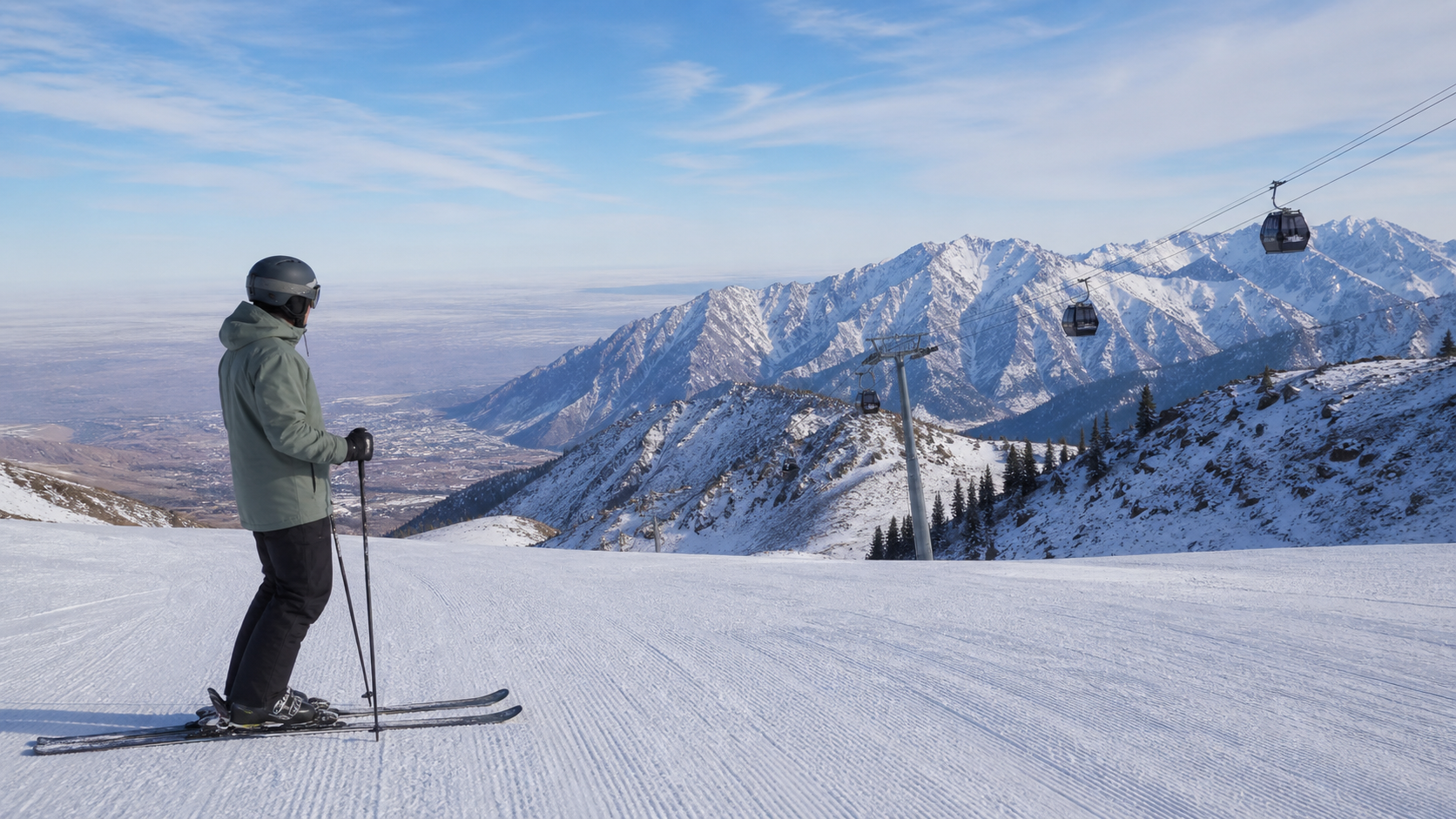
For a first Kazakhstan ski trip, use Almaty as your base and make Shymbulak the primary ski area. Its own site provides current lift sectors, tickets, rentals, lessons, access information, and operating times. Add another resort only after confirming that its ski lifts and slopes are operating on your dates.
Do not book around an evergreen promise such as “November to April” or a fixed dollar lift-pass price. Snow, wind, maintenance, weekday operations, tariffs, and open sectors can change independently.
Which Kazakhstan ski area should you choose?
The practical choice is not a national ranking. It is a match between your group, transport, confirmed open terrain, and the non-ski facilities you actually need.
| Option | Best use | What the primary source confirms | What to verify before leaving Almaty |
|---|---|---|---|
| Shymbulak | Main lift-served ski day, lessons, rental, repeat visits | Access from Medeu, named lift sectors, ticket, rental and school links | Which lifts and pistes are open, weather, wind, ticket rules and last descent |
| Ak-Bulak | Alternative resort day with lodging and mixed facilities | Winter ski and snowboard slopes, five ropeways, accommodation and a pool | Ski-area opening, operating lifts, lesson and rental availability, road transport |
| Oi-Qaragai | A family or mixed-activity resort comparison | Its official site presents a year-round family mountain resort and separate winter information | Exact ski zone, open lifts, usable terrain, transfer, hours and price on your date |
| Other named complexes | Only when the operator confirms a current ski product | No durable nationwide source establishes one stable list | Current operator, exact location, snow cover, lift operation, rental and return transport |
Shymbulak has the clearest official operational path for an independent visitor. Ak-Bulak’s own about page confirms that it operates year-round and offers prepared ski slopes, skiing, snowboarding, winter family activities, five ropeways, rooms, and a pool. Those features justify considering it; they do not prove that every lift runs every day.
Oi-Qaragai’s official site is the place to check its current winter product. During this review, the exact information page returned an authentication/CAPTCHA shell through the research tool, so this guide does not repeat the old run count or operating hours as verified facts.
Tabagan, Pioneer, Nurtau, and eastern heli-ski products appeared in the old article with precise terrain, price, and season claims. No suitable current primary evidence was retained for those claims, so they are not presented here as bookable recommendations.
Why Shymbulak is the default Almaty choice
Shymbulak combines a city base with an official public-transport and gondola access chain. The resort’s how-to-get-there page directs visitors to the Medeu base, then onward by gondola, taxi, or the resort’s eco-bus. It currently names city bus routes 12 and 21 to Medeu, but a bus number and timetable still need a same-day transport check.
The same official page describes Shymbulak at 2,260 metres above sea level. Its live information page lists the Medeu-Shymbulak gondola and the Combi-1, Combi-2, KKD-4, and Left Talgar sectors, plus separate links for tickets, rental, school, hotels, restaurants, and rules.
That is enough to build a reliable decision process, but not enough to claim that all sectors are open. Before buying:
- Check the official operating page for each lift sector you intend to use.
- Open the current ticket terms, not an old screenshot or converted dollar figure.
- Confirm that the rental shop has your boot size and that lessons are bookable.
- Note the last uplift and last descent for the Medeu connection.
- Recheck wind, visibility, precipitation, and any closure notice on the morning.
Beginners should book a lesson and ask which learning area is operating. Intermediates should choose the day from the open piste map, not from an undated total-run figure. Advanced skiers should not read the presence of high lift sectors as permission to enter uncontrolled terrain.
When is the Kazakhstan ski season?
There is no date range this guide can guarantee for every winter or every resort. A resort can sell winter products while a lower slope, upper lift, night session, or off-piste route remains closed.
Use three separate checks:
- Season status: Has the operator announced winter skiing, or is the mountain operating only for sightseeing and restaurants?
- Daily status: Which lifts and marked pistes are open today?
- Surface and weather: Is the available terrain suitable for your ability, with acceptable wind, visibility, temperature, and snow surface?
Historical month labels are weak booking evidence. An early storm does not establish a durable opening date, and a late patch of snow does not keep the full network operating. Smaller or lower operations can have a different window from Shymbulak.
For a multi-day trip, reserve one flexible day. If skiing is interrupted, use it for Almaty museums, food, or a lower mountain outing rather than forcing a marginal ski day. The best time to visit Kazakhstan guide gives broader climate context, but the resort remains the authority for actual lift operation.
How much does skiing in Kazakhstan cost?
Build the budget from live tenge prices and booking terms; do not convert an old package into a current dollar promise. Exchange rates move, weekday and weekend products differ, and a gondola sightseeing ticket may not be the ski pass you need.
| Cost line | Source to check | Question that prevents a bad comparison |
|---|---|---|
| Lift access | Resort’s current ticket page | Does this product cover every sector you plan to ski? |
| Equipment | Resort or named rental shop | Are skis, boots, poles, helmet, deposit, and damage terms included? |
| Lesson | Resort school or named instructor | Is the price private or group, and does it include lift access? |
| Transport | Current city route and resort access page | Can you make the first lift and still catch the last connection? |
| Food | Current resort menu or your own packed plan | Is the chosen venue open at the sector where you will ski? |
| Accommodation | Almaty or resort booking terms | Can weather disruption be cancelled or moved? |
| Insurance | Your policy wording | Are skiing, snowboarding, rescue, altitude, and off-piste activities covered? |
Shymbulak’s live page links directly to tickets, rental, and school. Use those three sources on the same date. A cheap lift product is not cheap if a separate gondola leg, equipment, or return transport was omitted.
Compare accommodation by total trip friction rather than “ski-in/ski-out” language alone. An Almaty base gives more dining and backup-day options; a mountain stay may reduce the morning transfer but can limit alternatives during a closure.
How do you get from Almaty to Shymbulak?
Treat Medeu as the transport handoff, not as the ski resort itself. Shymbulak’s access page currently describes city buses to the Medeu base and an onward gondola, taxi, or eco-bus connection to the resort.
A robust morning plan looks like this:
- Check the current city-bus route and first departure.
- Confirm that the Medeu-Shymbulak gondola is operating for the journey you need.
- Allow time for ticket collection, equipment fitting, lockers, and a lesson meeting point.
- Save the last downhill connection and a backup taxi plan before skiing.
- Do not rely on a driver’s promise to bypass a closure or access control.
The old guide converted taxi and bus fares into fixed US-dollar estimates. Those figures were removed because both the local fare and the exchange rate can change.
If arriving by air, do not plan a tight airport-to-slope connection. Use the flights to Kazakhstan guide for the arrival framework and the Almaty guide for neighborhoods, airport transfer, and city transport. A first night in the city also creates time to fit equipment and recover from the flight.
Piste skiing and off-piste are different risk categories
A lift ride does not make the terrain beside a marked piste controlled or safe. A prepared run has an operator-defined boundary, current status, and resort procedures. Beyond that boundary, route choice, avalanche assessment, navigation, rescue time, and insurance can change completely.
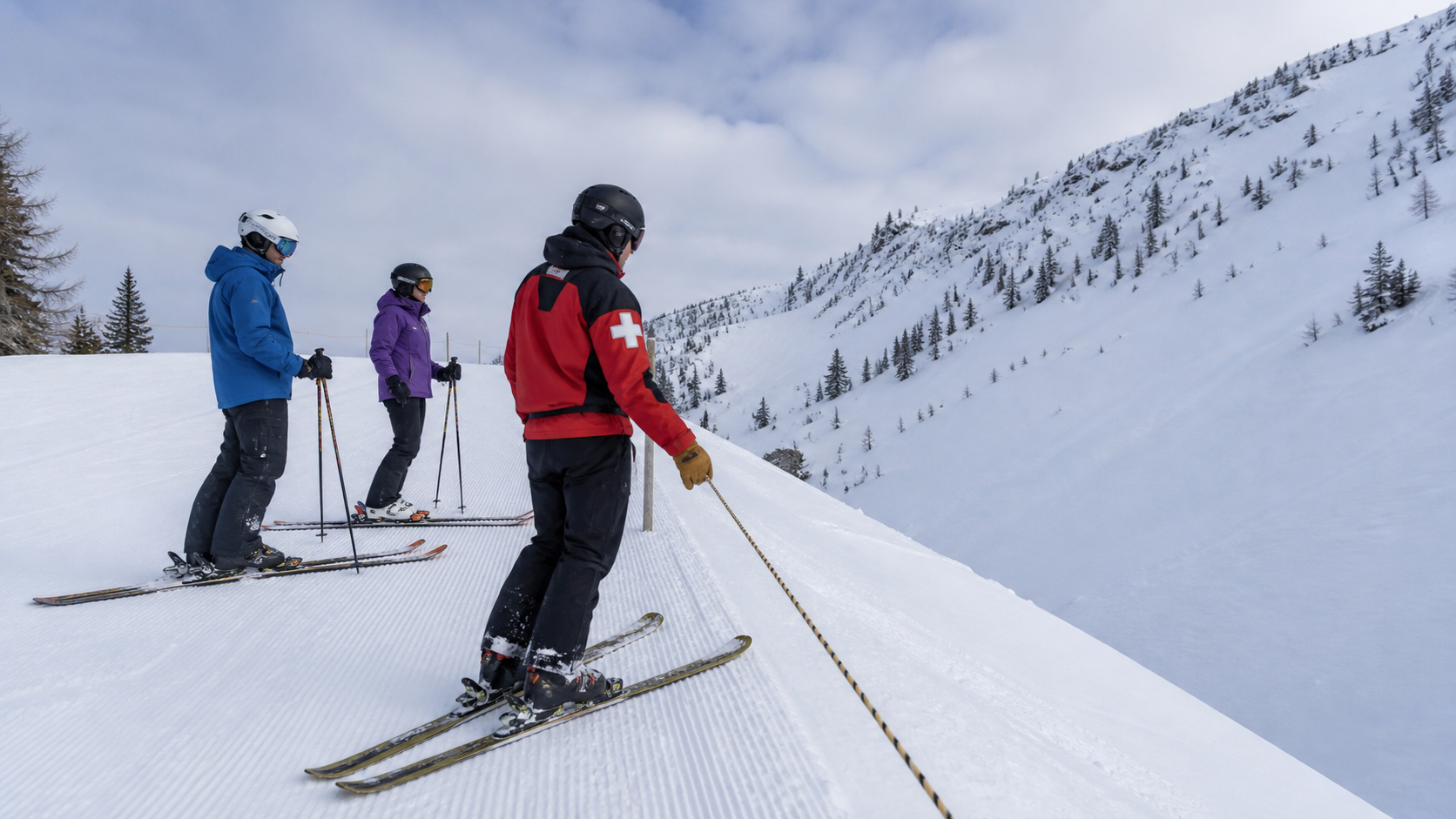
Conceptual illustration of a managed piste boundary. It is not a photograph of Shymbulak, a current terrain opening, or proof that snow beyond a rope is safe.
Kazakhstan’s Ministry for Emergency Situations avalanche notice identifies skiers, tourists, and climbers as exposed groups. It advises people to stay out of the mountains when an avalanche warning is in force, check forecasts and routes, avoid unprepared areas and dangerous slopes, use marked paths, and postpone mountain travel after heavy snowfall while the snowpack settles.
The notice also recommends an avalanche transceiver for mountain travel. A transceiver is a rescue tool, not permission to enter avalanche terrain. Effective backcountry travel requires a trained group, transceiver, probe, shovel, route plan, current local assessment, and the ability to turn around. An airbag does not replace those controls.
Do not use “avalanche control” as a blanket safety claim. A resort can manage specific open pistes and still close a sector. It does not control every bowl, couloir, ridge, or approach visible from a lift.
The ministry’s broader mountain-safety notice also tells travelers to check the route and forecast, use marked trails, and report specified higher-risk mountain trips and the expected return through 112. That formal notice is relevant to a backcountry itinerary, not proof that every normal day on an open resort piste requires identical advance registration.
If you do not already know how to plan in avalanche terrain, stay on the open marked pistes. A qualified local guide must still explain the route, weather threshold, equipment, group size, evacuation plan, and what happens if the chosen objective is unsafe.
Altitude, cold, and travel insurance
Shymbulak’s stated 2,260-metre resort altitude is high enough for cold, sun, dehydration, and exertion to feel different, even though altitude illness risk rises more clearly above that base. Some visitors will travel higher during the day, and a rapid arrival from low elevation can compound fatigue.
The US Centers for Disease Control and Prevention says altitude illness becomes a risk above 8,000 feet and advises gradual increases in sleeping elevation at higher levels. Do not ascend further while headache, nausea, unusual fatigue, or other altitude symptoms persist. Confusion, poor coordination, or breathlessness at rest requires urgent descent and medical help.
For an ordinary lift-served day:
- eat before skiing and carry water;
- protect exposed skin and eyes from sun and wind;
- add an insulating layer that still works if the outer layer becomes wet;
- use a helmet and equipment adjusted to your ability;
- stop before fatigue damages technique;
- keep a phone warm and save the resort’s contact details offline.
Read the insurance policy rather than relying on a generic “winter sports included” badge. Check altitude limits, piste definitions, off-piste exclusions, guide requirements, search and rescue, medical evacuation, and whether alcohol invalidates cover.
The Kazakhstan travel safety guide covers the wider trip, while the Kazakhstan mountains guide explains weather, communication, and emergency planning beyond skiing.
What should you rent or bring?
Renting skis or a board locally can simplify the flight, but boots and clothing are harder to replace when fit matters. Confirm the shop and size before assuming “full rental” means a complete kit.
Ask the rental desk:
- whether the booking includes skis or board, boots, poles, and helmet;
- which ability level and terrain the equipment is prepared for;
- how bindings are set and who records the skier’s details;
- whether damage, theft, or overnight storage requires a deposit;
- when equipment must be returned after the lifts close.
Bring ski socks, base layers, waterproof gloves, goggles suitable for flat light, sunscreen, and a small insulating layer even if you rent hard goods. A power bank is useful because cold reduces phone battery life.
Do not buy used safety-critical equipment during a short visit merely to beat a rental price. Unknown binding history, damaged helmets, poor boot fit, and no adjustment record are weak trade-offs. Rent from a shop that can fit and service the equipment.
A realistic Almaty ski itinerary
Plan one main ski area, a flexible weather day, and enough time for fitting and transport. Resort-hopping is not automatically better than repeating a mountain whose access and terrain you understand.
Three-day winter stop
- Day 1: arrive in Almaty, check the live mountain status, fit equipment, and confirm the next morning’s transport.
- Day 2: Shymbulak piste day matched to the open sectors and your ability.
- Day 3: second Shymbulak day if conditions suit, or an Almaty backup day.
This is more resilient than promising two ski days when wind or maintenance can remove one.
Five-day ski-focused trip
- Day 1: arrival, equipment, lesson and ticket checks.
- Days 2 and 3: Shymbulak, with the second day chosen after learning the live sector layout.
- Day 4: weather reserve or a confirmed Ak-Bulak day.
- Day 5: final piste day or city program before departure.
Do not schedule an unverified remote or heli-ski product as a casual add-on. It needs a named operator, current license and insurance checks, aircraft and weather terms, guide credentials, avalanche plan, rescue arrangements, and written cancellation conditions.
For general arrival preparation, use the Kazakhstan travel tips and Kazakhstan eSIM guide before the mountain day. Keep offline copies of bookings because reception can be inconsistent in mountain terrain.
Sources and verification
- Shymbulak access page: Medeu handoff, gondola and current transport directions.
- Shymbulak live information page: named lift sectors and current links for tickets, rental, school, hotels, restaurants, rules, and operations.
- Ak-Bulak about page: its own winter ski and snowboard product, ropeways, accommodation, pool, and year-round positioning.
- Oi-Qaragai official site: current operator contact and winter-product verification point; no fixed run count was retained.
- Kazakhstan MCHS avalanche notice: warning, forecast, marked-route, unprepared-slope, post-snowfall, group, phone, and transceiver guidance.
- Kazakhstan MCHS mountain-safety notice: route, forecast, 112, and scoped advance-notification guidance for higher-risk trips.
- CDC high-altitude travel guidance: altitude thresholds, symptom response, and descent guidance.
Frequently Asked Questions
Where is the best place to ski in Kazakhstan for a first visit?
Shymbulak is the most practical first choice because its official site provides a clear Medeu access chain plus current tickets, lift sectors, rentals, lessons, and operating information. Confirm the open terrain before each visit.
When does the ski season start in Kazakhstan?
There is no guaranteed national opening date. Check the resort's winter announcement, then the daily lift and piste status. Wind, snow, maintenance, and lower versus upper terrain can produce different openings on the same mountain.
How do I get from Almaty to Shymbulak?
Shymbulak's official access page routes visitors to the Medeu base, then onward by gondola, taxi, or resort eco-bus. It currently names city buses 12 and 21 to Medeu, but schedules and operating status need a same-day check.
Are Shymbulak lift prices cheap?
Use the live tenge ticket page rather than an old dollar comparison. Check whether the product covers the Medeu connection and every ski sector you plan to use, then add rental, lessons, transport, food, insurance, and cancellation terms.
Can beginners ski at Shymbulak?
The resort has an official ski-school and rental path, making it a practical place to investigate beginner instruction. Ask which learning terrain is open, book the correct lesson, and do not choose a run from an undated piste total.
Is off-piste skiing safe near Almaty?
No off-piste route is made safe by proximity to a lift. MCHS advises checking warnings and forecasts, avoiding unprepared and dangerous slopes, and carrying avalanche equipment. Stay on open marked pistes unless you have the training, group, current assessment, equipment, and qualified local support for avalanche terrain.
Last reviewed: August 22, 2026. Resort access and product claims were checked against local operator pages; avalanche guidance was checked against Kazakhstan’s Ministry for Emergency Situations. Prices, dates, open lifts, piste status, transport schedules, and off-piste conditions are intentionally delegated to live sources.
Google Preferred Sources
See more Kazakhstan stories in Google
Add About Kazakhstan as a preferred source to find more of our fresh, relevant stories in Google Search.
More Stories
travel
Kazakhstan Mountains: Regions, Hikes & Safety (2026)
Choose the right Kazakhstan mountain region: Almaty and Ile-Alatau, Western Tian Shan, Kolsai, Dzungarian Alatau, and Altai, with seasons and safety checks.
travel
Solo Female Travel in Kazakhstan: A Practical Safety Plan
Plan solo female travel in Kazakhstan with current advice for arrivals, taxis, nightlife, trains, mountain routes, lodging, and emergencies.
travel
Atyrau, Kazakhstan: Things to Do & Saraishyq Guide
Plan a short Atyrau stay around the Zhayyk riverfront and Saraishyq, with honest sightseeing scope, live transport checks, hotels, weather, and local sources.
travel
Cities in Kazakhstan: 90 Cities and Major City Guide
Cities in Kazakhstan ranked by size and travel value: Almaty, Astana, Shymkent, Karaganda and more, with May 2026 stat.gov.kz population data.
Plan the Next Step
travel
Kazakhstan Tourist Attractions: Choose the Right First-Trip Route
Compare Kazakhstan tourist attractions by base and logistics: Almaty nature, Turkestan heritage, Mangystau, Astana, Baikonur, and more.
food
Beshbarmak Recipe: How Kazakh Et Is Served
A source-checked guide to Kazakh et, widely called beshbarmak: what is on the platter, a practical home recipe, regional differences, and guest etiquette.
culture
Women in Kazakhstan: Rights, Work and Daily Life in 2026
Source-checked guide to women in Kazakhstan: current legal rights, dated work and wage data, marriage statistics, safety, and respectful language.
travel
Things to Do in Kazakhstan: 13 Places Worth Your Time
Choose the best things to do in Kazakhstan by trip length: Almaty, Charyn, Kolsai, Astana, Turkestan, Tamgaly, Altyn-Emel, food, and Nauryz.
travel
12 Best Day Trips from Almaty: Complete Guide 2026
Best Almaty day trips — Charyn Canyon, Big Almaty Lake, Kolsai Lakes, Tamgaly petroglyphs, Altyn-Emel. Distances, costs, and how to get there.
travel
Shymkent Travel Guide: City Sights, Food & Day Trips
Plan a Shymkent visit with reliable city clusters, food choices, Turkestan and Sayram options, live transport checks, and heat-aware itineraries.

Travel Writer & Local Expert · Almaty, Kazakhstan
Tugelbay Konabayev is a Kazakhstan-based travel writer who has lived in Almaty for 7+ years and Astana for 4+ years. He grew up in Aktobe, Kazakhstan and has covered Kazakh travel, food, culture, and visa policy with first-hand reporting since 2023.