Lake Balkhash Travel Guide: Two Waters, One Lake
Reported from the ground: Tugelbay Konabayev is a Kazakh native (born in Aktobe) who has lived 7 years in Almaty and 4 in Astana. About the author.
In this article10 sections
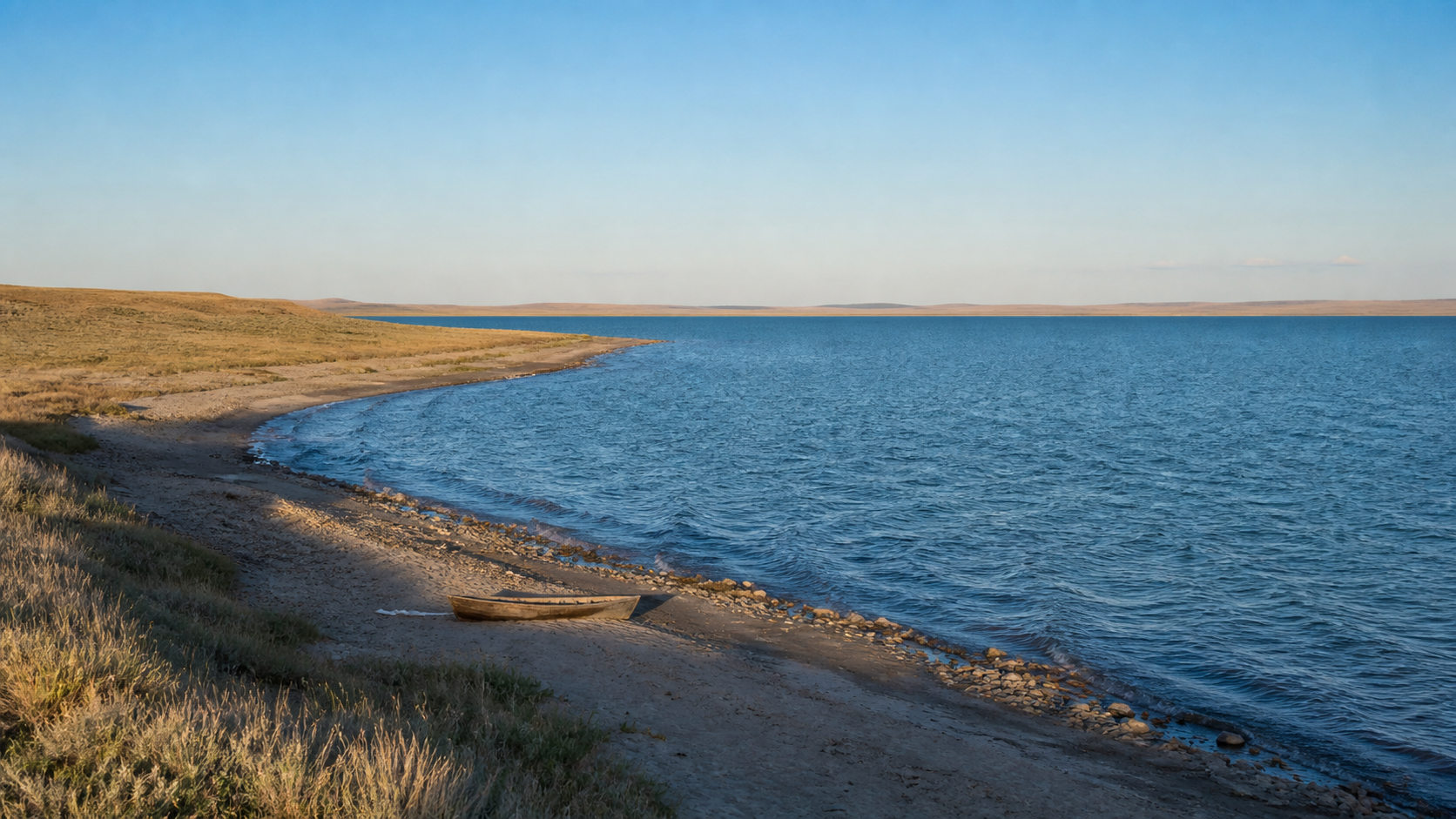
Lake Balkhash is one connected lake with two different water regimes. The Ili River enters the west, keeping that basin fresher; the eastern basin is more mineralized. The distinction is scientifically important, but it is not a bright line that a traveller can see from the beach.
For most visitors, the useful question is not “where do I cross from fresh to salt?” It is whether a long overland trip to a remote steppe lake fits the itinerary. Balkhash city offers the simplest first visit. The Ili delta and distant shores require more time, local logistics and a much more cautious approach.
This guide uses current Kazakhstan sources, separates the government’s January 2026 water-level statement from long-term risk, and removes old fares, schedules, fishing-camp prices and unsupported environmental projections.
Quick facts that are safe to use
The clearest official local profile describes Balkhash as a 614-kilometre closed lake with a maximum depth of 26 metres. The Kazakh-language Open Qazaqstan profile of Lake Balkhash gives a width range of about 3.5 to 44 kilometres and names the Ili, Karatal and Lepsy as inflowing rivers, with the Ayagoz reaching the lake in some years.
| Question | Source-checked answer |
|---|---|
| Where is it? | In southeastern and central Kazakhstan, in an arid continental basin |
| Why are the waters different? | The Ili supplies the west; the east is more mineralized |
| How long is the lake? | 614 km in the Open Qazaqstan profile |
| How deep is it? | Up to 26 m in the same profile |
| Which rivers feed it? | Ili, Karatal, Lepsy and, in some years, Ayagoz |
| What is the easiest visitor base? | Balkhash city for a first, short shore visit |
| Can you drink the western water? | No. “Fresher” chemistry does not mean treated drinking water |
The lake’s dimensions and level vary with inflow and evaporation. A single area figure can therefore look precise while referring to a particular period or water level. This guide does not use the old article’s unsupported 16,400 to 18,200 square-kilometre range as a fixed travel fact.
Why the west is fresher than the east
The Ili River is the main reason the western basin remains fresher. Open Qazaqstan states that the Ili brings abundant water into the west, while the eastern part is more mineral-rich. It also notes the basin’s high evaporation and year-to-year level changes.
Lake shape and restricted exchange help preserve the contrast. Water still moves within the lake, so “half fresh, half salt” is a memorable shorthand rather than two sealed tanks. Exact salinity changes by location, depth and sampling date. The old article’s universal “below 1 gram per litre” and “3 to 6 grams per litre” values were not retained because its named local research was not actually linked.
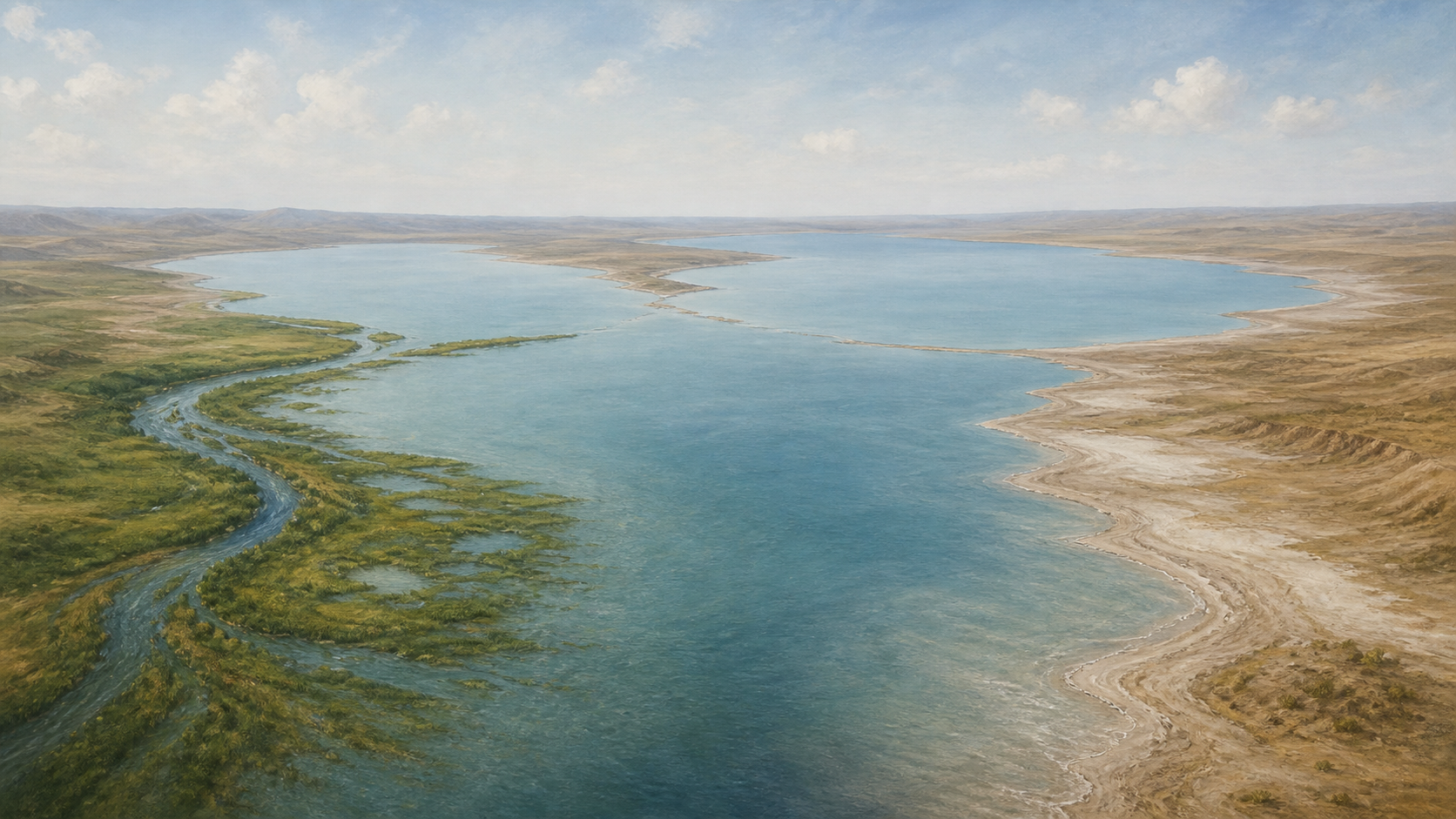
Editorial concept, not a map or satellite image. The greener Ili-fed west and drier eastern shore explain the water balance; salinity cannot be read from water colour.
This also corrects a common travel myth. You should not expect to stand at a narrow strait and watch blue freshwater meet a visibly different salty colour. The contrast is chemical and hydrological, not a permanent surface spectacle.
What Kazakhstan reported in January 2026
The latest retained government statement describes the level as stable, not as being in immediate collapse. On January 21, 2026, Kazakhstan’s Ministry of Water Resources and Irrigation said Ili inflow was near the long-term average and that Lake Balkhash was being maintained around 341 metres in the Baltic height system. The ministry also said about 30 billion cubic metres had reached the lake over the previous two years, helping stabilize the level.
That is a dated ministry report, not a guarantee about the next decade. The same statement discusses climate change, rising water use in neighbouring countries and preparation of a Kazakhstan-China agreement on transboundary water allocation. Those are reasons to keep monitoring the basin, not evidence for the old article’s invented 20 to 40 percent future withdrawal scenario.
The balanced reading is:
- current ministry position: the level was stable around 341 m in January 2026;
- current inflow position: Ili flow was described as near its long-term average;
- management action: roughly 30 billion cubic metres reached the lake over two years;
- unresolved context: transboundary allocation, climate and domestic water use still matter;
- evidence boundary: none of this proves that decline is impossible or inevitable.
The conservation plan is still work in progress
Kazakhstan began developing a basin-wide master plan, but the retained source describes a roadmap and study process rather than a finished rescue programme. In April 2025, the Ministry of Water Resources announced a Kazakhstan-France master-plan effort covering surface and groundwater analysis, a digital platform for lake-level monitoring, hydrological infrastructure and more efficient basin water use.
The announcement names the French Development Agency, France’s geological survey BRGM and local specialists. It also mentions cooperation with China on protecting and using Ili basin water. The ministry’s own wording says earlier action had been fragmented and that the plan was intended to create a more coherent approach across ecology, energy, agriculture and regional development.
For readers, the distinction is important. A roadmap is evidence that the problem is being addressed; it is not proof that every measure is funded, complete or effective. The article therefore avoids “saved” and “doomed” language.
Wildlife and landscape without inflated counts
Balkhash is ecologically valuable because a huge lake, reed wetlands, tugai vegetation and arid steppe meet in one basin. The Open Qazaqstan profile describes reed and rush habitat, willow and turanga groves, pelicans and cormorants, and mammals including wild boar, goitered gazelle, fox and badger around the Ili delta.
It also lists fish such as carp, asp, catfish, bream, grass carp and whitefish, and notes conservation concern around Balkhash whitefish and Balkhash perch. That is enough to establish a diverse ecosystem. The old article’s exact bird count, fishery tonnage range, record catch weights and basin-by-basin species claims were removed because the cited pages did not prove them.
Wildlife watching is not guaranteed from a city beach. The richest delta habitat is remote, seasonal and logistically different from a casual lakeside stay. Do not enter reed beds, spawning areas or protected zones on the assumption that the shoreline is open public terrain.
Is Lake Balkhash worth the trip?
Choose Balkhash for open horizons, water, steppe light and solitude, not for a polished resort circuit or a visible chemistry trick. It works best for travellers who enjoy slow overland journeys and can accept basic, changeable services.
| Your priority | Better plan |
|---|---|
| A first look with the least complexity | Base in Balkhash city and use an established nearby shore area |
| Swimming and a simple summer break | Confirm a maintained beach, current water advice and accommodation before travel |
| Landscape photography | Allow sunrise or evening on the shore and a separate weather buffer |
| Bektau-Ata scenery | Treat it as a separate road excursion, not a walk from the city beach |
| Ili delta wildlife | Use a knowledgeable local operator and verify access or protection rules |
| A short first trip to Kazakhstan | Prioritize Almaty-area landscapes; Balkhash usually consumes too much transit time |
The Open Qazaqstan page mentions Bektau-Ata as a defining feature of the wider region. It is an inland rocky landscape, not part of the lake beach. Combining the two can make a stronger trip, but only with suitable road planning, water and a driver who knows the route.
Getting there without stale schedules
Treat the journey as a long overland transfer and check the exact train or road plan for your date. The previous guide published fixed hour ranges, ticket prices, a highway label, “limited domestic flights” and a claim that no direct bus existed. None had a current exact source.
Use this planning sequence instead:
- Search the official Kazakhstan rail booking system for your origin, travel date and the Balkhash station shown on the ticket.
- Map the station or road arrival point to the actual accommodation before paying.
- Ask the property whether it arranges station pickup and which shore area it serves.
- If driving, download offline navigation and mark fuel stops before leaving a major city.
- Do not build a tight same-day connection after arrival; wind, road work and rail timings can change the plan.
From Almaty or Astana, Balkhash is not a quick day trip. If the itinerary has only a week, compare the transit cost with closer landscapes such as Charyn Canyon or the Kolsai Lakes.
When to visit and what to pack
The warm season is the practical window for a shore trip, while winter demands local experience and cold-weather planning. Open Qazaqstan characterizes the climate as sharply continental, with hot, dry summers and cold winters. It does not support one universal water-temperature calendar.
Late spring and early autumn can offer quieter light but also wind and sudden temperature changes. July and August are usually the simplest months for a beach-oriented plan, yet heat, insects and demand can be higher. Check a short-range forecast immediately before departure rather than copying an annual average.
Pack for exposure:
- more drinking water than the road plan appears to require;
- sun protection and a wind layer;
- offline maps and a charged power bank;
- first-aid supplies and any essential medication;
- closed footwear for rough or littered shore sections;
- cash as a backup, without assuming cards never work;
- a rubbish bag so everything you bring leaves with you.
Swimming, boating and fishing boundaries
A fresher western basin is not automatically potable, swimmable everywhere or free of local contamination. Use a maintained swimming area, read posted restrictions and ask the accommodation or local authorities for current water-quality and weather advice. Avoid stormy water, reed channels, industrial edges and unknown drop-offs. Children still require close supervision even where the near shore looks shallow.
Do not publish or rely on one permanent fishing rule. Seasons, spawning closures, zones, gear limits and permits can change. Ask the current territorial fisheries authority or a registered local operator before fishing. A guide who provides a boat should also explain safety equipment, weather cancellation and which rule authorizes the trip.
The same applies to boating. Lake scale, wind and sparse shore services make a small craft more consequential than it looks from land. Do not hire an unverified boat solely because someone offers a low cash price at the beach.
Before committing to a shore base, ask the property to identify its exact location on a map and describe the maintained access between the room and the water. “Lake Balkhash” can refer to a broad destination rather than a walkable beach. Confirm whether meals, drinking water, shade, toilets, secure parking and a staffed reception are available at the hours you need. If a boat or fishing trip is offered, request the operator’s name, passenger limit, safety equipment and weather cancellation rule in writing.
Use the first evening to inspect the shore and reassess the next day’s plan. Strong wind, poor visibility, litter, algae, industrial activity or an unsafe entry point are reasons to move the activity, not inconveniences to ignore because the trip was prepaid. Keep one land-based alternative and enough schedule margin to leave before a long onward transfer. The purpose of the buffer is to avoid turning a remote lake visit into a chain of rushed decisions.
Sources
Three exact Kazakhstan sources define the retained facts and their limits.
- Open Qazaqstan: Балқаш көлі for dimensions, inflowing rivers, the fresher west and more mineralized east, climate, landscape and representative wildlife.
- Ministry of Water Resources, January 21, 2026 for the dated 341 m level, near-average Ili inflow, two-year water volume and transboundary-policy context.
- Ministry of Water Resources, April 29, 2025 for the scope and development status of the Kazakhstan-France master plan.
Search previews, Wikipedia, generic World Bank/WMO/BirdLife homepages and an empty regional GOV.KZ capture were not used as evidence. No source in the retained set proves the old fishing prices, catch maxima, fixed journey times, exact tourist-season temperature bands or quantified China/climate projections.
Frequently Asked Questions
Why does Lake Balkhash have fresher and more mineralized water?
The Ili River brings abundant water into the western basin, keeping it fresher. The eastern basin receives less of that inflow and is more mineralized. Water still exchanges within the lake, so the popular 'half fresh, half salt' phrase is a simplification rather than two sealed halves.
Can you see where the fresh and salty parts meet?
Not as a permanent line of two colours. The difference is measured in water chemistry and varies by place and time. The central connection helps limit mixing, but it is not a reliable shore attraction for casual visitors.
Is Lake Balkhash drying up?
Kazakhstan's Water Ministry reported a stable level around 341 metres in January 2026 and near-average Ili inflow. It is also developing a basin master plan and transboundary measures, which shows that long-term water balance remains an active management issue. Current stability is neither proof of collapse nor a permanent guarantee.
Can you swim in Lake Balkhash?
Swimming is a warm-season activity at established shore areas, but conditions are local. Use a maintained beach, check current water and weather advice, supervise children and never treat the fresher western water as drinking water.
How do you get to Lake Balkhash?
Balkhash is a long overland trip from Kazakhstan's main visitor hubs. Rail and road are the practical options to check, but schedules, station details and road conditions are date-specific. Confirm the final transfer to your accommodation before booking.
What is the best first Lake Balkhash itinerary?
Use Balkhash city for a one- or two-night introduction, choose an established shore area and add Bektau-Ata only as a separately planned road excursion. The Ili delta is a specialist wildlife trip, not an easy extension from the city beach.
Do visitors need a fishing permit?
Rules can depend on season, zone, gear and current fisheries orders. Verify the live requirement with the territorial fisheries authority or a registered local operator rather than relying on a permanent online answer.
Last verified: August 22, 2026
Google Preferred Sources
See more Kazakhstan stories in Google
Add About Kazakhstan as a preferred source to find more of our fresh, relevant stories in Google Search.
More Stories
nature
Lake Kaindy, Kazakhstan: Sunken Forest & Saty Access Guide
Plan Lake Kaindy from Saty or Almaty with the park's official 11 km route, river crossings, walking approach, live fee check and safety rules.
nature
Big Almaty Lake: The Turquoise Lake 30 Minutes from the City
Big Almaty Lake guide - how to get there from Almaty, best time for turquoise color, hiking, and tips for a half-day mountain trip.
nature
Charyn Canyon Guide: Valley of Castles & Access
Plan Charyn Canyon from Almaty: Valley of Castles route, weather, safety, current park-access checks, and responsible travel advice.
nature
Altyn-Emel National Park: Routes, Basshi & Access Guide
Plan Altyn-Emel from Almaty: choose the Singing Dune, Aktau-Katutau or Besshatyr route, check live park fees and decide where to stay.
Plan the Next Step
travel
Kazakhstan Tourist Attractions: Choose the Right First-Trip Route
Compare Kazakhstan tourist attractions by base and logistics: Almaty nature, Turkestan heritage, Mangystau, Astana, Baikonur, and more.
food
Beshbarmak Recipe: How Kazakh Et Is Served
A source-checked guide to Kazakh et, widely called beshbarmak: what is on the platter, a practical home recipe, regional differences, and guest etiquette.
culture
Women in Kazakhstan: Rights, Work and Daily Life in 2026
Source-checked guide to women in Kazakhstan: current legal rights, dated work and wage data, marriage statistics, safety, and respectful language.
nature
Mangystau, Kazakhstan: Routes, Seasons and Trip Costs
Plan a Mangystau expedition from Aktau with current route, season, operator, sacred-site, safety and quote-check guidance for 2026.
nature
Kazakh Steppe: Landscape, Wildlife and How to Visit
Source-checked guide to the Kazakh steppe: its extent, Saryarka, Korgalzhyn, 2025 saiga data, seasons, and responsible access.
nature
Big Almaty Lake: The Turquoise Lake 30 Minutes from the City
Big Almaty Lake guide - how to get there from Almaty, best time for turquoise color, hiking, and tips for a half-day mountain trip.

Travel Writer & Local Expert · Almaty, Kazakhstan
Tugelbay Konabayev is a Kazakhstan-based travel writer who has lived in Almaty for 7+ years and Astana for 4+ years. He grew up in Aktobe, Kazakhstan and has covered Kazakh travel, food, culture, and visa policy with first-hand reporting since 2023.