Central Asia: Map, 5 Countries, Capitals & Borders
Reported from the ground: Tugelbay Konabayev is a Kazakh native (born in Aktobe) who has lived 7 years in Almaty and 4 in Astana. About the author.
In this article9 sections
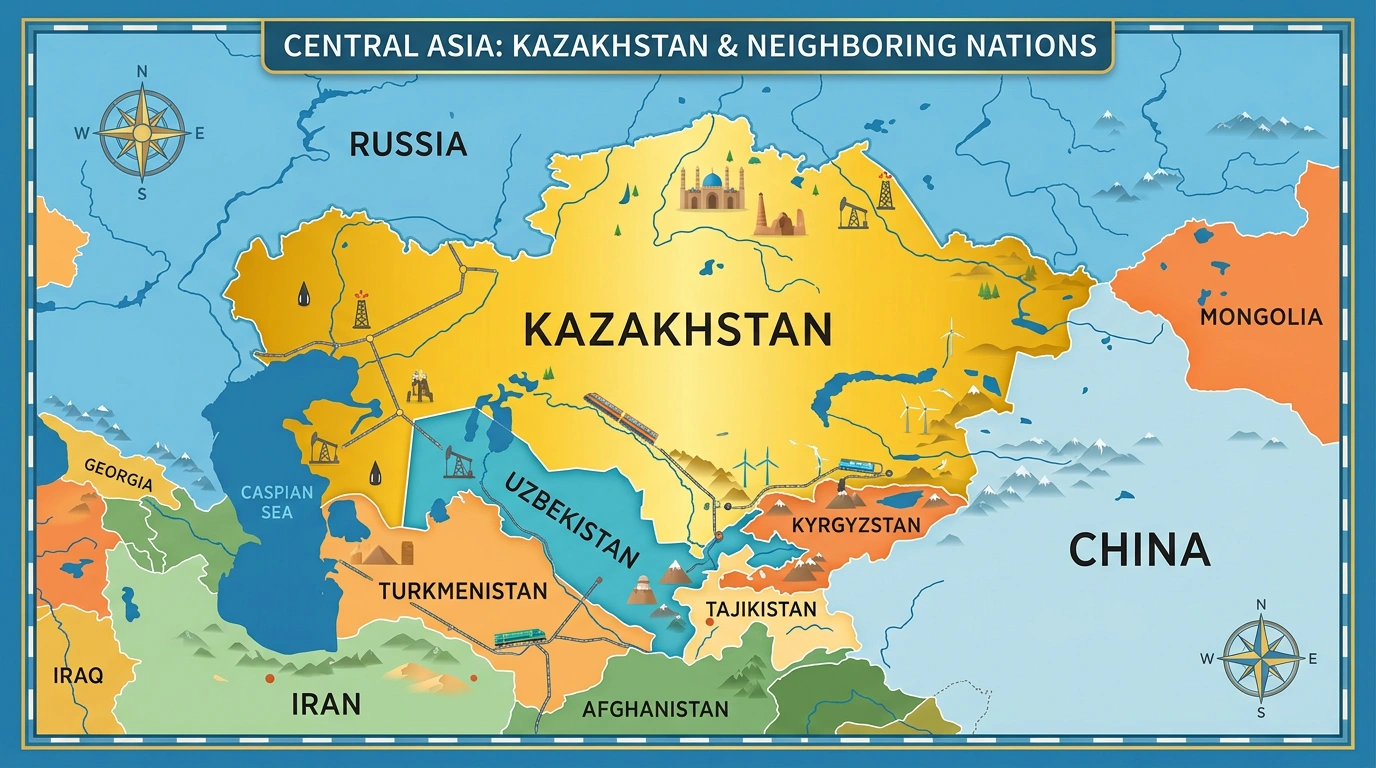
Central Asia usually means five countries: Kazakhstan, Uzbekistan, Kyrgyzstan, Tajikistan, and Turkmenistan. Britannica’s regional overview places them between Russia, China, Afghanistan, Iran, and the Caspian Sea. Together they cover roughly 4 million km² and had about 82.3 million residents in the World Bank 2024 snapshot used below. The values are not a synchronized 2026 census.
Central Asia on the Map: Exact Geographic Location
Central Asia occupies the interior of the Eurasian landmass, far from any ocean. There is no single official “center of Central Asia” coordinate because the result depends on the regional definition and calculation method.
Here is how the region is bordered on all four sides:
- North: Russia (the longest border, stretching over 7,600 km along Kazakhstan’s northern edge)
- East: China (Xinjiang Uyghur Autonomous Region), sharing borders with Kazakhstan, Kyrgyzstan, and Tajikistan
- South: Afghanistan (bordering Tajikistan, Uzbekistan, and Turkmenistan) and Iran (bordering Turkmenistan)
- West: The Caspian Sea (bordered by Kazakhstan and Turkmenistan), with the Caucasus and Russia beyond
The five countries have no direct access to an ocean. The Caspian and Aral are inland water bodies, so freight depends heavily on land corridors and Caspian port connections. The World Bank’s Central Asia overview discusses growth and connectivity, but growth rankings change by forecast year and should not be turned into an undated “fastest-growing” claim.
The 5 Central Asian Countries: Quick Profiles
The United Nations officially defines Central Asia as five post-Soviet republics, all of which gained independence in 1991. Here is a comparison of each country:
| Country | Capital | Area (km²) | Population snapshot | State/official language note |
|---|---|---|---|---|
| Kazakhstan | Astana | 2,724,900 | 20.6M (2024) | Kazakh |
| Uzbekistan | Tashkent | 448,978 | 36.4M (2024) | Uzbek |
| Kyrgyzstan | Bishkek | 199,951 | 7.2M (2024) | Kyrgyz; Russian also official |
| Tajikistan | Dushanbe | 143,100 | 10.6M (2024) | Tajik (Persian) |
| Turkmenistan | Ashgabat | 488,100 | 7.5M (2024) | Turkmen |
Sources: World Bank and CIA World Factbook 2024 population snapshots. Consult each country’s current statistics office for a synchronized comparison.
Total region: about 4.0 million km² and 82.3 million people in the World Bank 2024 snapshot; later national revisions will differ.
Kazakhstan: The Giant
Kazakhstan accounts for about 68% of the five-country region’s land area. Its geography stretches from the Caspian coast across the Kazakh Steppe to the Altai and Tian Shan.
Uzbekistan: The Cultural Heart
Uzbekistan is the most populous Central Asian country in the table’s World Bank 2024 snapshot (36.4 million). The Silk Road cities of Samarkand, Bukhara, and Khiva contain major Islamic architectural ensembles. Visa eligibility is passport- and date-specific and must be checked with Uzbekistan’s current official rules.
Kyrgyzstan: The Mountain Republic
Over 90% of Kyrgyzstan lies above 1,500 meters, earning it the nickname “the Switzerland of Central Asia.” Lake Issyk-Kul, the world’s second-largest alpine lake, sits at 1,607 meters. Kyrgyzstan is the most democratic of the five countries and has the most developed trekking and adventure tourism infrastructure.
Tajikistan: The Roof of the World
Tajikistan is the poorest Central Asian country by GDP per capita but arguably the most dramatic in landscape. The Pamir Mountains (known locally as “the Roof of the World”) dominate the eastern Gorno-Badakhshan region, with peaks exceeding 7,000 meters. The Pamir Highway is one of the world’s greatest road trips. Tajikistan is the only Central Asian country where the dominant language is Persian (Tajik), not Turkic.
Turkmenistan: The Hermit State
Turkmenistan is one of the world’s most isolated and authoritarian nations. The Karakum Desert covers roughly 80% of the country. Despite this, Turkmenistan sits on the world’s fourth-largest natural gas reserves. The Darvaza Gas Crater (“Door to Hell”), a burning natural gas field that has been alight since 1971, is its most famous attraction. Independent tourism is extremely restricted; most visitors require a government-approved guide.
Broader Definitions: What Else Counts as Central Asia?
The five-country definition is standard, but broader definitions exist:
- UNESCO’s definition includes Afghanistan, Mongolia, northeastern Iran, northern Pakistan, and parts of western China (Xinjiang and Tibet). This “greater Central Asia” reflects historical and cultural continuity rather than modern political borders.
- The Soviet definition was essentially the four southern republics (Uzbekistan, Kyrgyzstan, Tajikistan, Turkmenistan) grouped as “Средняя Азия” (Middle Asia), with Kazakhstan classified separately as part of a broader “Kazakhstan and Central Asia” concept.
- Geopolitical definitions sometimes include Afghanistan (sharing ethnic Uzbek and Tajik populations in its north) and Mongolia (steppe culture, nomadic heritage). The countries ending in “-stan” also include Afghanistan and Pakistan, both of which share cultural roots with the region.
For most practical purposes (travel, diplomacy, and statistics), Central Asia means the five post-Soviet republics.
Geographic Features: Steppes, Deserts, Mountains, and Rivers
Central Asia’s landscape is extraordinarily diverse, ranging from flat grasslands at sea level to peaks above 7,000 meters within a few hundred kilometers.
The Steppe
The Kazakh Steppe is part of the vast Eurasian steppe belt, stretching from Hungary to Mongolia. In Central Asia, it dominates northern and central Kazakhstan, one of the world’s largest unbroken grassland ecosystems. These flat, treeless plains enabled the horse-mounted nomadic cultures that shaped history: the Scythians (8th–3rd century BCE), the Huns (4th–5th century CE), the Mongols (13th century), and the Kazakh nomads (15th–19th century) all emerged from or moved through the Central Asian steppe.
The Deserts
Central Asia contains several major deserts:
- Kyzylkum Desert (“Red Sand”), shared between Uzbekistan and Kazakhstan, approximately 298,000 km². Despite its name, it contains significant deposits of gold, uranium, and natural gas.
- Karakum Desert (“Black Sand”), covering roughly 350,000 km², or about 80% of Turkmenistan. The Darvaza Gas Crater sits in its northern reaches.
- Ustyurt Plateau: a high desert plateau between the Caspian and Aral seas, shared by Kazakhstan and Uzbekistan. Its dramatic chalk cliffs and canyons are increasingly popular with adventurous travelers.
The Mountain Systems
Central Asia’s mountains are among the highest and most dramatic on Earth:
- Tian Shan (“Heavenly Mountains”), running east-west through Kazakhstan, Kyrgyzstan, and into China’s Xinjiang. The highest peak, Jengish Chokusu (Victory Peak), reaches 7,439 meters. The range forms the spectacular backdrop to Almaty, Kazakhstan’s largest city.
- Pamir Mountains (“Roof of the World”), predominantly in Tajikistan, with extensions into Afghanistan, China, and Kyrgyzstan. Ismoil Somoni Peak reaches 7,495 meters, the highest point in the former Soviet Union.
- Altai Mountains, in northeastern Kazakhstan and extending into Russia, Mongolia, and China. Lower than the Tian Shan (peaks to ~4,500 m) but extraordinarily beautiful, with dense taiga forests and glaciated valleys.
- Hindu Kush and Karakoram: the southernmost mountain systems, in the border zone between Tajikistan, Afghanistan, and Pakistan.
The Rivers
Two great river systems defined Central Asian civilization:
- Amu Darya (the ancient Oxus), flowing from the Pamir glaciers of Tajikistan through Afghanistan, Uzbekistan, and Turkmenistan. Historically it fed the Aral Sea; today most of its water is diverted for irrigation.
- Syr Darya (the ancient Jaxartes), flowing from the Tian Shan in Kyrgyzstan through Uzbekistan and Kazakhstan to the Aral Sea. Like the Amu Darya, Soviet-era cotton irrigation decimated its flow.
- Ili River, flowing from China through Kazakhstan into Lake Balkhash, Central Asia’s second-largest lake.
These river systems created the oasis civilizations (Samarkand, Bukhara, Khiva, Merv) where the Silk Road cities flourished for centuries.
Historical Significance: From the Silk Road to the Soviet Union
Central Asia was not peripheral to world history; it was the crossroads. For over two thousand years, the region connected Chinese, Indian, Persian, and European civilizations.
The Silk Road (2nd Century BCE – 15th Century CE)
The network of trade routes connecting China with the Mediterranean ran directly through Central Asia. Samarkand and Bukhara became two of the wealthiest and most cosmopolitan cities on Earth, where Chinese silk, Indian spices, Persian metalwork, and Roman glass were exchanged. These cities were also major centers of Islamic scholarship. According to UNESCO’s Silk Roads Programme, the region was also a center of scientific learning. The mathematician al-Khwarizmi (from whom we get the word “algorithm”) and the physician Avicenna (Ibn Sina) both came from Central Asia.
The Mongol Empire (13th Century)
Genghis Khan conquered Central Asia between 1219 and 1221, destroying many of its great cities (Bukhara, Samarkand, Merv, Urgench). According to Britannica’s article on the Mongol Empire, contemporary accounts describe the sack of Samarkand as one of the most catastrophic urban destructions of the medieval period, with population estimates suggesting the city lost the majority of its inhabitants. His successors, particularly Chagatai Khan, ruled Central Asia for over a century. The Mongol period, though devastatingly violent initially, eventually reopened the Silk Road and enabled cultural exchange across all of Eurasia.
Timur and the Timurid Renaissance (1370–1507)
Timur (Tamerlane), born near Samarkand, built a vast empire stretching from India to Turkey. He made Samarkand his capital and filled it with the world’s finest Islamic architecture: the Registan, Bibi-Khanym Mosque, and Gur-e-Amir mausoleum. His descendants presided over a remarkable cultural renaissance, producing the astronomer Ulugh Beg and the painter Kamaleddin Behzad.
The Great Game and Russian Conquest (19th Century)
The Russian Empire absorbed the Kazakh steppe gradually through the 18th and 19th centuries, then conquered the Central Asian khanates by military force. Tashkent fell in 1865, Samarkand in 1868, Khiva in 1873, and the Turkmen fortress of Geok Tepe in 1881. Meanwhile, Britain pushed northward from India. This rivalry for control of Central Asia was dubbed “the Great Game.”
The Soviet Period (1917–1991)
Stalin-era policies created the five Soviet Socialist Republics with borders deliberately drawn to cut across ethnic lines, a divide-and-rule strategy. Forced collectivization destroyed the Kazakh nomadic economy, causing the devastating famine of 1931–1933 that killed an estimated 1.5 million Kazakhs (roughly 40% of the population). According to Wikipedia’s article on the Kazakh famine of 1930-1933, some estimates place the death toll even higher, at 38-42% of the entire Kazakh population. Soviet irrigation projects drained the Aral Sea (once the world’s fourth-largest lake) into an environmental catastrophe. The Virgin Lands campaign (1954–1960s) converted millions of hectares of Kazakh steppe into wheat farms.
Independence (1991–Present)
All five countries declared independence when the Soviet Union collapsed. They have taken markedly different paths: Kazakhstan became the most economically successful (driven by oil and mineral wealth); Uzbekistan the most culturally rich and populous; Kyrgyzstan the most democratic (with two revolutions); Tajikistan the poorest (scarred by a civil war, 1992–1997); and Turkmenistan the most isolated authoritarian state.
Is Central Asia in Europe or Asia?
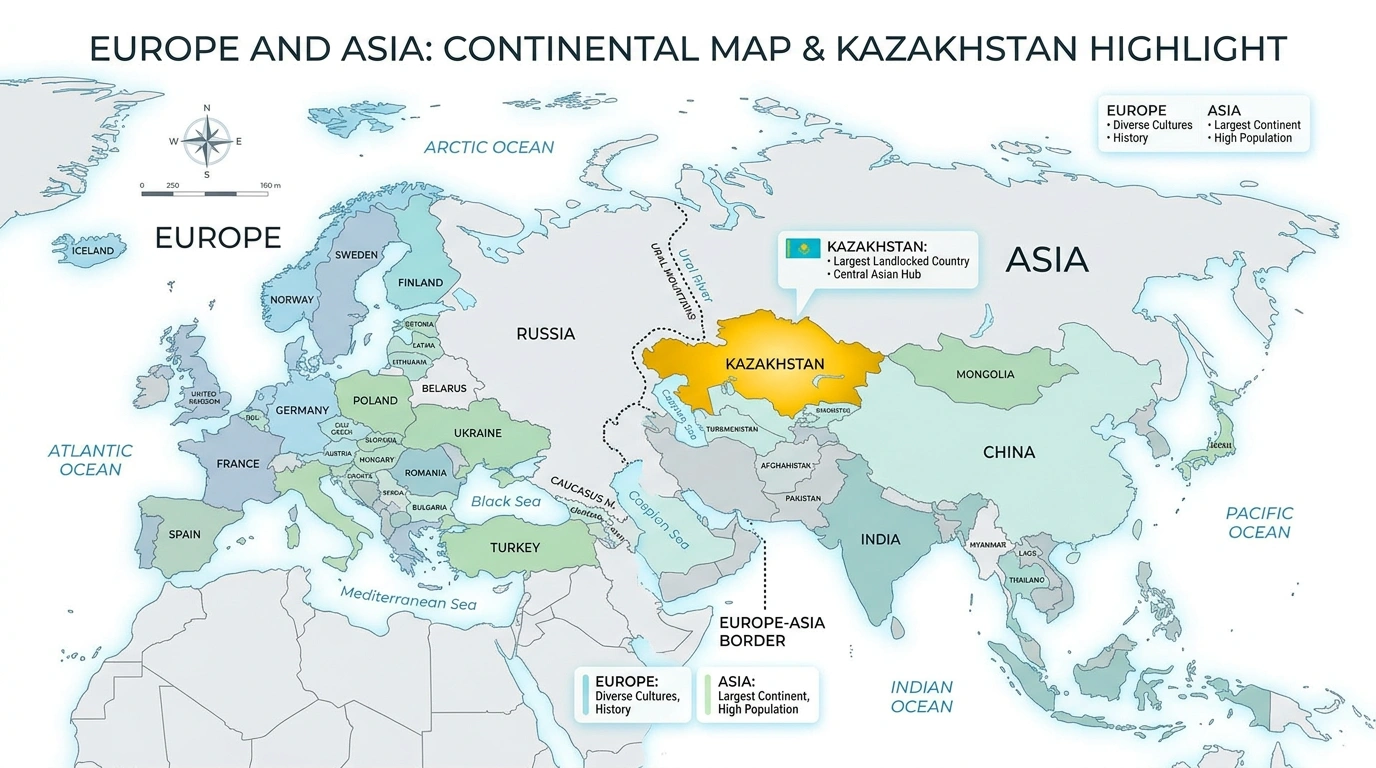
Central Asia is definitively in Asia. However, this question arises because Kazakhstan straddles the conventional Europe-Asia boundary. The standard geographic division runs along the Ural Mountains, down the Ural River, and along the Caspian Sea’s western shore. A small sliver of northwestern Kazakhstan (roughly 4–5% of its territory, west of the Ural River) technically falls on the European side of this divide.
Despite this technicality, no international organization classifies any Central Asian country as European. Kazakhstan competes in both Asian and European sports federations (notably UEFA for football) for practical reasons, but geographically and culturally, Central Asia is Asian, with deep Turkic, Persian, and Mongol roots rather than European ones.
Climate: Extreme Continentality
Central Asia has one of the most extreme continental climates on Earth. Far from any moderating ocean influence, the region experiences:
- Scorching summers: Temperatures in the Karakum and Kyzylkum deserts regularly exceed 45°C (113°F) in July. Tashkent averages 36°C in summer.
- Brutal winters: Northern Kazakhstan regularly sees temperatures below −30°C (−22°F) in January. According to Wikipedia’s list of cities by average temperature, Astana is the second-coldest capital city in the world (after Ulaanbaatar).
- Low rainfall: Most of Central Asia receives less than 300 mm of precipitation annually. The deserts receive under 100 mm.
- Massive temperature swings: Almaty can see −25°C in January and +35°C in July, a 60°C annual range.
The best time to visit is April–June and September–October, when temperatures are moderate (15–28°C) and the landscape is at its most beautiful, wildflowers on the steppe in spring, golden foliage in autumn.
Population and Languages
Central Asia had about 82.3 million people in the World Bank 2024 snapshot used here, with Uzbekistan the most populous of the five. Do not add country figures from different years and label the result as a current regional census.
The Turkic Language Family
According to UNESCO’s Atlas of the World’s Languages in Danger, several smaller languages of Central Asia including Shor, Khorasani Turkic, and various Pamiri languages are classified as endangered, reflecting the linguistic diversity of a region where dozens of languages have coexisted for millennia.
Four of the five Central Asian languages belong to the Turkic language family:
- Kazakh, spoken by 20+ million people, closely related to Kyrgyz
- Uzbek, spoken by 37+ million, the most widely spoken Central Asian language
- Kyrgyz, spoken by 7+ million, mutually intelligible with Kazakh to a significant degree
- Turkmen, spoken by 7+ million, more closely related to Turkish and Azerbaijani
Tajik: The Persian Exception
Tajik is the one non-Turkic Central Asian language, it is a variety of Persian (Farsi), mutually intelligible with the Persian spoken in Iran and the Dari spoken in Afghanistan. This reflects the deep Persian cultural influence across Central Asia, particularly in the great cities of Samarkand and Bukhara (where Persian was the language of literature and governance for centuries).
Russian as a Lingua Franca
Russian remains widely spoken across the region as a legacy of Soviet rule. Among the five countries, only Kyrgyzstan grants Russian formal status as an official language; in Kazakhstan, Russian is not an official language but is used in state bodies alongside Kazakh under the Constitution. It is commonly used in business, education, and inter-ethnic communication across all five countries. However, all five nations are actively promoting their national languages, and Russian fluency is declining among younger generations.
Why Central Asia Matters Today
Central Asia is increasingly relevant in global geopolitics, energy, and trade:
- Energy resources: According to the World Nuclear Association, Kazakhstan is the world’s largest uranium producer (43% of global supply), a top-15 oil producer, and holds massive natural gas reserves. Turkmenistan has the world’s fourth-largest gas reserves. Uzbekistan is a significant gold producer.
- China’s Belt and Road Initiative (BRI): Central Asia is the overland corridor for China’s signature infrastructure project. New railways, highways, and pipelines are transforming the region’s connectivity, echoing the ancient Silk Road.
- Russia-China competition: Both powers vie for influence. Russia retains military bases and cultural ties; China offers investment and trade. The Shanghai Cooperation Organisation (SCO), headquartered in Beijing, includes all five Central Asian states.
- Water and climate: Disputes over the Amu Darya and Syr Darya water rights are intensifying as upstream countries (Kyrgyzstan, Tajikistan) build hydroelectric dams and downstream countries (Uzbekistan, Turkmenistan) depend on irrigation. Climate change is accelerating glacier melt in the Tian Shan and Pamirs, threatening long-term water security.
- The “Middle Corridor”: Since Russia’s 2022 invasion of Ukraine disrupted northern trade routes, the Trans-Caspian International Transport Route (Middle Corridor) through Central Asia has gained enormous strategic importance as an alternative freight link between China and Europe.
Central Asia’s geographic position, between the world’s two largest economies (China and the EU) and two nuclear powers (Russia and China), ensures the region will only grow in strategic significance.
Frequently Asked Questions
Where exactly is Central Asia located?
Central Asia is in the interior of Eurasia between Russia, China, Afghanistan, Iran, and the Caspian Sea. A common five-country map spans roughly 35°N to 55°N and 46°E to 87°E, but there is no single official center coordinate because definitions and calculation methods differ.
What countries are in Central Asia?
Central Asia comprises five countries: Kazakhstan, Uzbekistan, Kyrgyzstan, Tajikistan, and Turkmenistan. All five are former Soviet republics that gained independence in 1991. Kazakhstan is the largest by area. Uzbekistan is the most populous at 36.4 million in the World Bank 2024 snapshot. Broader definitions sometimes include Afghanistan, Mongolia, and parts of western China.
Is Central Asia in Europe or Asia?
Central Asia is definitively in Asia. However, a small portion of northwestern Kazakhstan (about 4-5% of its territory, west of the Ural River) technically falls on the European side of the conventional Europe-Asia boundary. No international organization classifies any Central Asian country as European. The region's cultural roots are Turkic, Persian, and Mongol rather than European.
What languages are spoken in Central Asia?
Four of the five Central Asian countries speak Turkic languages: Kazakh, Uzbek, Kyrgyz, and Turkmen. Tajikistan speaks Tajik, which is a variety of Persian. Russian is widely spoken across the entire region as a legacy of Soviet rule and serves as a lingua franca for inter-ethnic communication. Among the five, only Kyrgyzstan grants Russian formal official-language status; Kazakhstan recognizes only Kazakh as its state language, while permitting Russian to be used alongside Kazakh in state bodies under its Constitution.
Is Central Asia safe to visit?
Safety and entry conditions differ by country, border region, passport, and date. Check the current government travel advisory for every country on the route, especially border and mountain areas, rather than applying one regional rating to all five states.
What is Central Asia known for?
Central Asia is known for the ancient Silk Road cities of Samarkand, Bukhara, and Khiva (Uzbekistan); the vast Kazakh Steppe; the Tian Shan and Pamir mountain ranges; Lake Issyk-Kul (Kyrgyzstan); the Aral Sea environmental disaster; the Darvaza Gas Crater in Turkmenistan; nomadic horse culture; and extraordinary Islamic architecture. Historically, it was the crossroads connecting China, India, Persia, and Europe.
Last verified: July 10, 2026. Regional totals are explicitly treated as mixed-source estimates rather than a synchronized census.
Google Preferred Sources
See more Kazakhstan stories in Google
Add About Kazakhstan as a preferred source to find more of our fresh, relevant stories in Google Search.
More Stories
facts
Where Is Kazakhstan? Map, Borders, Size & Central Asia Location
Where is Kazakhstan? Map, Central Asia location, borders with Russia and China, 2.7 million km2 size, nearby countries, capitals, and regions.
facts
Countries Ending in -stan: The 7 Names Explained
Seven country names end in -stan. Learn what the suffix means, why five are in Central Asia, and why the names do not describe one uniform region.
facts
Is Kazakhstan in Europe or Asia? The Accurate Answer
Kazakhstan is classified in Central Asia, although one common Europe-Asia boundary places a small part of western Kazakhstan in Europe.
facts
Kazakhstan Visa-Free Countries 2026: MFA Policy Data
Kazakhstan visa-free countries 2026 from the MFA table: Russia 90 days, Western countries 30 days, 87 ordinary-passport rows, CSV dataset.
Plan the Next Step
travel
Kazakhstan Tourist Attractions: Choose the Right First-Trip Route
Compare Kazakhstan tourist attractions by base and logistics: Almaty nature, Turkestan heritage, Mangystau, Astana, Baikonur, and more.
food
Beshbarmak Recipe: How Kazakh Et Is Served
A source-checked guide to Kazakh et, widely called beshbarmak: what is on the platter, a practical home recipe, regional differences, and guest etiquette.
culture
Women in Kazakhstan: Rights, Work and Daily Life in 2026
Source-checked guide to women in Kazakhstan: current legal rights, dated work and wage data, marriage statistics, safety, and respectful language.
facts
Kazakhstan Economy in 2026: GDP, Trade, Oil and Growth
Kazakhstan's economy in 2026: 2025 GDP, sector shares, oil and uranium exports, trade partners, inflation, agriculture and the IMF outlook.
facts
Silk Road Kazakhstan: Cities, Routes & Sites
Explore Kazakhstan Silk Road sites: Turkistan, Otyrar, Sauran, Taraz, UNESCO distinctions, route planning, and responsible visits.
food
Popular Food in Kazakhstan: 15 Foods and Drinks to Try
Popular food in Kazakhstan explained: 15 Kazakh dishes and drinks, what each contains, how meals are served, and what to ask before ordering.

Travel Writer & Local Expert · Almaty, Kazakhstan
Tugelbay Konabayev is a Kazakhstan-based travel writer who has lived in Almaty for 7+ years and Astana for 4+ years. He grew up in Aktobe, Kazakhstan and has covered Kazakh travel, food, culture, and visa policy with first-hand reporting since 2023.