Kazakhstan Flag: Meaning, Symbolism & Colors
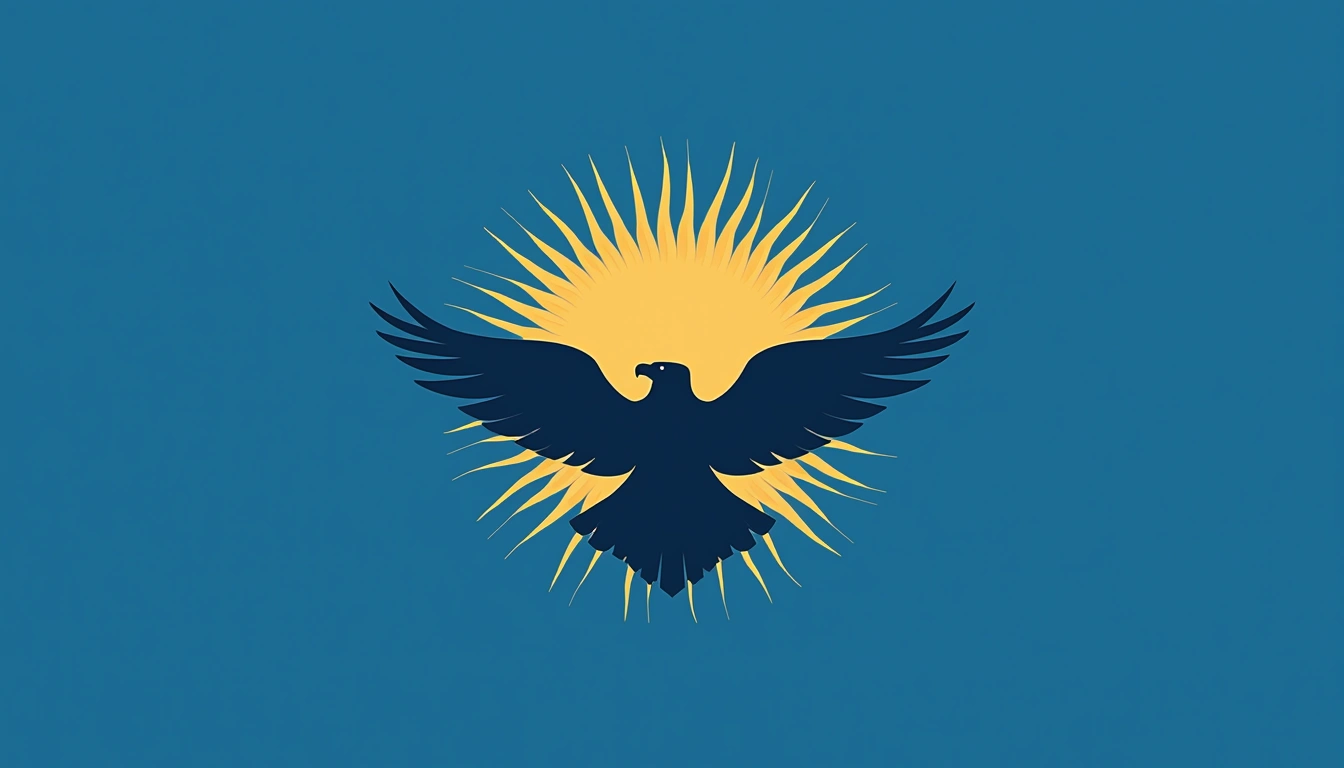
The Kazakhstan flag features a sky blue background with a golden sun radiating 32 rays at the center, a soaring steppe eagle (berkut) beneath the sun, and a vertical golden koshkar-muiz (ram’s horn) ornamental pattern along the hoist side. Adopted on June 4, 1992, the flag was designed by Kazakh artist Shaken Niyazbekov and selected from over 1,000 competition entries. The blue represents the Turkic sky and peace, the gold symbolizes wealth and energy, the eagle embodies freedom and power, and the ornament reflects the artistic heritage of the Kazakh people. It is one of the most distinctive and symbolic national flags in the world.
What the Kazakhstan Flag Looks Like
The flag of Kazakhstan has a 1:2 proportion (height to width). The entire field is a uniform sky blue (cerulean), with all design elements rendered in gold. The golden sun with 32 grain-shaped rays sits in the upper-center of the flag. Directly beneath it, a steppe eagle soars with wings fully spread. Along the left (hoist) side, a vertical strip of traditional Kazakh ornament, the koshkar-muiz pattern, runs the full height of the flag, occupying roughly one-ninth of the total width.
There are only two colors on the flag: sky blue and gold. This deliberate simplicity gives the flag a clean, instantly recognizable silhouette. Unlike many national flags that use three or more colors, Kazakhstan’s two-color scheme carries concentrated symbolism in every element.
The flag is flown at all government buildings, schools, embassies, and international sporting events. It has become a powerful symbol of national identity since Kazakhstan’s independence in 1991.
Meaning of the Sky Blue Background
The sky blue color (көк / kök in Kazakh) is the most symbolically significant element of the flag. In Kazakh culture and across Turkic civilizations, blue carries layers of meaning:
- Tengri (the Eternal Sky): In the pre-Islamic Turkic belief system, Tengri was the supreme sky deity. The blue field directly references this ancient spiritual tradition that shaped Kazakh identity for millennia.
- Peace and tranquility: Blue universally symbolizes peace, and for Kazakhstan it represents the country’s commitment to harmony among its 130+ ethnic groups.
- Freedom: The endless blue sky above the Kazakh steppe is the defining image of nomadic liberty. Kazakhs traditionally associated the open sky with boundless possibility.
- Unity: A single unbroken color across the entire flag represents the Kazakh people united under one sky.
The specific shade is a clear, bright cerulean, not turquoise, not navy. It intentionally recalls the blue banners historically used by the Kazakh Khanate and other Turkic states. In Central Asian vexillology, Kazakhstan is the only country that uses blue as the sole background color, making it immediately distinguishable from its neighbors.
The blue also connects to a broader Turkic tradition: the Göktürk (Blue Turk) Khaganate of the 6th–8th centuries used blue as their imperial color. This heritage runs through Kazakh national consciousness and is reflected in official branding, sports uniforms, and the architecture of Astana.
Meaning of the Golden Sun with 32 Rays
At the upper center of the flag, a golden sun radiates 32 rays outward. The sun is one of the oldest and most universal symbols in human civilization, but on the Kazakhstan flag it carries specific national meaning:
- Life and energy: The sun sustains all life on the steppe, from the grasslands that fed nomadic herds to the wheat fields that make Kazakhstan one of the world’s top grain exporters today.
- Wealth and abundance: The gold color represents both the sun’s warmth and Kazakhstan’s vast mineral wealth, including gold, uranium, and oil reserves.
- The future: A radiant sun symbolizes Kazakhstan as a young, rising nation moving toward prosperity and development.
Why exactly 32 rays? The 32 rays are deliberately shaped to resemble grains of wheat (бидай / biday). This references Kazakhstan’s agricultural power; the country is consistently among the world’s top ten wheat exporters, and the steppe was historically called the “breadbasket” of the Soviet Union. The wheat-grain shape also reinforces the idea of abundance and sustenance.
The sun sits slightly above the geometric center of the flag, positioned in the upper half to suggest it is high in the sky at its most powerful, not rising or setting, but at full strength.
Meaning of the Steppe Eagle (Berkut)
Below the sun, a golden steppe eagle soars with wings spread wide. This is the berkut (golden eagle, Aquila chrysaetos), the most culturally significant bird in Kazakhstan and a central figure in Kazakh nomadic tradition.
The eagle represents:
- Freedom: Soaring above the steppe without constraint, the eagle embodies the Kazakh ideal of liberty and independence.
- Power and courage: As the apex predator of the Central Asian skies, the eagle signifies strength and fearlessness.
- Far-sightedness: The eagle’s legendary vision symbolizes a nation looking clearly into its future.
- Nomadic heritage: Eagle hunting (berkutchi / кұсбегі) has been practiced by Kazakhs for over 4,000 years. The tradition is recognized by UNESCO as Intangible Cultural Heritage and remains alive in western Kazakhstan today.
The eagle is depicted from below, showing its full wingspan as it soars high above the viewer. This perspective is intentional: it places the observer on the ground, looking up at the eagle against the blue sky. The posture is not aggressive (the talons are not extended in attack) but rather majestic, implying free and confident flight.
The eagle flies toward the sun, which symbolically represents Kazakhstan advancing toward its future. This directional symbolism (creature moving toward light) is a powerful and deliberate design choice by Niyazbekov.
On the flag, the eagle also serves a practical function: its large, detailed silhouette makes the Kazakhstan flag identifiable even at a distance or in low wind, when other flags might hang limp and unreadable.
Meaning of the Koshkar-Muiz Ornamental Pattern
Along the left (hoist) side of the flag runs a vertical golden stripe of traditional Kazakh ornament called koshkar-muiz (қошқар мүйіз), which translates literally as “ram’s horns.”
The koshkar-muiz is the most fundamental and ancient pattern in Kazakh decorative art. It appears on:
- Syrmak and tuskiiz (felt carpets and embroidered wall hangings in yurts)
- Clothing and jewelry: traditional Kazakh silver and gold ornaments
- Architectural elements: from ancient mausoleums to modern buildings in Astana and Almaty
- Horse tack and saddles: reflecting the centrality of horses in nomadic life
- The shanyrak: the circular crown of the yurt, which also features ram’s horn motifs
The pattern is a pair of symmetrical spirals that mirror each other, creating a continuous interlocking design. The spiral form represents:
- Continuity and infinity: The spirals have no clear beginning or end, suggesting the eternal cycle of life.
- Prosperity: Rams and livestock were the primary measure of wealth in nomadic Kazakh society.
- Artistic identity: The ornament declares that this flag belongs to the Kazakh people specifically, not generically to any Turkic or Central Asian nation.
The ornamental stripe occupies approximately one-ninth of the flag’s width and runs the full height. In Niyazbekov’s original design, the ornament was on the right side, but it was moved to the left (hoist) during the approval process so it would be the first element seen when the flag unfurls.
Designer of the Kazakhstan Flag: Shaken Niyazbekov
The flag of Kazakhstan was designed by Shaken Onlassynuly Niyazbekov (1938–2014), a Kazakh artist, designer, and Honored Art Worker of the Republic of Kazakhstan. Niyazbekov’s design was selected through a national competition held in early 1992, shortly after Kazakhstan declared independence on December 16, 1991.
According to the Kazakhstan National Archives, the competition attracted over 1,000 submissions from artists across the country. Niyazbekov’s design stood out for its clean composition, deep symbolism, and distinctive color palette. The selection jury included artists, historians, and government officials, and the final design was approved by the Supreme Council of the Republic of Kazakhstan.
Key facts about Niyazbekov and the design process:
- Original submission had the ornamental stripe on the right side; it was moved to the hoist (left) side on the recommendation of the jury.
- The shade of blue was debated extensively. Niyazbekov advocated for the specific cerulean that was ultimately adopted, arguing it best represented the Kazakh sky.
- Niyazbekov also contributed to the design of other state symbols and was active in Kazakh visual arts throughout his career.
- He received the state award “Honored Art Worker of Kazakhstan” partly in recognition of his flag design.
According to Shaken Niyazbekov memorial records maintained by the Kazakh Ministry of Culture, Niyazbekov passed away in 2014, but his creation flies over every government building, school, and embassy, a lasting legacy seen daily by millions.
Flag Dimensions, Color Codes & Technical Specifications
For designers, developers, and vexillologists, here are the precise technical specifications of the Kazakhstan flag:
Official Dimensions
| Element | Specification |
|---|---|
| Proportions | 1:2 (height to width) |
| Ornamental stripe width | 1/9 of total flag width |
| Sun position | Upper half, centered horizontally |
| Sun rays | 32, wheat-grain (lance-ovate) shape |
| Eagle position | Below sun, centered |
| Adopted | June 4, 1992 |
| Designer | Shaken Niyazbekov |
Color Codes for Web Developers
| Color | Pantone | Hex | RGB |
|---|---|---|---|
| Sky Blue | 299 C | #00AFCA | rgb(0, 175, 202) |
| Gold | 116 C | #FFC72C | rgb(255, 199, 44) |
These are the most commonly referenced values. Exact shades may vary slightly between government sources and Pantone editions. The official standard is defined in Kazakhstan’s state flag law, which specifies Pantone references rather than digital color codes.
For CSS usage:
- Background:
#00AFCA(sky blue) - Sun, eagle, ornament:
#FFC72C(gold)
Historical Flags: From Kazakh Khanate to Independence
Kazakhstan’s current flag is the product of centuries of vexillological evolution. Understanding the historical flags provides context for why the modern design looks the way it does.
The Kazakh Khanate (1465–1847)
The Kazakh Khanate did not have a single standardized flag in the modern sense, but historical records and miniature paintings show that Kazakh rulers used blue banners, consistent with the broader Turkic tradition of associating blue with the sky and political authority. The kök (blue) banners were carried into battle and displayed at khan’s courts.
This blue tradition is the direct ancestor of the modern flag’s color choice. When Niyazbekov selected sky blue for the post-independence flag, he was reaching back across centuries to reconnect with pre-colonial Kazakh statehood.
Alash Autonomy (1917–1920)
During the brief period of the Alash Autonomy (the first attempt at modern Kazakh self-governance), a blue flag with a white crescent was used. This flag reflected both Turkic (blue) and Islamic (crescent) identity, and it foreshadowed the blue that would return in 1992.
Kazakh SSR (1953–1991)
Under Soviet rule, the Kazakh Soviet Socialist Republic used a flag that followed the standard Soviet template:
- Red background: representing Soviet communism
- Blue horizontal stripe: at the lower portion, a token reference to Kazakh identity
- Golden hammer and sickle: the universal Soviet symbol
- Golden star: above the hammer and sickle
The contrast with the post-independence flag could not be more complete. The red of Soviet ideology was entirely replaced with the sky blue of Kazakh identity. The hammer and sickle gave way to the eagle and sun of nomadic civilization. This visual break was intentional: the new flag declared that Kazakhstan was no longer a Soviet republic but a sovereign nation rooted in its own history.
Transition (1991–1992)
After independence was declared on December 16, 1991, Kazakhstan briefly continued using the Kazakh SSR flag while the national competition was held. The new flag was officially adopted on June 4, 1992, marking the symbolic completion of independence.
Flag Etiquette and Laws in Kazakhstan
Kazakhstan has strict regulations governing how the national flag must be displayed, handled, and respected. These rules are codified in the Law on State Symbols of the Republic of Kazakhstan (adopted June 4, 2007, with amendments).
Display Rules
- The flag must be flown at all government buildings, courts, schools, and military installations during working hours.
- At international events, the Kazakhstan flag must be flown at the same height as other nations’ flags, never lower.
- When displayed with other flags, the Kazakhstan flag occupies the position of honor (far left from the viewer’s perspective, or center in an odd-numbered row).
- The flag must never touch the ground, floor, or water.
- A damaged or faded flag must be replaced immediately and the old flag disposed of respectfully.
Penalties
Desecrating, defacing, or publicly disrespecting the Kazakhstan flag is a criminal offense under Article 372 of the Criminal Code of Kazakhstan, punishable by fines or imprisonment. This reflects the deep importance the state places on national symbols.
Flag Days and National Holidays
The flag is prominently displayed on:
- Independence Day: December 16
- Republic Day: October 25
- Nauryz (Kazakh New Year): March 22
- Constitution Day — August 30
- Flag Day — June 4 (the anniversary of the flag’s adoption)
- Victory Day — May 9
- International sporting events where Kazakh athletes compete
Kazakhstan’s National Emblem and Other State Symbols
The flag is one of three official state symbols of Kazakhstan, alongside the national emblem (coat of arms) and the national anthem.
National Emblem (Coat of Arms)
The state emblem of Kazakhstan is circular and features:
- Shanyrak: The circular crown of the yurt (the traditional Kazakh dwelling), shown from below with its radiating wooden struts. The shanyrak represents the home, family, and the unity of the Kazakh people. It is also the logo of the Kazakh parliament.
- Mythical winged horses (tulpar): Two golden horses flank the shanyrak, representing courage, speed, and the nomadic spirit.
- A five-pointed star: At the top, symbolizing the aspiration toward light and truth.
- The name “Qazaqstan”: Written in Kazakh at the bottom in gold.
The emblem shares the blue-and-gold color scheme of the flag, creating a unified visual identity across all state symbols. The shanyrak on the emblem echoes the koshkar-muiz on the flag; both are elements of the yurt, the quintessential Kazakh structure.
National Anthem
Kazakhstan’s anthem, “Menin Qazaqstanym” (My Kazakhstan), was adopted in 2006. The lyrics were co-written by President Nursultan Nazarbayev and poet Zhumeken Nazhimedenov. The anthem references many of the same themes as the flag: the golden sun, the steppe, freedom, and the Kazakh people’s unity.
The Golden Man (Altyn Adam)
The Golden Man of Kazakhstan, a 3rd–4th century BCE Saka warrior buried in golden armor discovered near Almaty in 1969, has become an unofficial national symbol. The golden color of the warrior’s armor resonates with the gold on the flag, and the Golden Man statue now stands atop the Independence Monument in Almaty’s Republic Square.
Comparing Kazakhstan’s Flag with Other Central Asian Flags
Kazakhstan’s flag is unique within Central Asia and the broader post-Soviet space. Here is how it compares with its neighbors:
| Country | Background | Key Symbols | Colors |
|---|---|---|---|
| Kazakhstan | Sky blue | Sun (32 rays), eagle, koshkar-muiz ornament | Blue, gold |
| Kyrgyzstan | Red | Sun with 40 rays, tunduk (yurt crown) | Red, gold |
| Uzbekistan | Horizontal stripes | Crescent, 12 stars | Blue, white, green, red |
| Turkmenistan | Green | Crescent, stars, carpet guls (5 tribal patterns) | Green, white, red |
| Tajikistan | Horizontal stripes | Crown, 7 stars | Red, white, green, gold |
| Mongolia | Vertical panels | Soyombo symbol | Red, blue, gold |
What makes Kazakhstan’s flag distinctive:
- Only Central Asian flag with a single-color background: No stripes, no divisions. The unbroken blue is immediately identifiable.
- Only flag with an eagle as the primary animal: While eagles appear on many coats of arms, Kazakhstan is rare in placing a full soaring eagle on its flag.
- Most minimal color palette: Only two colors (blue and gold), giving it a clean modern aesthetic.
- The ornamental stripe: No other Central Asian flag has a full-length ornamental border, though Turkmenistan features carpet patterns in a vertical stripe.
The Kyrgyz flag is the closest relative. Both feature a sun on a single-color background, reflecting shared Turkic heritage. However, Kyrgyzstan chose red (representing valor) while Kazakhstan chose blue (representing sky and peace), making the two flags visually distinct despite their conceptual similarity.
The Kazakhstan Flag Emoji and Digital Use
The Kazakhstan flag emoji is 🇰🇿, formed by combining Unicode regional indicator symbols K and Z (the ISO 3166-1 alpha-2 code for Kazakhstan). It displays correctly on iOS, Android, Windows, macOS, and all modern browsers.
The emoji is widely used by the Kazakh diaspora on social media, in sports commentary during Olympic and World Championship events, and in travel content. It is one of the most searched flag emojis from Central Asia, with over 1,400 monthly global searches.
For web developers embedding the flag: use the Unicode sequence U+1F1F0 U+1F1FF, or the HTML entities 🇰🇿.
Frequently Asked Questions
- What do the colors of the Kazakhstan flag mean?
- The sky blue background represents the Turkic eternal sky (Tengri), peace, freedom, and national unity. The gold color of the sun, eagle, and ornamental pattern represents wealth, energy, abundance, and Kazakhstan's mineral riches. Together, blue and gold symbolize a prosperous, peaceful, and free nation.
- What is the eagle on the Kazakhstan flag?
- The eagle is a golden eagle (berkut, Aquila chrysaetos), the most culturally significant bird in Kazakhstan. It represents freedom, power, courage, and the Kazakh nomadic heritage of eagle hunting (berkutchi), practiced for over 4,000 years. The eagle soars toward the sun, symbolizing Kazakhstan advancing toward its future.
- What is the pattern on the left side of the Kazakhstan flag?
- The vertical stripe is a traditional Kazakh ornamental pattern called koshkar-muiz (ram's horns). It is the most fundamental motif in Kazakh decorative art, found on yurts, carpets, jewelry, and architecture. The interlocking spiral pattern symbolizes continuity, prosperity, and the artistic identity of the Kazakh people.
- When was the Kazakhstan flag adopted and who designed it?
- The Kazakhstan flag was adopted on June 4, 1992, approximately six months after independence from the Soviet Union (December 16, 1991). It was designed by Kazakh artist Shaken Niyazbekov, whose entry was selected from over 1,000 submissions in a national competition.
- Why does the Kazakhstan flag have 32 rays on the sun?
- The 32 sun rays are shaped like grains of wheat, referencing Kazakhstan's role as one of the world's top wheat exporters and the life-giving power of the sun. The wheat-grain design symbolizes abundance, agricultural heritage, and sustenance rather than carrying specific numerical symbolism.
- What are the official color codes of the Kazakhstan flag?
- The sky blue is Pantone 299 C (hex #00AFCA, RGB 0/175/202) and the gold is Pantone 116 C (hex #FFC72C, RGB 255/199/44). These Pantone values are specified in Kazakhstan's state flag law. Exact digital equivalents may vary slightly between sources.
More Stories

facts
Is Kazakhstan in Europe or Asia? The Definitive Answer
Is Kazakhstan in Europe? No — it's in Central Asia. A tiny western sliver crosses into Europe geographically, but 95%+ of the country is in Asia.
facts
Interesting Facts About Kazakhstan: 25+ Surprising Truths
Interesting facts about Kazakhstan — the largest landlocked nation, Baikonur space launches, origin of the apple, and 25+ surprising truths.
facts
Countries Ending in Stan: All 7 Explained
Countries ending in stan: all 7 nations explained — Kazakhstan to Pakistan. Population, GDP, area, maps and a detailed side-by-side comparison table.