Kazakhstan Digital Nomad Visa: B9-1 vs B12-1 Compared
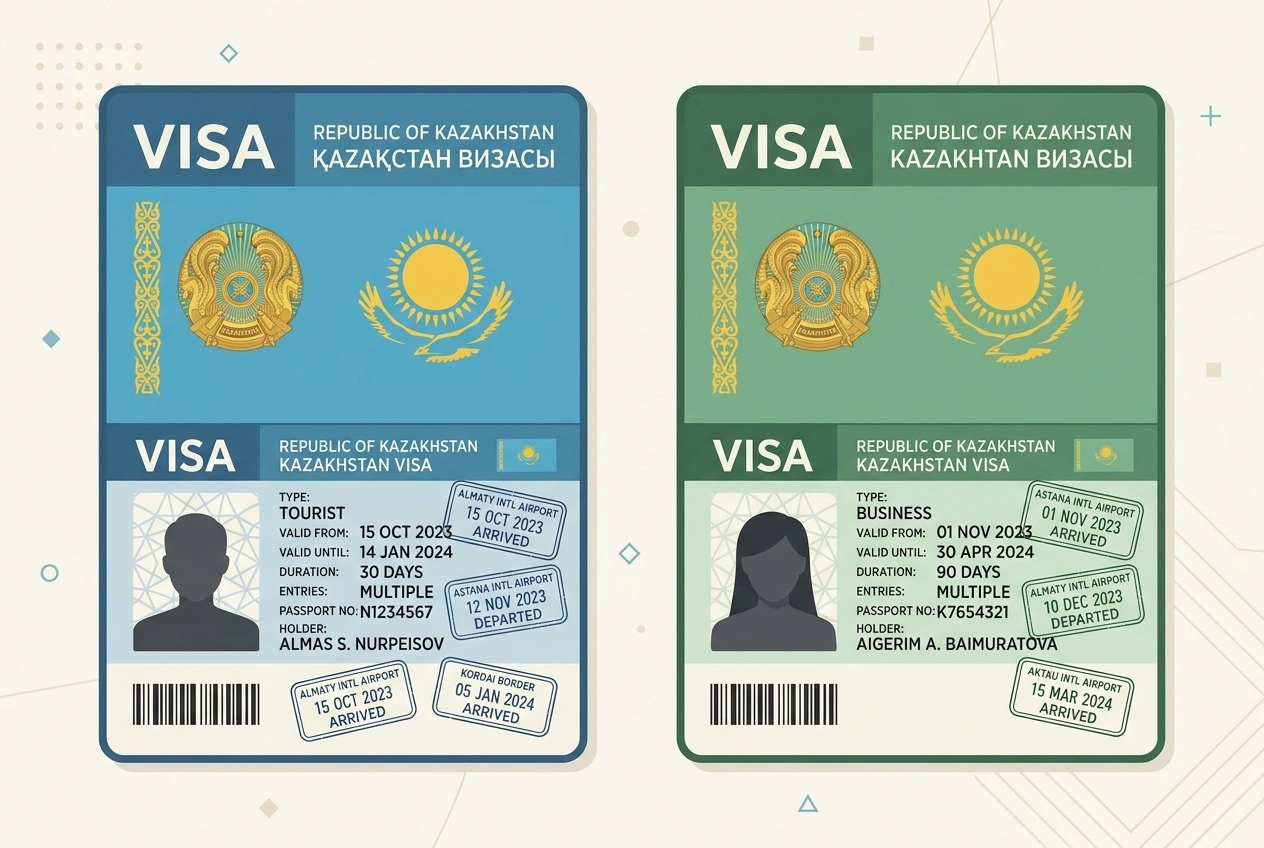
Kazakhstan introduced two digital nomad visa programs in early 2025: the Neo Nomad Visa (B12-1) for any remote worker earning $3,000+/month with approval in 5 business days, and the Digital Nomad Residency (B9-1) exclusively for IT professionals with no income requirement and a path to 10-year residence. According to Astana Hub, 270+ applications were submitted in the first two months from citizens of 20+ countries including the US, Canada, France, and Turkey. The B12-1 is faster and open to all professions. The B9-1 offers longer residency but requires IT accreditation. This guide compares both programs with exact requirements, timelines, costs, and step-by-step application processes.
Choosing between these two visas is the first decision every digital nomad considering Kazakhstan must make. The programs launched within weeks of each other, target overlapping audiences, and have confusingly similar names. Most English-language guides either mix them up or only cover one. This comparison uses data from official Kazakh government sources, iWorld immigration portal, Relokatz, and Fragomen legal analysis to explain exactly how each visa works, who qualifies, and which one fits your situation.
Side-by-Side Comparison
The fundamental difference: B12-1 is a tourist-category visa for any remote worker (max 2 years), while B9-1 is a residency path for IT professionals (up to 10 years). B12-1 is faster to get (5 days vs 22+ days) but B9-1 offers far more long-term benefits.
| Feature | Neo Nomad (B12-1) | Digital Nomad Residency (B9-1) |
|---|---|---|
| Target audience | All remote workers | IT professionals only |
| Income requirement | $3,000/month minimum | None |
| Maximum stay | 2 years (1 year + 1 renewal) | 10 years (via residence permit) |
| Application time | 5 business days | ~22 business days |
| Work for KZ employer? | No | Yes |
| Family included? | Yes | Yes |
| Online application? | Yes | Yes (preliminary) |
| Need to be in KZ? | No (apply from abroad) | No (preliminary online) |
| IT accreditation needed? | No | Yes (Astana Hub) |
| Visa type | Tourist category | Residency category |
| Tax implications | Non-resident (under 183 days) | Resident after 183 days (10% PIT) |
| Launched | February 2025 | March 2025 |
| Program status | Permanent | Pilot (ends Dec 31, 2025) |
Neo Nomad Visa (B12-1): Complete Guide
The Neo Nomad Visa is the simpler option: prove $3,000/month remote income, submit documents online, and receive approval in 5 business days. It is open to all professions, not just IT. The main limitation is the 2-year maximum stay and the restriction against working for Kazakh companies.
Who Qualifies
According to Kursiv Media and Global Citizen World:
- Remote workers employed by a foreign company (not Kazakh)
- Freelancers with foreign clients generating $3,000+/month
- Entrepreneurs with a foreign-registered business
- Any profession (not limited to IT)
- Citizens of countries eligible for Kazakhstan e-visa
Required Documents
- Proof of remote income ($3,000+/month): employment contract with a foreign company, freelance invoices, bank statements, or tax returns showing consistent income
- Valid health insurance covering Kazakhstan for the full visa duration
- Criminal background check from your home country, apostilled or legalized
- Valid passport with at least 6 months remaining validity
- Completed online application through the e-visa portal
Application Process
- Gather documents and translations (notarized where required)
- Apply online through the Kazakhstan e-visa portal
- Pay the visa fee
- Receive approval notification: 5 business days
- Receive e-visa via email
- Enter Kazakhstan and register at your place of stay within 3 days
Key Limitations
- Cannot work for Kazakh companies. Your income must come from foreign sources. If you take a contract with a Kazakh employer while on B12-1, you violate visa terms
- Maximum 2 years. The visa is valid for 1 year and renewable once. After 2 years, you must leave or switch to a different visa category
- No path to residency. Unlike B9-1, the Neo Nomad Visa does not lead to permanent residence
- $3,000/month threshold. You must maintain this income level. If your income drops below the threshold, renewal may be denied
Digital Nomad Residency (B9-1): Complete Guide
The B9-1 is the more powerful visa: no income requirement, up to 10 years of residence, and the ability to work for Kazakh companies. The tradeoff is a longer application process (~22 business days), mandatory IT accreditation through Astana Hub, and the fact that this is currently a pilot program ending December 31, 2025.
Who Qualifies
According to Astana Hub and ACSOUR legal analysis:
- IT professionals with verifiable experience in: software development, cybersecurity, UI/UX design, DevOps, data science, AI/ML engineering, system administration, QA/testing
- No income requirement (you can be between jobs or building a startup)
- Must pass IT accreditation through Astana Hub or an authorized organization
- Citizens of 109 countries eligible for Kazakhstan e-visa
- Available to applicants of any age with relevant IT background
Required Documents
- Proof of IT specialization: portfolio, GitHub profile, work history, certifications, degree in computer science or related field
- Valid passport with at least 6 months remaining
- Health insurance covering Kazakhstan
- Criminal background check (apostilled)
- No income documentation required
Application Process (Detailed Timeline)
According to DOS Immigration and Relokatz:
| Step | What Happens | Timeline |
|---|---|---|
| 1 | Apply online through Astana Hub portal | Day 0 |
| 2 | Document verification and interview scheduling | ~5 business days |
| 3 | IT specialization accreditation by Astana Hub | ~10 business days |
| 4 | Invitation letter issued after petition | ~7 business days |
| 5 | Receive 1-year e-visa (single entry) | After step 4 |
| 6 | Enter Kazakhstan | When ready |
| 7 | Convert to B9-1 paper visa (1 year, multiple entry) | After arrival |
| 8 | Apply for residence permit (VNZh) | After B9-1 granted |
| Total preliminary process | ~22 business days |
The residence permit can be issued for up to 10 years (or until your passport expires, whichever is shorter).
The Pilot Program Warning
This is critical information that most guides miss. The B9-1 Digital Nomad Residency is a pilot project, officially running until December 31, 2025. After this date, the program may be:
- Extended (most likely, given positive reception)
- Made permanent
- Modified with new requirements
- Discontinued
If you are seriously considering B9-1, apply before the pilot expires. Even if the program changes later, existing visa holders are typically grandfathered under their original terms.
Key Advantages Over B12-1
- No income requirement. You can be bootstrapping a startup, between jobs, or earning less than $3,000/month
- Work for Kazakh companies. You can take freelance projects, consulting work, or employment from Kazakh businesses
- 10-year residence. Far longer than the B12-1’s 2-year maximum
- Path to permanent residence. The residence permit (VNZh) is a step toward long-term settlement
- Astana Hub ecosystem access. IT accreditation connects you to 1,700+ tech companies in the Astana Hub network
Tax Implications: What Each Visa Means for Your Money
Your tax liability depends on which visa you hold and how long you stay. Neo Nomad (B12-1) holders staying under 183 days are non-residents and generally not taxed on foreign income. B9-1 holders who become tax residents pay 10% individual income tax on worldwide income.
| Scenario | Tax Status | What You Pay |
|---|---|---|
| B12-1, under 183 days/year | Non-resident | No Kazakhstan tax on foreign income |
| B12-1, over 183 days/year | Tax resident | 10% on worldwide income |
| B9-1, with Astana Hub company | Resident (Astana Hub rates) | Reduced rates (0% CIT, 0% VAT) |
| B9-1, freelancing for foreign clients | Depends on days in KZ | 10% if resident (183+ days) |
Business Registration for Foreigners
According to Alatau City Bank’s business guide, there is a critical restriction most English guides do not mention:
- Individual entrepreneur (IP/ИП): Only available to EAEU citizens (Russia, Belarus, Kyrgyzstan, Armenia) and Tajikistan. All other foreigners cannot register as IP, even with a residence permit
- TOO (LLP): The alternative for non-EAEU foreigners. More paperwork but functionally similar
- Astana Hub registration: Foreign companies can register at Astana Hub for 0% corporate tax without needing a Kazakh legal entity. This is the simplest route for IT freelancers and companies
Free Alternative: 30-Day Visa-Free Entry
Before committing to either visa program, most nomads test Kazakhstan using the 30-day visa-free entry available to citizens of 77 countries (EU, US, UK, Canada, Australia, Japan, South Korea). No application needed, just show up with a valid passport.
This is the recommended approach:
- Enter visa-free for 30 days
- Set up banking (Kaspi Gold), SIM card, apartment
- Experience daily life, test internet, explore coworking spaces
- If you decide to stay, apply for B12-1 or B9-1 from within Kazakhstan or return home and apply online
Many nomads cycle through 30-day visa-free periods by briefly leaving the country (common destinations: Kyrgyzstan by bus, Uzbekistan by flight) and re-entering. According to Citizen Remote’s visa index, Kazakhstan ranks among the top 15 countries globally for digital nomad visa programs thanks to its dual-visa approach and zero income requirement on the B9-1 path. The official visa programs are designed exactly for people who want to stay longer than the free 30 days.
Decision Framework: Which Visa Should You Choose?
Choose based on your profession, income level, and how long you plan to stay. The flowchart below covers the most common scenarios.
Choose Neo Nomad (B12-1) if:
- You are NOT in IT (marketer, designer, writer, consultant, teacher, etc.)
- You earn $3,000+/month from foreign clients/employer
- You want quick approval (5 days vs 22)
- You plan to stay 1-2 years maximum
- You do not need to work for Kazakh companies
Choose B9-1 Digital Nomad Residency if:
- You are a software developer, DevOps, cybersecurity, data scientist, or other IT professional
- You want long-term residency (up to 10 years)
- Your income is below $3,000/month (or variable)
- You might want to work for Kazakh companies
- You want access to the Astana Hub IT ecosystem
Consider Visa-Free (30 days) if:
- You want to test Kazakhstan before committing
- You plan a short working trip
- You are deciding between Kazakhstan and other destinations
Common Mistakes When Applying
Most visa rejections come from incomplete documentation, missing apostilles, or misunderstanding which visa fits your situation. According to Nomads Embassy eligibility analysis, the most common errors include submitting unverified income documents, lacking health insurance coverage for the full stay period, and confusing the two visa types.
Avoid these specific mistakes:
- Applying for B9-1 without IT credentials. Marketing managers, content writers, and business consultants do not qualify for B9-1. Use B12-1 instead
- Providing gross income instead of net. The $3,000 threshold for B12-1 typically refers to income after taxes. Verify with the consulate
- Missing apostille on criminal background check. This is the document that takes longest to prepare (2-4 weeks in most countries). Start this first
- Buying short-term insurance. Your health insurance must cover the entire visa period. Monthly subscriptions (SafetyWing) work if they auto-renew
- Assuming B9-1 will continue after 2025. The pilot ends December 31, 2025. While extension is likely, it is not guaranteed
Practical Tips for Both Visas
Regardless of which visa you choose, several practical steps apply to both programs.
Before You Apply
- Get your criminal background check apostilled (this takes 2-4 weeks in most countries, start early)
- Purchase health insurance that specifically covers Kazakhstan. SafetyWing and World Nomads are popular choices among nomads
- Prepare income documentation: 3-6 months of bank statements, employment contracts, or invoices
- Ensure your passport has 6+ months validity remaining
After Arrival
- Get a Kazakh phone number immediately (Beeline or Kcell, $2-3 at the airport)
- Visit a TSON (public service center) to obtain your IIN (Individual Identification Number), free, same day
- Open a Kaspi Bank account (in person, requires IIN + Kazakh phone number)
- Register your place of stay within 3 days (your landlord or hotel does this)
- For the full first-week setup guide, see our digital nomad in Kazakhstan guide
Where to Live
Almaty is the top choice for most digital nomads: mountains, cafes, larger expat community, and vibrant social life. Astana is better for families (82% modern housing stock, lower rents, newer infrastructure) and those working directly with Astana Hub or government agencies. Full city comparison in our digital nomad guide.
Monthly Costs
According to Numbeo cost-of-living data, Almaty is 62% cheaper than Berlin and 71% cheaper than London. A single digital nomad spends $1,000-1,500/month in Almaty or $800-1,200 in Astana. Families of four spend $2,000-3,500/month including school or kindergarten. According to Statista’s Central Asia data, Kazakhstan offers the highest average salaries in the region while maintaining some of the lowest living costs. Full cost breakdown with real prices from Krisha.kz in our complete guide.
Frequently Asked Questions
- What is the difference between B9-1 and B12-1 Kazakhstan digital nomad visas?
- B12-1 (Neo Nomad) is for all remote workers earning $3,000+/month, approved in 5 days, maximum 2 years. B9-1 (Digital Nomad Residency) is for IT professionals only, has no income requirement, takes ~22 days, and offers up to 10 years of residence. B12-1 is faster but shorter. B9-1 is slower but offers permanent residency and more rights.
- Do I need to be an IT professional for the Kazakhstan digital nomad visa?
- Not for the Neo Nomad Visa (B12-1), which is open to all professions. You need IT credentials only for the B9-1 Digital Nomad Residency, which requires accreditation through Astana Hub in fields like software development, cybersecurity, UI/UX design, DevOps, or data science.
- How much income do I need for the Kazakhstan digital nomad visa?
- The Neo Nomad (B12-1) requires $3,000/month from foreign sources. The B9-1 Digital Nomad Residency has no income requirement at all, making it accessible to bootstrapping founders, job-seekers, and early-career IT professionals.
- Is the B9-1 Digital Nomad Residency permanent?
- The B9-1 program is currently a pilot running until December 31, 2025. It may be extended or made permanent. The residence permit itself can be issued for up to 10 years. Existing visa holders are typically grandfathered if the program changes.
- Can I bring my family on a Kazakhstan digital nomad visa?
- Yes, both visa programs allow family members. Spouses and children can apply for the same visa category. Kazakhstan offers affordable family life: state kindergartens from $40-60/month, international schools from $7,000/year, and 2-bedroom apartments in good areas from $500-700/month.
- Do I pay taxes in Kazakhstan as a digital nomad?
- It depends on your visa and length of stay. B12-1 holders staying under 183 days are non-residents and generally not taxed on foreign income. Those staying 183+ days become tax residents and pay 10% on worldwide income. B9-1 holders working through Astana Hub benefit from 0% corporate tax and reduced individual tax.
- Can I work for a Kazakh company on a digital nomad visa?
- Only on the B9-1 Digital Nomad Residency. The Neo Nomad B12-1 explicitly prohibits employment by Kazakh companies. Your income on B12-1 must come from foreign sources only.
- How long does it take to get the Kazakhstan digital nomad visa?
- The Neo Nomad (B12-1) is approved in approximately 5 business days. The B9-1 Digital Nomad Residency takes approximately 22 business days total: 5 days for document verification, 10 days for IT accreditation, and 7 days for the invitation letter.
Last verified: March 2026. Kazakhstan visa requirements change periodically. Check Astana Hub and eGov.kz for current requirements before applying.
More Stories

travel
Digital Nomad in Kazakhstan: Visas, Costs & Tax (2026)
Digital nomad in Kazakhstan: two visa types, Astana Hub 0% tax, real costs $1,000-1,500/month, family costs, schools, coworking, internet, and banking.

facts
How to Send Money to Kazakhstan: Best Methods Compared 2026
Compare the best ways to send money to Kazakhstan — Wise, Western Union, Remitly, bank wire. Fees, exchange rates, speed, and step-by-step guide.

culture
Nauryz in Kazakhstan
Nauryz in Kazakhstan: the 3,000-year-old spring New Year celebrated every March 22. Nauryz kozhe, horse games, yurt festivals, and 2026 event calendar.