Kazakhstan Tourist Attractions: 18 Must-See Places
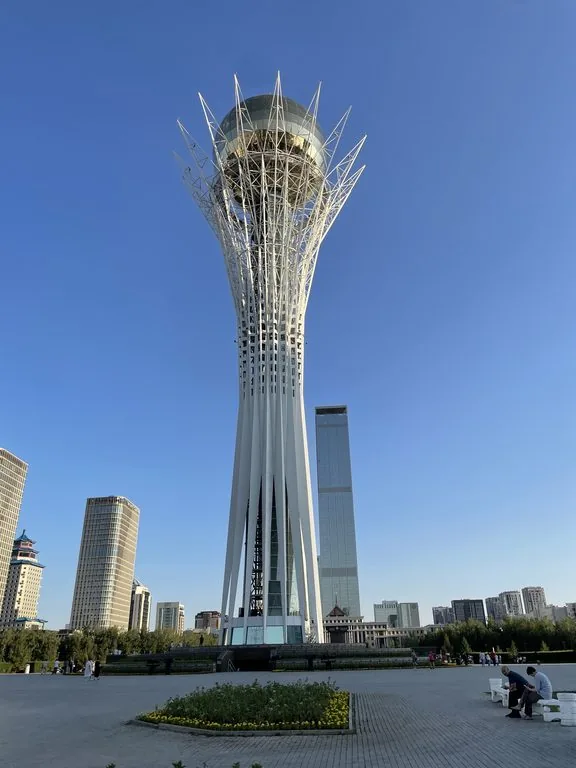
The top Kazakhstan tourist attractions are Charyn Canyon, Big Almaty Lake, the Mausoleum of Khoja Ahmed Yasawi in Turkestan (UNESCO), Astana’s Baiterek Tower, and Kolsai Lakes. Kazakhstan spans 2.72 million km² across Central Asia (the world’s ninth-largest country) yet, according to UNWTO tourism data, receives fewer than 10 million international visitors per year, meaning most attractions remain uncrowded and authentic. From Tian Shan alpine lakes and Singing Dunes to a Soviet-era cosmodrome and futuristic capital architecture, Kazakhstan’s diversity of sights rivals countries ten times more visited.
This guide covers 18 Kazakhstan tourist attractions organized by region, with location details, entry fees, best seasons, and practical tips so you can plan efficiently. Whether you have five days or three weeks, you will find the right mix below. For route planning ideas, see our guide to places to visit in Kazakhstan.
Top 15 Attractions at a Glance
Before diving into detailed descriptions, here is a summary table of the most important Kazakhstan tourist attractions:
| # | Attraction | Region | Best Season | Entry Fee | Suggested Duration |
|---|---|---|---|---|---|
| 1 | Charyn Canyon | Almaty Region | Apr–Oct | 945 KZT (~$2) | Half day–full day |
| 2 | Big Almaty Lake | Almaty Region | Jun–Sep | Free | 3–4 hours |
| 3 | Kolsai Lakes | Almaty Region | Jun–Sep | 945 KZT (~$2) | 1–2 days |
| 4 | Shymbulak Ski Resort | Almaty Region | Dec–Mar (ski), Jun–Sep (hike) | Lift pass ~$25–40 | Half day–full day |
| 5 | Medeu Skating Rink | Almaty Region | Nov–Mar (skating), year-round (visit) | 1,800 KZT (~$4) | 2–3 hours |
| 6 | Petroglyphs of Tamgaly (UNESCO) | Almaty Region | Apr–Oct | 500 KZT (~$1) | 2–3 hours |
| 7 | Baiterek Tower | Astana | Year-round | 700 KZT (~$1.50) | 1–2 hours |
| 8 | Khan Shatyr | Astana | Year-round | Free | 2–3 hours |
| 9 | Nur-Astana Mosque | Astana | Year-round | Free | 1 hour |
| 10 | Mausoleum of Khoja Ahmed Yasawi (UNESCO) | Turkestan | Mar–Nov | 500 KZT (~$1) | 2–3 hours |
| 11 | Baikonur Cosmodrome | Kyzylorda Region | Year-round (permit required) | Tour: $200–600 | 1–2 days |
| 12 | Altyn-Emel National Park | Almaty Region | Apr–Oct | 945 KZT (~$2) | 1–2 days |
| 13 | Underground Mosques of Mangystau | Mangystau Region | Mar–May, Sep–Nov | Free–500 KZT | 2–3 days |
| 14 | Lake Balkhash | Karaganda/Almaty border | May–Sep | Free | 1–2 days |
| 15 | Burabay National Park | Akmola Region | Jun–Sep (summer), Dec–Feb (winter) | 470 KZT (~$1) | 1–2 days |
Almaty Region Attractions
The Almaty region is where most international visitors start. The former capital sits at the foot of the Tian Shan mountains, giving access to the highest concentration of natural attractions in Kazakhstan. For a complete city guide, see our Almaty travel guide.
1. Charyn Canyon
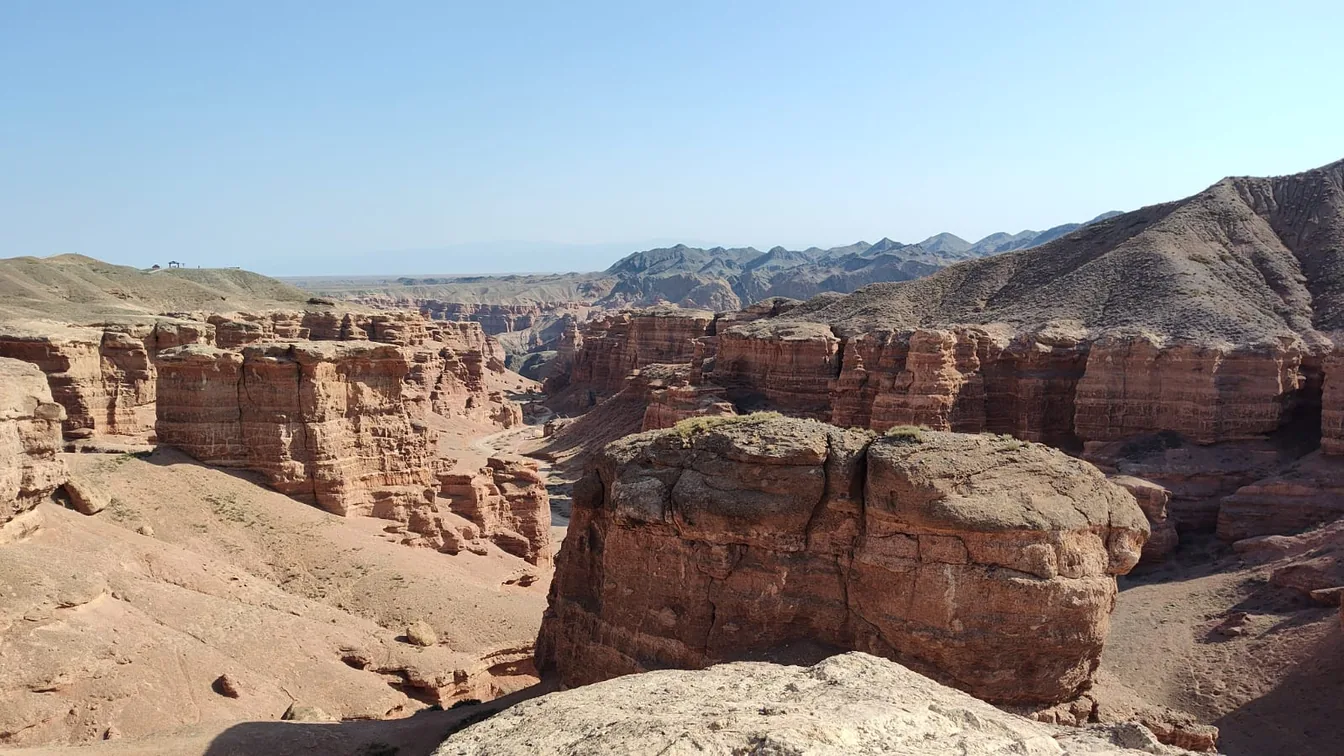
Charyn Canyon is Kazakhstan’s most famous natural landmark and one of the most photographed places to visit in Kazakhstan. According to Wikipedia’s geological summary, the canyon was carved by the Charyn River over approximately 12 million years and stretches 80 km through the steppe southeast of Almaty, with walls reaching 150–300 meters in depth.
The most visited section is the Valley of Castles, a 2 km corridor of red and orange sandstone formations that glow intensely at sunrise and sunset. A second highlight is the Sogdian Ash Tree Grove, protecting a stand of Fraxinus sogdiana trees that have survived here since the Ice Age. Only one other such grove exists on the planet.
Why visit: The scale and color of the rock formations are genuinely dramatic. Unlike more famous canyons elsewhere, Charyn is rarely crowded, even in peak season you might share the Valley of Castles with only a few dozen other visitors.
Practical info:
- Location: 195 km east of Almaty (approximately 3 hours by car)
- Entry fee: 945 KZT (~$2) per person
- Best time: April through October; mornings and late afternoons for best light
- Getting there: No public transport. Book a day tour from Almaty or hire a private driver. Most tours depart around 7:00 AM and return by evening.
- Facilities: Basic yurt camp at the canyon floor for overnight stays; bring food and water
2. Big Almaty Lake
Big Almaty Lake sits at 2,511 meters above sea level in the Ile-Alatau National Park, just 28 km from central Almaty. The lake changes color throughout the year, from deep turquoise in summer to pale green in autumn, depending on glacial meltwater and mineral content.
Surrounded by peaks reaching 3,600–4,000 meters, the lake is one of the most accessible high-altitude alpine landscapes in all of Central Asia. On a clear day, the reflection of the surrounding mountains in the turquoise water is extraordinary.
Why visit: Few places on Earth offer a glacial alpine lake this spectacular within a 45-minute drive of a major city. It is the single most popular day trip from Almaty for good reason.
Practical info:
- Location: 28 km south of Almaty center
- Entry fee: Free (national park fee may apply at checkpoint)
- Best time: June through September for turquoise color; the road is often closed November through April due to snow
- Getting there: Taxi, private car, or organized tour. The road is steep and unpaved in sections, 4WD recommended but not always required in summer
- Note: Swimming is prohibited; the lake supplies Almaty’s drinking water
3. Kolsai Lakes
The Kolsai Lakes are a chain of three alpine lakes set among spruce forests and mountain ridges in the Tian Shan, 330 km southeast of Almaty near the Kyrgyz border. Each lake sits at a higher elevation than the last:
- Kolsai 1 (1,818 m): The most accessible, surrounded by pine forest, with basic guesthouses nearby
- Kolsai 2 (2,252 m): A 3-hour hike from the first lake; significantly more dramatic and less visited
- Kolsai 3 (2,650 m): Serious mountain terrain requiring a guide; rarely visited
Nearby Kaindy Lake (1,667 m) is equally striking: a flooded forest where dead spruce trunks rise from the turquoise water, creating one of Kazakhstan’s most surreal landscapes.
Why visit: The combination of three lakes at ascending elevations, dense forest, and virtually no crowds makes this one of the finest trekking destinations in Central Asia.
Practical info:
- Location: 330 km southeast of Almaty (5–6 hours by car)
- Entry fee: 945 KZT (~$2) per person
- Best time: June through September
- Getting there: No regular public transport. Hire a driver or join a 2-day tour from Almaty. Basic guesthouses and homestays available near Kolsai 1.
- Tip: Combine Kolsai and Kaindy in a single 2-day trip
4. Shymbulak Ski Resort
Shymbulak is Kazakhstan’s premier ski resort, sitting at 2,260 meters in the Zailiysky Alatau range above Almaty. The resort offers runs descending from 3,200 meters, modern gondola infrastructure, and views across the entire Almaty valley.
In summer, Shymbulak transforms into a hiking and mountain biking hub. The gondola operates year-round, giving non-skiers access to alpine meadows, wildflower trails, and ibex-spotting opportunities above the tree line.
Why visit: World-class mountain scenery combined with genuine ski infrastructure, all within 30 minutes of a 2-million-person city. Few ski resorts anywhere offer this combination of access and altitude.
Practical info:
- Location: 25 km south of Almaty center, accessed via Medeu
- Entry fee: Gondola ride
3,000 KZT ($6.50); day ski pass $25–40 - Best time: December through March for skiing; June through September for hiking
- Getting there: Bus #12 from Almaty to Medeu, then gondola to Shymbulak
For more on things to do in Kazakhstan in winter, Shymbulak is the top pick.
5. Medeu Skating Rink
Medeu is the world’s highest outdoor speed skating rink, sitting at 1,691 meters in the mountains above Almaty. Built in 1972, this Soviet-era facility has hosted multiple world records and remains a functioning ice rink open to the public during winter months.
Even outside skating season, Medeu serves as the starting point for hikes and the gondola up to Shymbulak. The dam above the rink (built to protect Almaty from mudflows) offers panoramic views of the city below.
Why visit: Skating at 1,691 meters with mountain peaks surrounding you is a unique experience found nowhere else. Even non-skaters visit for the setting and the gondola access.
Practical info:
- Location: 15 km south of Almaty center
- Entry fee:
1,800 KZT ($4) for skating; skate rental available - Best time: November through March for ice skating; year-round for the view and gondola access
- Getting there: Bus #12 from central Almaty (30 minutes)
6. Petroglyphs of Tamgaly (UNESCO World Heritage Site)
The Tamgaly rock art site contains over 5,000 petroglyphs dating from the Bronze Age (14th century BC) through the early Turkic period. Located in a rocky gorge northwest of Almaty, Tamgaly was inscribed as a UNESCO World Heritage Site in 2004 for its exceptional concentration of rock carvings depicting sun-headed deities, animals, hunting scenes, and ritual dances.
The site is divided into five groups spread along the gorge. The most famous image is the “sun god” figure, a human form with radiating lines around its head, believed to represent a Bronze Age solar deity.
Why visit: Tamgaly is one of only three UNESCO World Heritage Sites in Kazakhstan and the best-preserved open-air rock art gallery in Central Asia. The carvings span nearly 3,000 years of human history in a single location.
Practical info:
- Location: 170 km northwest of Almaty
- Entry fee:
500 KZT ($1) - Best time: April through October (the gorge is hot in midsummer; morning visits recommended)
- Getting there: No public transport. Day trip by car from Almaty (2–2.5 hours one way)
Astana Attractions
Kazakhstan’s capital since 1997, Astana is famous for its ambitious futuristic architecture rising from the northern steppe. The city has transformed from a modest Soviet-era settlement into a showcase of 21st-century design. For a full breakdown, see our Astana city guide.
7. Baiterek Tower
Baiterek is Astana’s most recognizable landmark, a 97-meter tower representing a poplar tree holding a golden egg (the sun) in its branches. The design references the Kazakh legend of the mythical Samruk bird, which laid its egg in the branches of the tree of life.
The observation deck at 86 meters offers 360-degree panoramic views of the capital, including the entire length of Nurzhol Boulevard. Inside the golden sphere is a gilded handprint of former president Nursultan Nazarbayev.
Why visit: No visit to Astana is complete without Baiterek. The tower is both the city’s defining symbol and the best vantage point from which to understand Astana’s planned layout.
Practical info:
- Location: Central Astana, on Nurzhol Boulevard
- Entry fee:
700 KZT ($1.50) - Best time: Year-round; late afternoon for best light from the observation deck
- Getting there: Central location, walking distance from most hotels
8. Khan Shatyr Entertainment Center
Khan Shatyr is a 150-meter-tall transparent tent and the world’s largest tent-like structure. Designed by Norman Foster (the same architect behind London’s Gherkin), the building uses a special ETFE plastic layer to maintain a warm interior climate even when outside temperatures drop to -30°C.
Inside you will find a shopping mall, food court, cinema, indoor park, and an artificial beach resort with sand imported from the Maldives, complete with wave pool and tropical temperature.
Why visit: The architectural ambition is remarkable. Khan Shatyr represents Astana’s philosophy of building the impossible on the open steppe. It is also genuinely useful as a warm-weather escape during Kazakhstan’s brutal winters.
Practical info:
- Location: Northern end of Nurzhol Boulevard, Astana
- Entry fee: Free to enter; individual attractions inside have their own fees
- Best time: Year-round; especially valuable in winter
- Getting there: Walking distance from Baiterek; well-connected by bus and taxi
9. Nur-Astana Mosque
The Nur-Astana Mosque is one of the largest mosques in Central Asia, with a 40-meter dome and minarets reaching 63 meters. Opened in 2005, the mosque’s design blends traditional Islamic architecture with modern Central Asian elements. It can accommodate up to 5,000 worshippers.
For visitors interested in Islamic architecture, the newer Hazrat Sultan Mosque (opened 2012) is even larger, the biggest mosque in Central Asia, and sits nearby on the left bank of the Ishim River.
Why visit: The scale of religious architecture in a country that was officially atheist just 35 years ago is striking. Both mosques reflect Kazakhstan’s post-independence identity formation and its ties to the broader Islamic world.
Practical info:
- Location: Nurzhol Boulevard area, Astana
- Entry fee: Free
- Best time: Year-round; visit outside prayer times for easier access
- Dress code: Modest clothing required; headscarves available for women at the entrance
Southern Kazakhstan: Silk Road Heritage
Southern Kazakhstan holds the country’s deepest historical significance. The ancient Silk Road ran through this region, leaving behind cities, mausoleums, and pilgrimage sites that predate modern Kazakhstan by centuries.
10. Mausoleum of Khoja Ahmed Yasawi, Turkestan (UNESCO)
The Mausoleum of Khoja Ahmed Yasawi is Kazakhstan’s most important historical monument and its first UNESCO World Heritage Site (inscribed 2003). Built between 1389 and 1405 on the orders of Timur (Tamerlane), the mausoleum honors the 12th-century Sufi poet and mystic Khoja Ahmed Yasawi, one of the most influential figures in Turkic Islam.
The building is an architectural masterpiece of the Timurid period. As Lonely Planet notes in its Central Asia coverage, its unfinished main portal (construction halted after Timur’s death) reveals techniques later perfected in Samarkand’s famous monuments. Inside, the central hall contains a 2-ton bronze qazan (ritual vessel), one of the largest in the Islamic world.
The surrounding Turkestan archaeological complex includes the Rabbia Sultan Begim Mausoleum, medieval bathhouse ruins, and sections of the old city walls. Turkestan is being developed as a major pilgrimage and tourism destination, with a new airport, hotels, and restored historical quarters.
Why visit: This is the most significant piece of architecture in Kazakhstan and one of the finest Timurid-era buildings in the world. For anyone interested in Silk Road history, Islamic architecture, or Central Asian civilization, Turkestan is essential.
Practical info:
- Location: Turkestan city, 160 km northwest of Shymkent
- Entry fee:
500 KZT ($1) for museum sections - Best time: March through November (summers are very hot; spring and autumn are ideal)
- Getting there: Domestic flights to Turkestan airport; 1.5-hour drive from Shymkent; overnight train from Almaty or Astana
Central and Western Kazakhstan
11. Baikonur Cosmodrome
Baikonur is the world’s first and largest operational spaceport. As National Geographic reports, Yuri Gagarin launched into orbit from here on April 12, 1961, and the facility continues to launch crewed Soyuz missions to the International Space Station. The cosmodrome covers 6,717 km² of steppe in the Kyzylorda Region.
Visitors can tour the Gagarin launch pad, the Buran space shuttle hangar, and the cosmonaut museum. With advance booking and luck with scheduling, you can witness a live rocket launch. Russia leases the facility from Kazakhstan through 2050.
Why visit: There is no other place on Earth where you can stand on the pad where human spaceflight began and potentially watch a live launch. It is one of the most unique tourist experiences in the world.
Practical info:
- Location: Kyzylorda Region, central Kazakhstan
- Entry fee: Tours range from $200–600+ depending on operator and whether a launch is included
- Best time: Year-round, but launch viewing requires planning months ahead
- Getting there: Organized tours only, independent access is not permitted. Book through licensed operators at least 2 months in advance. Nearest city: Kyzylorda (3-hour drive)
- Important: You need a special permit arranged by the tour operator; passport details required in advance
12. Altyn-Emel National Park (Singing Dunes)
Altyn-Emel is one of Kazakhstan’s most unusual national parks, covering 4,600 km² of desert, mountain, and steppe ecosystems in the Almaty Region. The park’s star attraction is the Singing Dune (Akkum-Kalkan), a 150-meter-high crescent-shaped sand dune that produces a deep humming or rumbling sound when wind moves across its surface.
Other highlights within the park include the Aktau Mountains (colorful layered sedimentary formations resembling a Martian landscape), the Katutau Mountains (volcanic rock formations), and ancient burial mounds (kurgans) from the Saka period.
Why visit: The Singing Dune phenomenon is genuinely eerie. The sound can be heard from several kilometers away on the right day. Combined with the Aktau Mountains and empty desert landscapes, Altyn-Emel feels like visiting another planet.
Practical info:
- Location: 250 km northeast of Almaty
- Entry fee: 945 KZT (~$2) per person; vehicle entry fee additional
- Best time: April through October (summer can be extremely hot; spring is ideal)
- Getting there: 4WD vehicle required within the park. Book through the park office in Basshi village or arrange a tour from Almaty.
- Tip: Combine with Charyn Canyon in a 3-day itinerary from Almaty
Altyn-Emel is also one of Kazakhstan’s most important protected areas. Read more about Kazakhstan national parks.
13. Underground Mosques of Mangystau
The Mangystau Region on Kazakhstan’s Caspian coast contains one of the most surreal and least-visited landscapes in Central Asia. Among its many geological wonders are a series of underground mosques carved directly into rock, sacred sites dating from the 10th to 19th centuries.
The most significant include:
- Shakpak-Ata. A 10th-century mosque carved into a chalk cliff, with ancient inscriptions and a meditation chamber
- Sultan-Epe. An underground pilgrimage site near the Caspian Sea
- Beket-Ata. The most revered pilgrimage destination in western Kazakhstan, set in a remote canyon that requires a challenging drive through desert terrain
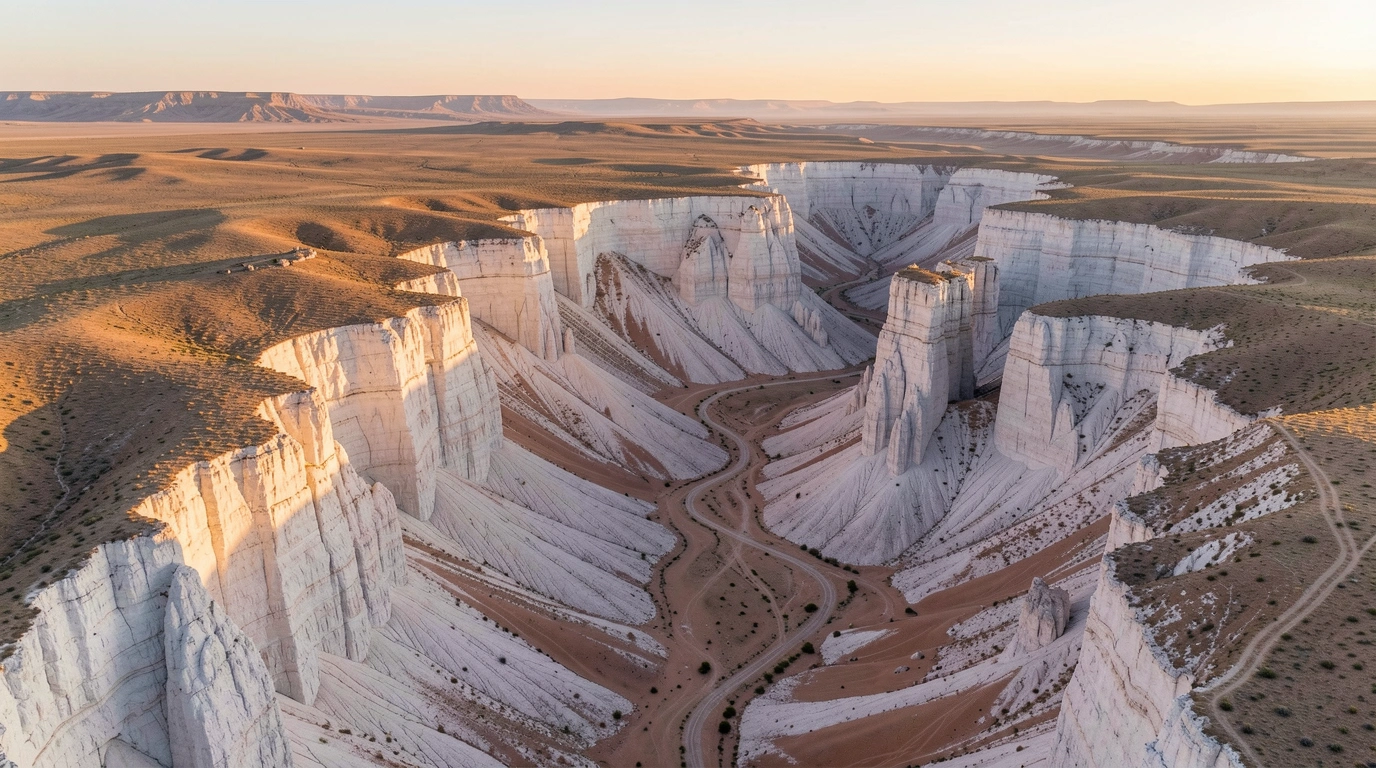
Beyond the mosques, Mangystau’s Bozzhyra tract features chalk cliffs, tabletop mountains, and canyons that look like they belong on Mars. The Torysh Valley contains thousands of perfectly spherical stone concretions scattered across the desert floor.
Why visit: Mangystau is frontier travel: remote, empty, and visually unlike anywhere else on Earth. The underground mosques add a deep spiritual and historical layer to landscapes that are already extraordinary.
Practical info:
- Location: Mangystau Region, western Kazakhstan (nearest city: Aktau)
- Entry fee: Free for most sites; some may charge 200–500 KZT
- Best time: March through May and September through November (summers exceed 40°C)
- Getting there: Fly to Aktau, then hire a 4WD vehicle and driver. Independent navigation is difficult, GPS coordinates and an experienced local guide are strongly recommended.
- Duration: Plan at least 3 days to cover the key sites
14. Lake Balkhash
Lake Balkhash is one of the largest lakes in Asia and one of the most unusual bodies of water on Earth. According to Wikipedia, it stretches 614 km across central-eastern Kazakhstan and has a remarkable characteristic: the western half is freshwater while the eastern half is saline, separated by a narrow strait. This dual-nature phenomenon is found in very few lakes worldwide.
The lake is surrounded by steppe and semi-desert, with small fishing villages along its shores. It is an important habitat for migratory birds and fish species, though water levels have been declining due to upstream irrigation.
Why visit: The sheer scale of Balkhash (visible from space) and its freshwater/saltwater split make it a geographic curiosity worth seeing. The sunsets over the steppe-rimmed lake are remarkable.
Practical info:
- Location: Central-eastern Kazakhstan, straddling Karaganda and Almaty regions
- Entry fee: Free
- Best time: May through September
- Getting there: The town of Balkhash on the northern shore is reachable by train from Almaty (12 hours) or Astana (8 hours). A car provides more flexibility for exploring the shoreline.
Northern Kazakhstan
15. Burabay National Park (Borovoe)
Known locally as “the Pearl of Kazakhstan” and sometimes called the “Switzerland of Kazakhstan,” Burabay is a lake district in the Akmola Region, 250 km north of Astana. Pine-covered granite hills rise from clear lakes, creating a landscape that feels completely different from the surrounding steppe.
Key sights include Lake Borovoe, Lake Shchuchye, the distinctive Zhumbaktas rock (a sphinx-shaped granite formation rising from the water), and the Okzhetpes cliff. The park is a major domestic holiday destination, with sanatoriums, hiking trails, and beach areas.
Why visit: After days of steppe driving or city touring in Astana, Burabay’s forested hills and clear lakes feel like a different country. It is the most accessible nature escape from the capital and an excellent place to see how Kazakhstani families vacation.
Practical info:
- Location: 250 km north of Astana
- Entry fee:
470 KZT ($1) - Best time: June through September for swimming and hiking; December through February for winter scenery
- Getting there: 2.5-hour drive from Astana; regular buses and shared taxis available
Additional Notable Attractions
16. Green Bazaar (Zelyony Bazaar), Almaty
Almaty’s Green Bazaar is the most iconic urban market in Kazakhstan, a covered bazaar where you can find everything from dried fruits and horse meat sausage (kazy) to spices, nuts, dairy products, and Kazakh handicrafts. The bazaar has operated in some form since the 19th century and remains the best single location to experience Kazakhstan’s food culture.
Practical info:
- Location: Central Almaty, corner of Zhibek Zholy and Pushkin streets
- Entry fee: Free
- Best time: Morning (8–11 AM) for the freshest produce and least crowded aisles
17. Aisha-Bibi Mausoleum, Taraz
A 12th-century mausoleum near the city of Taraz, Aisha-Bibi is unique for its detailed terracotta tile decoration. It is the only monument in Central Asia entirely faced with carved terracotta. The monument is connected to a Kazakh love legend about a woman who died traveling to meet her beloved.
Practical info:
- Location: 18 km south of Taraz
- Entry fee: Free
- Best time: March through November
18. Aksu-Zhabagly Nature Reserve
Kazakhstan’s oldest nature reserve (established 1926) protects a section of the Western Tian Shan mountains near the Uzbek border. The reserve is home to snow leopards, ibex, golden eagles, and over 1,400 plant species. Hiking trails lead through juniper forests to alpine meadows with views of peaks exceeding 4,000 meters.
The reserve is part of the Western Tian Shan UNESCO World Heritage Site (inscribed 2016, shared with Uzbekistan and Kyrgyzstan), making it Kazakhstan’s third UNESCO site. For more on mountain landscapes, see our guide to Kazakhstan mountains.
Practical info:
- Location: Turkestan Region, near Shymkent
- Entry fee:
1,500 KZT ($3) plus guide fee - Best time: May through September
- Getting there: 2-hour drive from Shymkent; guides arranged through the reserve office in Zhabagly village
Best Time to Visit Kazakhstan’s Tourist Attractions
Kazakhstan’s continental climate creates extreme temperature swings, from -30°C in winter to +40°C in summer, so timing matters depending on which attractions you plan to visit.
Spring (April–May): The best overall season for southern and western attractions. Wildflowers in the steppe, comfortable temperatures, and snow beginning to melt at higher elevations. Charyn Canyon, Altyn-Emel, Turkestan, and Mangystau are all ideal.
Summer (June–August): Peak season for mountain and lake attractions. Big Almaty Lake, Kolsai Lakes, Burabay, and Shymbulak hiking are all at their best. Southern Kazakhstan (Turkestan, Altyn-Emel) can be uncomfortably hot.
Autumn (September–October): Excellent for most attractions. Crowds thin, temperatures moderate, and the Tian Shan mountains display golden autumn colors. One of the best times to visit Charyn Canyon.
Winter (December–February): Limited to city attractions (Astana, Almaty), Shymbulak skiing, and Medeu skating. Mountain lakes and remote natural sites are inaccessible.
How to Get Around Kazakhstan’s Attractions
Kazakhstan is enormous. The distance from Almaty to Aktau (Mangystau) is 3,000 km, roughly the distance from London to Cairo. Transport planning is essential.
Domestic flights: Air Astana and FlyArystan connect all major cities. Almaty to Astana is 1.5 hours by air (vs. 18 hours by train). Flights to Aktau, Turkestan, Kyzylorda, and Shymkent are regular and affordable ($30–100 one-way with FlyArystan).
Rental cars and drivers: Essential for most natural attractions. Roads between cities are generally good, but routes to places like Charyn Canyon, Kolsai Lakes, and Mangystau range from unpaved to genuinely challenging. Hiring a local driver is often more practical and safer than self-driving.
Organized tours: The most hassle-free option for remote attractions like Baikonur, Mangystau, and Altyn-Emel. Almaty-based tour operators offer 1-day to 2-week packages covering all major sites.
Trains: Kazakhstan’s rail network connects most major cities. Trains are slow but comfortable and extremely affordable. The Almaty–Astana route (18 hours) and Almaty–Turkestan route (14 hours) are popular with budget travelers.
For more ideas on structuring your trip, see things to do in Kazakhstan.
Attractions by Interest
Not sure which attractions match your travel style? Here is a breakdown by interest:
Nature and landscapes: Charyn Canyon, Big Almaty Lake, Kolsai Lakes, Lake Balkhash, Altyn-Emel, Burabay, Aksu-Zhabagly
History and culture: Mausoleum of Khoja Ahmed Yasawi, Petroglyphs of Tamgaly, Aisha-Bibi, underground mosques of Mangystau
Architecture: Baiterek Tower, Khan Shatyr, Nur-Astana Mosque, Hazrat Sultan Mosque
Adventure and outdoors: Shymbulak, Medeu, Bozzhyra (Mangystau), Kolsai trekking, Kazakhstan mountains
Unique experiences: Baikonur Cosmodrome, Singing Dune (Altyn-Emel), underground mosques, eagle hunting festivals
Family travel: Medeu skating, Burabay, Green Bazaar, Khan Shatyr
Budget Tips for Kazakhstan Tourist Attractions
Kazakhstan is significantly more affordable than most visitors expect. Here is what to budget for major attractions:
- National park entry fees are standardized at around 945 KZT (~$2) per person, among the cheapest in the world
- City attractions (Baiterek, mosques, museums) rarely exceed 1,000 KZT (~$2)
- Organized day tours from Almaty to Charyn Canyon or Big Almaty Lake typically cost $40–80 per person including transport and lunch
- Multi-day tours to Kolsai/Kaindy (2 days) run $150–250 per person
- Baikonur is the major exception, expect $200–600 for a guided tour with permits
- Accommodation near attractions ranges from $15–25/night for guesthouses and homestays to $80–150 for hotels in Astana and Almaty
The best way to save money is to combine nearby attractions into multi-day loops: Charyn Canyon + Altyn-Emel in 3 days, or Kolsai + Kaindy in 2 days, rather than making separate round trips from Almaty.
Safety at Kazakhstan Tourist Attractions
Kazakhstan is one of the safest countries in Central Asia for tourists. Violent crime against visitors is extremely rare, and most attractions are well-maintained. A few things to keep in mind:
- Altitude: Big Almaty Lake (2,511 m), Kolsai 2 (2,252 m), and Shymbulak (up to 3,200 m) can cause mild altitude sickness. Hydrate well and ascend gradually.
- Remote areas: Mangystau, Altyn-Emel, and Baikonur require careful planning. Carry extra water, fuel, and a charged phone. Cell coverage is limited.
- Weather: Conditions change rapidly in the mountains. Even in summer, carry warm layers for Big Almaty Lake and Kolsai.
- Wildlife: Brown bears and wolves exist in the Tian Shan but encounters with tourists are extremely rare. Snow leopards are present but almost never seen.
- Driving: Road conditions vary dramatically. Night driving on rural roads is not recommended due to livestock and poor lighting.
Frequently Asked Questions
- What are the top 5 tourist attractions in Kazakhstan?
- The top 5 Kazakhstan tourist attractions are Charyn Canyon, Big Almaty Lake, the Mausoleum of Khoja Ahmed Yasawi in Turkestan (UNESCO World Heritage Site), Baiterek Tower in Astana, and Kolsai Lakes. These five cover the country's best natural scenery, historical heritage, and modern architecture.
- How many UNESCO World Heritage Sites are in Kazakhstan?
- Kazakhstan has five UNESCO World Heritage Sites: the Mausoleum of Khoja Ahmed Yasawi in Turkestan, the Petroglyphs of Tamgaly, the Silk Roads corridor (shared listing), the Western Tian Shan (shared with Uzbekistan and Kyrgyzstan), and the Saryarka steppe and lakes. The two most visited are the Yasawi Mausoleum and Tamgaly petroglyphs.
- Is it safe to visit tourist attractions in Kazakhstan?
- Yes, Kazakhstan is one of the safest countries in Central Asia for tourists. Major attractions are well-maintained and violent crime against visitors is extremely rare. The main safety considerations are altitude sickness at high-elevation sites, extreme temperatures, and limited infrastructure in remote areas like Mangystau and Altyn-Emel.
- What is the best time of year to visit Kazakhstan tourist attractions?
- The best overall months are May through September, when mountain lakes are accessible and temperatures are comfortable. Spring (April–May) is ideal for southern and desert attractions. Winter (December–February) is limited to city sights, Shymbulak skiing, and Medeu skating. Avoid July–August for southern Kazakhstan, where temperatures can exceed 40°C.
- How many days do I need to see Kazakhstan's main attractions?
- Seven to ten days covers the essential highlights: 3–4 days in the Almaty region (Big Almaty Lake, Charyn Canyon, Medeu/Shymbulak), 2 days in Astana (Baiterek, Khan Shatyr, mosques), and 1–2 days in Turkestan. Remote destinations like Mangystau or Baikonur require an additional 3–5 days each.
- Do I need a visa to visit Kazakhstan tourist attractions?
- Citizens of over 70 countries, including the USA, UK, EU, Canada, Australia, Japan, and South Korea, can visit Kazakhstan visa-free for up to 30 days. Some nationalities qualify for 14-day visa-free stays. Check the current list on the Kazakh Ministry of Foreign Affairs website before booking.
Last verified: March 2026
More Stories
travel
Places to Visit in Kazakhstan
Places to visit in Kazakhstan: 20 best destinations by region, from Charyn Canyon and Kolsai Lakes to Mangystau's cliffs. Best seasons and travel tips.
travel
Is Kazakhstan Worth Visiting? 10 Reasons Yes
Is Kazakhstan worth visiting? Honest assessment with 10 reasons, who it suits best, costs, safety, and practical tips. Find out why travelers love it.
nature
Mangystau: Mars on Earth (Complete Travel Guide 2026)
Mangystau is Kazakhstan's most surreal destination with alien landscapes, ancient mosques, and zero crowds. How to get there, tour costs, and what to see.