Kazakhstan Time Now: UTC+5 Time Zone & Date Converter
Reported from the ground: Tugelbay Konabayev is a Kazakh native (born in Aktobe) who has lived 7 years in Almaty and 4 in Astana. About the author.
In this article11 sections
Kazakhstan uses UTC+5 nationwide. Almaty, Astana, Shymkent and Aktau have the same current time, with no seasonal clock change. The nationwide rule took effect on March 1, 2024, as described in the official Russian-language government notice.
What Time Is It in Kazakhstan Now?
The live clock below shows Kazakhstan time; the converter translates a chosen Kazakhstan date and time into another city’s local date and time. Use it for an Almaty meeting, an Astana arrival or a call with friends abroad. You do not need separate Almaty and Astana clocks.
Current time in Kazakhstan · UTC+5
UTC+5
The same time in Almaty, Astana, Shymkent and Aktau.
Live time uses your device clock and refreshes each minute. Kazakhstan does not change clocks seasonally.
Choose a Kazakhstan date and time, then convert it to your destination.
The result includes the destination date and its seasonal clock changes. The converter covers March 1, 2024 onward under Kazakhstan's current UTC+5 rule. Future government changes may require updated rules; keep your device software current.
The conversion starts from Kazakhstan local time. For example, enter 12:00 on your meeting date, choose London, and press Convert time. The result shows both the London clock and calendar date, so a previous-day result is explicit. “Use current time” resets the input to now; the live clock does not overwrite a meeting date you have entered.
The IANA Time Zone Database explains that UTC offsets and daylight-saving rules are maintained as software data and updated when governments change them. Kazakhstan’s side of this tool uses a fixed UTC+5 offset; other cities use the rules available in your browser. Keep your device clock and software up to date, and confirm important future bookings with the provider.
Which Time Zone Should I Select for Almaty or Astana?
Use UTC+5 for a current-time calculation. In calendar software, select the Kazakhstan city entry and confirm that it displays UTC+5 on your chosen date. Almaty’s IANA identifier is Asia/Almaty; older software may still show its former UTC+6 offset. The numeric offset is clearer than assuming that a short label such as “AQTT” is a single nationwide official abbreviation. KZT is the currency code, not the UTC offset.
This tool starts on March 1, 2024. Earlier historical times require the relevant city’s historical rules; applying today’s nationwide offset to an old timestamp can give the wrong answer.
Kazakhstan Time Zone Quick Facts
| Detail | Information |
|---|---|
| Time zone | UTC+5 (nationwide) |
| Recommended notation | UTC+5 (use the numeric offset; city abbreviations vary) |
| DST observed? | No (abolished in 2005) |
| Unified since | March 1, 2024 |
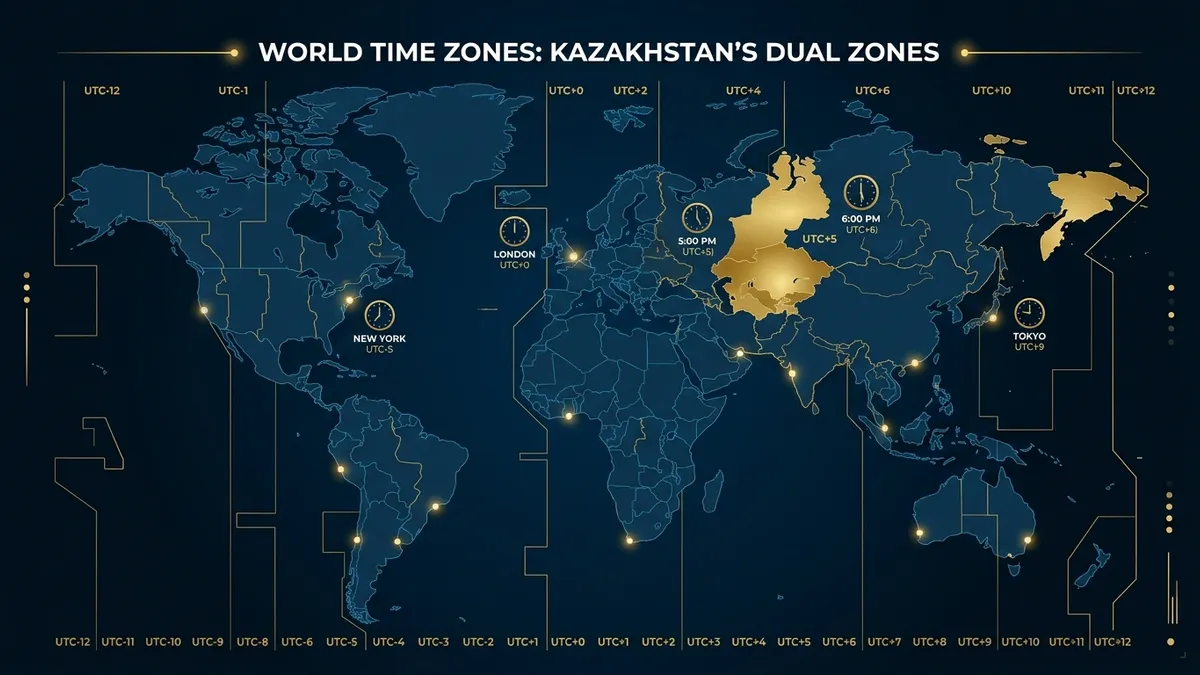
| Previous system | UTC+5 (west) and UTC+6 (east) |
| IANA identifiers | Asia/Almaty, Asia/Aqtau, Asia/Aqtobe, Asia/Atyrau, Asia/Oral, Asia/Qostanay, Asia/Qyzylorda (per the IANA Time Zone Database) |
| Government decree | Decree dated January 19, 2024, No. 20 |
According to the World Bank’s data on Kazakhstan, Kazakhstan is the ninth largest country in the world by land area, stretching across 2,700 km from west to east. According to Wikipedia’s article on time in Kazakhstan, the 2024 unification ended decades of complexity during which different parts of the country operated on different clocks, creating administrative and logistical friction for businesses and government institutions. To understand where Kazakhstan is on the map, it sits between Russia, China, and Central Asia, spanning an area larger than Western Europe. Despite this enormous size, the entire nation now shares a single time zone.
Official 2026 Answer: Kazakhstan Is UTC+5 Everywhere
Kazakhstan is UTC+5 everywhere in 2026, including Almaty, Astana, Shymkent, Aktau, Atyrau, Karaganda, and Turkestan. The country does not use Daylight Saving Time, so the offset is stable all year. The Russian-language government notice describes the January 19, 2024 decision, with clocks set back by one hour during the night from February 29 to March 1, 2024.
The 2024 Time Zone Unification: What Changed
On March 1, 2024, Kazakhstan unified its time zones under a single UTC+5 standard. This was one of the most significant administrative changes in the country’s recent history, affecting daily life for millions of people in the eastern regions.
Before March 2024: The Dual Time Zone System
For decades, Kazakhstan operated with two time zones:
| Zone | UTC Offset | Regions |
|---|---|---|
| Western Kazakhstan | UTC+5 | Aktobe, Atyrau, West Kazakhstan, Mangystau, Kyzylorda |
| Eastern Kazakhstan | UTC+6 | Almaty, Astana, Karaganda, Pavlodar, Shymkent, East Kazakhstan, North Kazakhstan |
This meant that when it was 12:00 noon in Astana, it was 11:00 in Aktau, a one-hour difference within the same country.
Why Kazakhstan Unified to UTC+5
Based on official government explanations around the January 19, 2024 decree, the Kazakh government cited several reasons for the unification:
- Administrative simplification. Government offices, banks, and transportation networks no longer need to account for internal time differences.
- Health considerations. The government referenced research suggesting that the UTC+6 zone pushed sunset and sunrise too late, disrupting circadian rhythms in eastern regions.
- Economic efficiency. Businesses operating across the country faced scheduling complications with internal time zone differences.
- Cross-region scheduling. The reform removed the difference between the eastern and western regions. Almaty and Astana were already in the same time zone before the reform.
According to the official gov.kz notice, the change was established by Government decree dated January 19, 2024, No. 20. Despite some public debate, particularly in Almaty and the eastern regions where clocks moved back one hour, the decision was implemented as planned on March 1, 2024.
Impact on Eastern Kazakhstan
For residents of Almaty, Astana, Shymkent, Karaganda, and other eastern cities, the change meant:
- Sunrise and sunset shifted one hour earlier on the clock. In December, Almaty now sees sunrise around 7:30 AM and sunset around 4:30 PM (UTC+5), compared to the previous 8:30 AM / 5:30 PM (UTC+6)
- Business hours remained the same in local clock terms but shifted one hour earlier in absolute (UTC) terms
- International time differences changed. Almaty is now only 2 hours ahead of Moscow instead of the previous 3
Time Difference: Kazakhstan vs. Major World Cities
Since Kazakhstan uses UTC+5 year-round with no DST, the time difference with countries that observe Daylight Saving Time shifts by one hour during their summer months. The tables below show both scenarios.
Standard Time Differences (Winter in Northern Hemisphere)
| City | Their UTC Offset | Difference from Kazakhstan | When it is 12:00 noon in Kazakhstan |
|---|---|---|---|
| New York, USA | UTC−5 | −10 hours | 02:00 (2 AM) in New York |
| Los Angeles, USA | UTC−8 | −13 hours | 23:00 (11 PM, previous day) |
| London, UK | UTC+0 | −5 hours | 07:00 in London |
| Paris / Berlin | UTC+1 | −4 hours | 08:00 in Paris |
| Istanbul, Turkey | UTC+3 | −2 hours | 10:00 in Istanbul |
| Moscow, Russia | UTC+3 | −2 hours | 10:00 in Moscow |
| Dubai, UAE | UTC+4 | −1 hour | 11:00 in Dubai |
| Delhi, India | UTC+5:30 | +30 minutes | 12:30 in Delhi |
| Beijing, China | UTC+8 | +3 hours | 15:00 in Beijing |
| Tokyo, Japan | UTC+9 | +4 hours | 16:00 in Tokyo |
| Sydney, Australia | UTC+11 | +6 hours | 18:00 in Sydney |
Summer Time Differences (DST in Northern Hemisphere)
When a destination switches to Daylight Saving Time, its difference from Kazakhstan changes. Europe, North America and Australia use different transition dates; the table shows seasonal offsets, not a shared start or end date. Use the converter for your exact date:
| City | Their Summer UTC Offset | Difference from Kazakhstan | When it is 12:00 noon in Kazakhstan |
|---|---|---|---|
| New York (EDT) | UTC−4 | −9 hours | 03:00 (3 AM) in New York |
| Los Angeles (PDT) | UTC−7 | −12 hours | 00:00 (midnight) in LA |
| London (BST) | UTC+1 | −4 hours | 08:00 in London |
| Paris / Berlin (CEST) | UTC+2 | −3 hours | 09:00 in Paris |
| Sydney (AEST) | UTC+10 | +5 hours | 17:00 in Sydney |
Moscow, Dubai, Beijing, Tokyo, and Delhi do not observe DST, so their differences from Kazakhstan remain constant year-round.
No Daylight Saving Time in Kazakhstan
According to the IANA Time Zone Database records, Kazakhstan abolished Daylight Saving Time in 2005, joining a growing list of countries that have opted out of seasonal clock changes. Wikipedia’s article on Kazakhstan time zones confirms this history, noting the abolition was part of a broader Central Asian trend away from Soviet-era DST practices. Since then, clocks in Kazakhstan do not change in spring or autumn.
Why This Matters for International Communication
Because Kazakhstan’s clock never changes but many partner countries’ clocks do, the effective time difference shifts twice a year:
- When the UK switches to BST (last Sunday of March): the UK–Kazakhstan gap narrows from 5 hours to 4 hours
- When the US switches to EDT (second Sunday of March): the US East Coast–Kazakhstan gap narrows from 10 hours to 9 hours
- In November (when US “falls back”) and October (when UK reverts to GMT): the gaps widen again
Mark these transition dates on your calendar if you regularly communicate with contacts in Kazakhstan. Your meeting time will shift by one hour even though Kazakhstan’s clocks did not move.
Business Hours in Kazakhstan
Understanding business hours is essential for travelers and anyone conducting business with Kazakh companies:
| Sector | Typical Hours (Local Time, UTC+5) |
|---|---|
| Government offices | 9:00 AM – 6:00 PM, Mon–Fri |
| Banks | 9:00 AM – 5:00 PM, Mon–Fri (some branches open Sat morning) |
| Shopping malls | 10:00 AM – 10:00 PM, daily |
| Restaurants | 11:00 AM – 11:00 PM (many stay open later on weekends) |
| Bazaars / markets | 8:00 AM – 5:00 PM (vary by season; winter hours shorter) |
| Supermarkets | 8:00 AM – 10:00 PM, daily |
| Museums | 10:00 AM – 6:00 PM, Tue–Sun (most closed Monday) |
The standard workweek in Kazakhstan is Monday through Friday, with a 40-hour work week mandated by the Labour Code. Based on World Bank data, Kazakhstan’s GDP reached approximately $261,000,000,000 in 2023, with over 40% of economic output concentrated in Almaty and Astana, both now operating on a single UTC+5 schedule that eliminates internal scheduling friction. According to the International Labour Organization’s country profile for Kazakhstan, Kazakhstan’s labour legislation aligns with ILO standards on working hours and rest periods. Friday afternoons tend to be quieter in government offices. Most business meetings are scheduled between 10:00 AM and 4:00 PM local time.
Best Windows for International Calls
If you need to schedule calls between Kazakhstan and other time zones, these windows tend to work best:
- Kazakhstan ↔ UK/Europe: 11:00–16:00 Kazakhstan time (06:00–11:00 GMT / 07:00–12:00 CET)
- Kazakhstan ↔ US East Coast: 18:00–21:00 Kazakhstan time (08:00–11:00 EST / 09:00–12:00 EDT)
- Kazakhstan ↔ Dubai: Nearly overlapping business hours; any time 10:00-17:00 Kazakhstan works
- Kazakhstan ↔ Beijing/Singapore: 10:00–14:00 Kazakhstan time (13:00–17:00 CST)
Flight Arrival Times and Time Zones
When booking flights to Kazakhstan, understanding UTC+5 helps you calculate arrival times accurately:
| Route | Approx. Flight Time | Time Zone Change | Example |
|---|---|---|---|
| London → Almaty | Illustrative 7 hours | +5 GMT / +4 BST | Depart 09:00 → arrive 21:00 GMT season / 20:00 BST season |
| Dubai → Almaty | ~3.5 hours | +1 hour | Depart 10:00 Dubai → arrive ~14:30 Almaty |
| Moscow → Almaty | ~4.5 hours | +2 hours | Depart 08:00 Moscow → arrive ~14:30 Almaty |
| Istanbul → Almaty | ~5.5 hours | +2 hours | Depart 07:00 Istanbul → arrive ~14:30 Almaty |
| Beijing → Almaty | ~5 hours | −3 hours | Depart 14:00 Beijing → arrive ~16:00 Almaty |
| Seoul → Almaty | ~6.5 hours | −4 hours | Depart 10:00 Seoul → arrive ~12:30 Almaty |
| New York → Almaty | ~14 hours (via hub) | +10 hours | Varies by connection city |
The flight examples are illustrations, not current schedules. Verify actual departure and arrival times, local dates and connection durations on the airline booking. Almaty and Astana share UTC+5 today and were both on UTC+6 before the reform.
Historical Timeline of Kazakhstan’s Time Zones
The key date for current travel is March 1, 2024. Before the reform, Kazakhstan had UTC+5 and UTC+6 regions. The official notice says that the January 19, 2024 government decision instructed the listed eastern and central regions, including Almaty, Astana and Shymkent, to move clocks back one hour during the transition into March 1.
| Date | What it means for this guide |
|---|---|
| Before March 1, 2024 | Current nationwide UTC+5 should not be applied automatically to historical timestamps |
| March 1, 2024 onward | The nationwide rule used by this converter is UTC+5 |
The earlier version of this page included an unsupported historical timeline and implied that Almaty and Astana had been in different time zones. That was incorrect. For older dates, consult city-specific historical time-zone records rather than extrapolating from the current travel rule.
Practical Tips for Travelers
Automatic Time Updates
According to the IANA Time Zone Database maintainers, modern smartphones automatically update to UTC+5 when you land in Kazakhstan (as long as “automatic time zone” is enabled). After the 2024 change, some older devices and world clock apps briefly displayed incorrect times. Whether a device has received the correction depends on its software updates. Confirm that your clock shows UTC+5 before relying on it for a booking.
Google Calendar and Scheduling Tools
When scheduling events in Kazakhstan, select the time zone “Almaty (UTC+5)” or “Aqtobe (UTC+5)” in Google Calendar. Both now point to the same offset. If you see an old entry showing “Almaty UTC+6,” it predates the 2024 change and may need manual correction.
Jet Lag Considerations
Depending on where you are arriving from, jet lag in Kazakhstan varies:
- From Western Europe (+5 hours ahead): Moderate jet lag. You will feel sleepy in the early evening. Adjust by staying active until at least 10 PM local time for the first two nights.
- From US East Coast (+10 hours ahead): Significant jet lag. Consider arriving a day early before important meetings. Melatonin and morning sunlight exposure help reset your circadian rhythm.
- From Dubai (+1 hour ahead): Minimal to no jet lag. This is one reason Dubai is the most popular transit hub for Kazakhstan flights.
- From Beijing/Shanghai (−3 hours behind): Mild jet lag. You may wake up earlier than usual for a day or two.
- From Moscow (+2 hours ahead): Almost no jet lag. The Moscow–Almaty corridor is Kazakhstan’s busiest international route.
Internal Travel Within Kazakhstan
Since the 2024 unification, traveling within Kazakhstan no longer requires adjusting your watch. Whether you fly from Almaty to Aktau, take the train from Astana to Shymkent, or drive across the country, the time is the same everywhere. This is a significant improvement over the previous system, where the Almaty-to-Astana route stayed in one zone but flights to western cities required a one-hour adjustment.
Kazakhstan Time vs. Neighboring Countries
Kazakhstan shares borders with five countries. According to CIA World Factbook, Kazakhstan’s total border length is approximately 13,364 km, one of the longest in the world, spanning 5 countries with 4 different time zones, making the 2024 unification to UTC+5 particularly valuable for national coordination. Here is how UTC+5 compares:
| Country | Time Zone(s) | Difference from Kazakhstan |
|---|---|---|
| Russia (bordering regions) | UTC+4 to UTC+6 | −1 to +1 hour |
| China | UTC+8 | +3 hours ahead |
| Kyrgyzstan | UTC+6 | +1 hour ahead |
| Uzbekistan | UTC+5 | Same time |
| Turkmenistan | UTC+5 | Same time |
This means Kazakhstan now shares the exact same time as Uzbekistan and Turkmenistan, which is convenient for cross-border trade. According to World Bank trade data, Kazakhstan’s bilateral trade with Uzbekistan exceeded $4,500,000,000 in 2023, and the shared UTC+5 time zone eliminates scheduling friction for the growing number of cross-border commercial and tourism links between the two economies. The growing number of Central Asian multi-country tours also benefits from this alignment. Kyrgyzstan (UTC+6) is one hour ahead, so keep this in mind if you are combining a Kazakhstan trip with a visit to Bishkek or Issyk-Kul.
Frequently Asked Questions
What time zone is Kazakhstan in?
Kazakhstan uses a single time zone: UTC+5, applied nationwide since March 1, 2024. Previously, the country had two time zones (UTC+5 in the west and UTC+6 in the east). Kazakhstan does not observe Daylight Saving Time, so UTC+5 is constant year-round.
What time zone is Almaty, Kazakhstan?
Almaty is in the UTC+5 time zone. Before March 2024, Almaty used UTC+6, but the entire country was unified under UTC+5 by government decree. The time in Almaty is 5 hours ahead of London (GMT), 10 hours ahead of New York (EST), and 3 hours behind Beijing.
Does Kazakhstan observe Daylight Saving Time?
No. Kazakhstan abolished Daylight Saving Time in 2005. Clocks do not change in spring or autumn. The UTC+5 offset is constant throughout the year. This means the time difference between Kazakhstan and countries that do observe DST (like the UK, EU, and US) changes by one hour when those countries adjust their clocks.
What is the time difference between Kazakhstan and New York?
Kazakhstan (UTC+5) is 10 hours ahead of New York during US Eastern Standard Time (winter) and 9 hours ahead during Eastern Daylight Time (summer). When it is noon in Kazakhstan, it is 2:00 AM in New York (EST) or 3:00 AM (EDT).
Why did Kazakhstan change its time zone in 2024?
The Kazakh government unified the country under UTC+5 on March 1, 2024, citing health benefits (better alignment with natural daylight cycles), administrative simplification, and economic efficiency. The decision was formalized by Government decree dated January 19, 2024, No. 20.
Is Kazakhstan time the same as Moscow time?
No. Kazakhstan (UTC+5) is 2 hours ahead of Moscow (UTC+3). When it is noon in Moscow, it is 2:00 PM in Kazakhstan. Before the 2024 time zone change, eastern Kazakhstan (UTC+6) was 3 hours ahead of Moscow.
Last verified: September 5, 2026 (UTC+5 rule and converter). Live time depends on your device clock; foreign seasonal rules depend on browser time-zone data.
Google Preferred Sources
See more Kazakhstan stories in Google
Add About Kazakhstan as a preferred source to find more of our fresh, relevant stories in Google Search.
More Stories
facts
Kazakhstan Population 2026: Official Data & Regional Guide
Kazakhstan had 20,590,589 residents on July 1, 2026. See the official regional totals, major cities, ethnicity data dates and measurement notes.
facts
Kazakhstan Public Holidays 2026–2027: Dates & CSV
Kazakhstan holiday dates under current law, including Constitution Day on 15 March. Download the CSV; compare archived calendars and preliminary 2027 dates.
facts
Kazakhstan UNESCO World Heritage Sites 2026: Data & List
All 6 Kazakhstan UNESCO World Heritage sites: 3 cultural (Yasawi mausoleum, Tamgaly, Silk Road), 3 natural (Saryarka, Tien-Shan, Turan deserts). Full dataset.

facts
Astana Hub: 0% Tax for IT Companies in Kazakhstan (2026)
Astana Hub: 0% corporate tax, 0% VAT for IT companies until 2029. Registration, requirements, 1,700+ members, comparison with Dubai and Estonia.
Plan the Next Step
travel
Kazakhstan Tourist Attractions: Choose the Right First-Trip Route
Compare Kazakhstan tourist attractions by base and logistics: Almaty nature, Turkestan heritage, Mangystau, Astana, Baikonur, and more.
food
Beshbarmak Recipe: How Kazakh Et Is Served
A source-checked guide to Kazakh et, widely called beshbarmak: what is on the platter, a practical home recipe, regional differences, and guest etiquette.
culture
Women in Kazakhstan: Rights, Work and Daily Life in 2026
Source-checked guide to women in Kazakhstan: current legal rights, dated work and wage data, marriage statistics, safety, and respectful language.
facts
Kazakhstan Economy in 2026: GDP, Trade, Oil and Growth
Kazakhstan's economy in 2026: 2025 GDP, sector shares, oil and uranium exports, trade partners, inflation, agriculture and the IMF outlook.
facts
Silk Road Kazakhstan: Cities, Routes & Sites
Explore Kazakhstan Silk Road sites: Turkistan, Otyrar, Sauran, Taraz, UNESCO distinctions, route planning, and responsible visits.
food
Popular Food in Kazakhstan: 15 Foods and Drinks to Try
Popular food in Kazakhstan explained: 15 Kazakh dishes and drinks, what each contains, how meals are served, and what to ask before ordering.

Travel Writer & Local Expert · Almaty, Kazakhstan
Tugelbay Konabayev is a Kazakhstan-based travel writer who has lived in Almaty for 7+ years and Astana for 4+ years. He grew up in Aktobe, Kazakhstan and has covered Kazakh travel, food, culture, and visa policy with first-hand reporting since 2023.